
S.04 — CRM & AUTOMATION
No lead waits longer than five minutes
CRM and automation for construction companies means instant lead response, staged follow-up across months-long sales cycles, and pipeline visibility by vertical and stage. BoxBuild implements and wires the system to your website, ads, and inbox, so no inquiry sits unanswered and no opportunity dies of silence in a busy season.
Most construction firms lose deals after the inquiry, not before it. We build the CRM and follow-up systems that keep every opportunity moving toward a signed contract.
Who this is for
Contractors whose business development runs on memory, spreadsheets, and whoever answers the phone. GCs and design-build firms with months-long sales cycles, where a promising conversation in March has to survive until a contract in November. Modular and off-site manufacturers fielding inquiries from developers at wildly different stages of readiness, from curious to funded. Firms investing in marketing for the first time, who are about to spend real money generating leads and have nowhere reliable to put them.
If your honest answer to “what happened to that lead from six weeks ago” is a shrug, this is the fix. The problem isn’t effort or intent; it’s that nobody built the system, and busy seasons punish firms that run business development from memory.
THE SHORT ANSWER
WHY FOLLOW-UP DECIDES THE JOB
More likely to convert when you respond within five minutes
SRC — INDUSTRY RESEARCH
Leads a builder needs to close one contract
SRC — BUILDERTREND, 2026
Builders who say generating quality leads is their biggest sales challenge
SRC — BUILDERTREND, 2026
“Revenue in construction lives in the follow-up — and follow-up belongs to a system, not a person’s memory.”
The problem, in your words
“We’re great at building and terrible at follow-up.” Inquiries land in three inboxes. Whoever is least buried replies, sometimes within the hour, sometimes Thursday. Estimating is slammed, so callbacks slip. There’s a spreadsheet somewhere with pipeline on it, last updated before the current job started. You’ve lost work you were qualified for, not to a better builder, but to a firm that simply responded first and kept showing up while you went quiet.
The bitter part is that these were bought-and-paid-for opportunities. Marketing produced them; operations starved them. Every busy season, the pattern repeats, and the leads that arrive when you’re slammed are exactly the ones that would fill the gap when you’re not.
What BoxBuild does differently
We treat follow-up as infrastructure, not as a personality trait you hope your team develops. Construction companies don’t have a traffic problem; they have trust, conversion, positioning, and follow-up problems, and follow-up is the one that quietly costs the most because it kills deals that were already won on merit.
The system starts at the source. Website forms route straight into the CRM — never stored on the site database — with ad campaigns, calls, and email inquiries feeding the same pipeline, so there is one place where every opportunity lives. Instant acknowledgment goes out the moment a lead arrives, and the right person gets notified with context, not just a name and number.
Then the long game, which is where construction differs from almost every industry this software was designed for. An owner researching a project today may not award it for two or three quarters, so we build staged sequences that keep your firm present across that entire arc: useful check-ins, relevant project stories, and clear next steps, written in your voice so nothing reads like a robot wearing your logo. Pipeline stages reflect how construction actually buys — inquiry, qualification, proposal or bid, shortlist, award — so leadership can finally see backlog risk and bid-hit performance in one view instead of reconstructing it from memory at the Monday meeting.
Inboxes vs. generic CRM vs. BoxBuild
| Inbox & memory | Generic CRM | BoxBuild | |
|---|---|---|---|
| First response | Whenever | Manual | Automated, under five minutes |
| Pipeline by stage | None | Off-the-shelf | Built around your sale |
| Long-cycle nurture | Forgotten | Basic | Automated across months |
| Vertical fit | N/A | Sales template | Construction buying cycle |
| You own the data | Scattered | Sometimes | Always |
What’s included
- CRM selection, configuration, and migration built around your sales process
- Website form, call, and email capture wired into one pipeline
- Instant lead acknowledgment and internal routing with context attached
- Staged nurture sequences written in your firm’s voice for long sales cycles
- Pipeline stages modeled on construction buying: inquiry through award
- Lead scoring and qualification rules so estimators see buyers, not noise
- Dashboards for pipeline value, source performance, and bid-hit ratio
- Team training and documentation, so the system survives staff changes
How it connects
A CRM is the engine room of everything else we build. The leads it manages arrive through website design and development engineered to convert owner vetting into inquiries, through construction SEO that reaches buyers in the research phase, and through Google Ads campaigns where response speed decides whether expensive clicks become meetings. Without the follow-up layer, all three channels leak; with it, every channel’s numbers improve because the same inquiries get answered faster and worked longer.
On top of the CRM, AI systems for lead qualification, workflows, and reporting dashboards do the sorting and summarizing your team shouldn’t do by hand. The payoff is sharpest in verticals with long, committee-driven buying cycles, which is why this work pairs naturally with pursuit programs in healthcare construction and power and energy infrastructure, where the firm that stays organized through a nine-month evaluation usually signs the contract.
How we build the system
- 01
Map the sale
We document how your firm actually wins work, stage by stage, from inquiry to award.
- 02
Build pipelines
Stages, fields, and views that mirror construction buying — long cycles and committee decisions.
- 03
Automate follow-up
Instant first response and structured nurture so nothing depends on who remembers.
- 04
Report
Live pipeline value and source performance, so leadership decides on current numbers.
SCOPE OF WORK — CRM & AUTOMATION
- 01Pipeline Design
- 02CRM Setup
- 03Instant Response
- 04Nurture Sequences
- 05Team Training
- 06Reporting
PROOF — CASE STUDY
Dave Cooper LIVE
Dave Cooper LIVE sits at the center of the off-site construction conversation, which means a constant flow of guests, sponsors, and partners — all managed through inboxes and memory. Sponsorship revenue in particular needed a real pipeline: a system to move conversations from first contact to signed agreement without anything slipping.
Read the full case study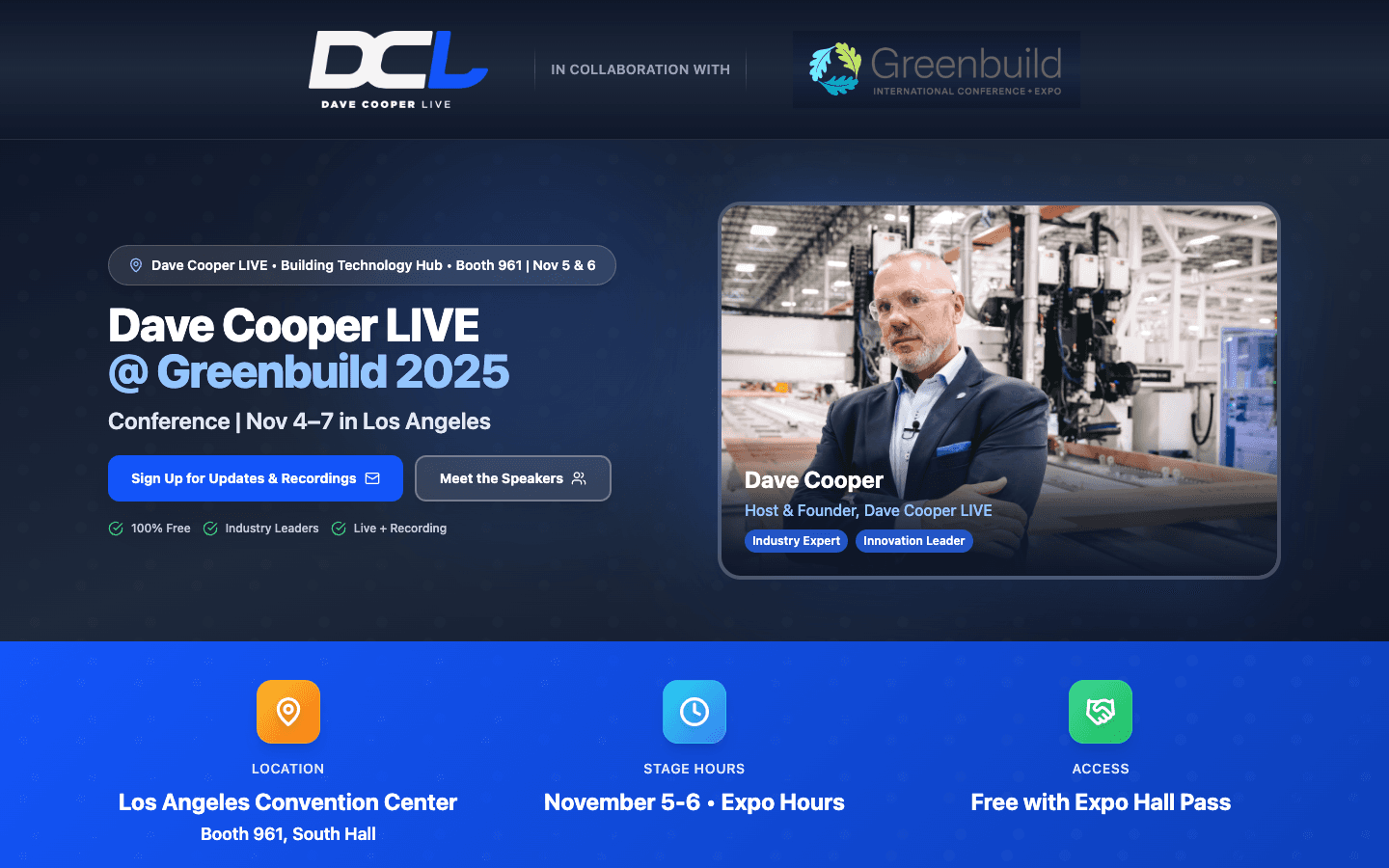
CRM & Automation — questions we hear
How much does CRM implementation cost for a construction company?
Two costs matter: software licensing, which you pay the platform directly, and implementation, which depends entirely on scope — pipelines, automations, integrations, migration, training. A well-configured mid-market CRM beats an expensive one nobody uses, so we scope implementation around how your team actually sells. You get a specific implementation number on the first call, once we’ve seen your sales process.
Which CRM is best for construction companies?
The one your team will actually use, configured around how construction buying works: long cycles, stages from inquiry through award, and pipeline visibility by vertical. That’s a more honest answer than naming a product, because the market shifts and the right fit depends on your team size, sales process, and existing tools. We select with clients rather than pushing one platform, and configuration matters far more than the logo on the login screen.
Do we need a CRM if we already run everything through email and spreadsheets?
If leads currently arrive, get handled, and occasionally vanish, then yes. Email and spreadsheets fail at exactly the moments that matter: when you’re busy, when a deal spans months, and when the person holding the relationship leaves. A CRM gives every opportunity a home, a next step, and an owner, and gives leadership a pipeline view that doesn’t depend on memory. The spreadsheet didn’t lose you deals politely; it lost them silently.
What is speed-to-lead and why does it matter in construction?
Speed-to-lead is the time between an inquiry arriving and your first meaningful response, and it decides more deals than most contractors realize. A buyer who fills out your form is often contacting two or three firms in the same sitting; the first credible response frames the conversation. Waiting days signals how you’ll communicate during a project. Automation makes minutes-level response the default, even during your busiest season, which is exactly when leads used to wait longest.
What should follow-up look like when the sales cycle takes months?
Instant acknowledgment, fast personal contact, then staged, useful touches across the whole arc: relevant project stories, genuine check-ins, and clear next steps, spaced so you stay present without pestering. Construction buyers researching today may not award for two or three quarters, and most firms go silent after two attempts. The system’s job is to make persistence automatic, so the deal is decided by your qualifications rather than your quietness.
Will automated follow-up make us sound like robots to owners?
Not if it’s written properly. Automation should handle timing and consistency; the words should sound like your firm, because we write sequences in your voice with real substance: project stories, useful answers, straight talk. What actually sounds robotic is silence followed by a panicked check-in three weeks late. Owners don’t penalize you for a well-written follow-up that arrived promptly; they penalize you for disappearing. The machine schedules. Your voice speaks.
Related
Data Center Construction
BoxBuild positions data center contractors for hyperscale and colo procurement — trust, vertical content, and conversion built around how owners vet builders.
Learn morePower & Energy Infrastructure
BoxBuild builds growth systems for power and energy contractors — positioning and conversion designed for utility, developer, and EPC procurement teams.
Learn moreIndustrial & Manufacturing
BoxBuild positions industrial and manufacturing builders for reshoring-era capital projects — sector-fluent content, trust signals, and conversion systems.
Learn moreHealthcare Construction
BoxBuild builds growth systems for healthcare contractors — compliance-first positioning and conversion for hospital systems and medical facility owners.
Learn moreCommercial General Contractors
BoxBuild helps commercial GCs differentiate — positioning, proof, and follow-up systems that improve bid-hit ratios in the most crowded market in construction.
Learn moreModular Construction
BoxBuild markets modular construction companies — education-first positioning, buyer-doubt content, and follow-up systems built for the volumetric sale.
Learn morePrefab Construction
BoxBuild markets prefab construction companies — capturing method-stage research, answering buyer doubts, and converting curiosity into contracts.
Learn morePanelized Construction
BoxBuild markets panelized construction firms — positioning speed, precision, and labor savings for the builders and owners who specify panels.
Learn moreContainer Construction
BoxBuild markets container construction companies — legitimacy-first positioning that converts container curiosity into qualified, financeable projects.
Learn moreADU Builders
BoxBuild markets ADU builders — local visibility, cost and permit education, and follow-up systems tuned to how homeowners buy backyard units.
Learn moreCustom Home Builders
BoxBuild markets custom home builders — portfolio-first trust, process transparency, and follow-up systems built for a seven-figure homeowner decision.
Learn moreRemodeling & Design-Build
BoxBuild markets remodeling and design-build firms — trust-first positioning and follow-up systems for a $518B market where homeowner anxiety decides.
Learn moreSpecialty Trades
BoxBuild markets specialty trade contractors — roofing, concrete, electrical, plumbing, HVAC, excavation — for GC bid lists and direct work alike.
Learn moreConstruction Suppliers
BoxBuild markets construction suppliers and building-product manufacturers — spec-ready content, specifier education, and lead systems that protect the spec.
Learn moreArchitects & Designers
BoxBuild markets architecture and design firms — visible authority, niche positioning, and referral-ready presence for a market where billings are soft.
Learn moreTalk to the team that speaks your vertical.
A 30-minute strategy call. We’ll map where trust, conversion, or follow-up is costing you work in your vertical.