
IND.03 — INDUSTRIAL & MANUFACTURING
Be the builder reshoring capital calls first
BoxBuild helps industrial and manufacturing contractors win reshoring-driven work — plants, expansions, and process facilities — by making sector fluency visible where capital project teams research builders. We build positioning around schedule certainty, design-build capability, and safety record, then add search visibility and follow-up systems matched to long industrial capital cycles.
Plant construction, expansions, and process facilities are being awarded to builders who demonstrate sector fluency before the first meeting. We make yours impossible to miss.
The market moment
Manufacturing construction has been running at levels the US has not seen in decades, driven by reshoring, supply chain hardening, and federal and state incentives that reward domestic capacity. Semiconductors, batteries, food processing, pharmaceuticals, defense suppliers, and the long tail of component makers that feed all of them — capital is moving into physical plant, and much of it is landing in markets that have not seen industrial projects of this scale in a generation.
That geographic spread is the opportunity. When a manufacturer sites a plant in a new region, they arrive without local builder relationships. Their site selectors, owner's reps, and capital project teams have to find and qualify contractors from scratch — and they do it the way every sophisticated buyer now does it: research first, contact second. Regional industrial contractors who look credible online are getting calls their larger competitors assume are relationship-locked.
The same tight skilled-labor market that constrains every vertical cuts here too, but with a twist: industrial owners have been burned by schedule slips, and they now weight demonstrated schedule certainty and workforce depth heavily in selection. Firms that can prove both have pricing power.
Off-site construction is increasingly how that certainty gets delivered. Modular process skids, prefabricated utility racks, and panelized building systems pull hours off congested sites and into controlled factory conditions — and industrial owners, who already think in terms of manufacturing efficiency, are the most receptive audience in construction for that argument. If off-site capability is part of your delivery model, it belongs at the front of your positioning, not buried in a services list.
THE SHORT ANSWER
THE MARKET MOMENT
U.S. construction spending, annualized in 2026
SRC — U.S. CENSUS BUREAU
Share of construction site traffic that is now mobile
SRC — 2026 BENCHMARK
Construction clients who prioritize brand recognition when selecting a contractor
SRC — CMA
“Plant owners buy on execution certainty — and they judge it online, on a phone, before an inquiry ever forms.”
How buyers in this space vet you
Industrial buyers are engineers. Plant managers, corporate capital project teams, site selection consultants, and industrial developers all vet the same way: methodically, in writing, and before you know they exist. A manufacturer planning a $40M expansion does not start by calling contractors. They start by building a list — from their AE firm, from their peers, from economic development contacts, from search — and then they strip it down through research.
What survives that strip-down:
- Process fluency. Evidence you understand production environments — utility-intensive scopes, equipment installation coordination, clean requirements, working around live manufacturing.
- Design-build and preconstruction depth. Industrial owners increasingly want a builder in the room early. If your site does not demonstrate real precon capability, you are positioned as a bid-only commodity.
- Schedule proof. Named projects with delivered timelines. Industrial capital has downstream commitments — production dates, customer contracts — and late buildings break them.
- Safety and compliance posture. Manufacturers audit their contractors the way they audit their suppliers. A serious safety presence is table stakes.
- Self-perform and trade relationships. In thin-labor markets, owners want to know how you will actually staff the job.
The silent vetting in this vertical is unusually thorough because the buyers are professional evaluators by trade. They read project pages the way they read equipment specs. Thin content does not just fail to persuade them — it actively signals that you have not done the work you claim.
What a growth system looks like here
Traffic
Industrial search is specific and commercial: design-build industrial contractor plus region, food processing facility construction, plant expansion contractor. Construction SEO here means building genuine depth in the sectors you serve — pages that demonstrate process knowledge, not keyword coverage — and earning citations in the AI research tools that capital project teams now use for first-pass market scans. When a manufacturer is siting in your region, Google Ads captures the high-intent window between site announcement and contractor selection.
Trust
The trust layer is proof of delivery under industrial constraints. Project pages that name the sector, the scope, the schedule, and the operating conditions — expansion under live production, utility tie-ins, equipment setting coordination. Leadership profiles with plant-side experience. A preconstruction page that shows your process, because industrial owners are buying a process as much as a building. Everything written for an engineer who will forward it to a committee.
Conversion & follow-up
Industrial capital cycles are long and lumpy. A plant manager who downloads your capability overview may not have an approved project for two years — and then need a builder in ninety days. The system has to hold that relationship: structured CRM, sector-segmented follow-up, and fast, professional response when an inquiry arrives, because the firm that answers a capital project team in four hours with substance beats the firm that answers in four days with a brochure.
Generic agency vs. a vertical-built system
| Generic agency | BoxBuild vertical-built system | |
|---|---|---|
| Speaks operations-first | Generic build copy | Phased work, tie-ins, uptime protection |
| Proof by facility type | Mixed gallery | Organized by process and scope |
| Trust for plant buyers | Stock photos | Safety, capacity, references visible |
| Findable in AI + search | Vanity keywords | The searches that precede sourcing |
Where to start
The sequence for most industrial contractors: a website that survives owner vetting built around sector proof and preconstruction capability, construction SEO to be found by capital project teams researching your regions and sectors, and CRM and follow-up automation to hold multi-year relationships until capital is approved. Firms with inbound volume add AI systems to qualify inquiries and keep response times inside the window that wins.
Industrial demand is also braided into two adjacent buildouts. The plants need power — see power and energy infrastructure — and the same wave of capital is driving data center construction, often in the same corridors and industrial parks. Contractors visible across those adjacencies get considered for scope their competitors never hear about.
How we build the vertical
- 01
Scope the buyer
We map how industrial and manufacturing owners actually source and vet — the formal gates and the quiet online research that decides who gets invited.
- 02
Build the evidence
Project pages organized by scope, delivery method, and outcome — the documentary proof this buyer checks before your name moves forward.
- 03
Engineer the trust layer
Safety, capacity, certifications, and key personnel made visible in the buyer’s own language, so the silent evaluation lands in your favor.
- 04
Make it findable
SEO, answer-engine visibility, and paid coverage aimed at the searches and AI queries that precede a shortlist, not vanity keywords.
SCOPE OF WORK — INDUSTRIAL & MANUFACTURING
- 01Vertical Audit
- 02Sector Positioning
- 03Capability Proof
- 04Demand Capture
- 05Capital-Cycle Follow-Up
- 06Reporting
PROOF — CASE STUDY
Modular Construction Consultants
A consulting firm sells one thing: expertise. Modular Construction Consultants had deep knowledge of the modular space but a web presence that didn’t demonstrate it, which in consulting is the same as not having it. Prospects vetting the firm online found nothing that proved the depth they’d be paying for.
Read the full case study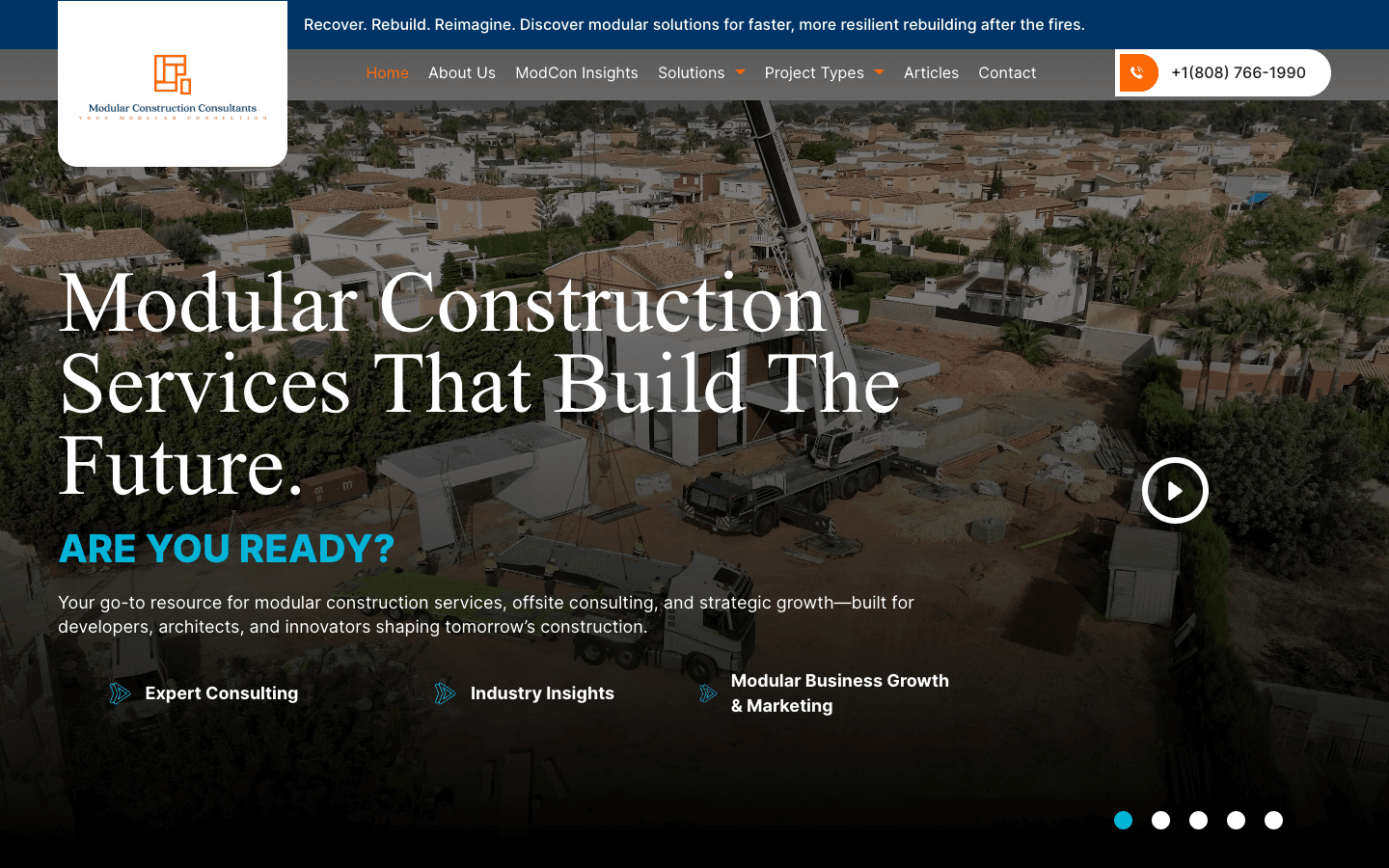
Industrial & Manufacturing — questions we hear
How do manufacturers choose contractors for new plants?
Methodically, and mostly before you know they exist. Capital project teams, site selectors, and their AE firms build contractor lists from peers, economic development contacts, and research — then strip the list down by vetting each firm online. What survives is process fluency, design-build and precon depth, schedule proof, and safety posture. These buyers are engineers; they read your project pages the way they read equipment specs.
How do we win reshoring projects coming to our region?
Be visible and verifiable before the manufacturer arrives. Reshoring projects land in markets where the owner has no builder relationships, so their teams research local capacity from scratch. Regional contractors with credible sector proof online get calls national firms assume are theirs. That means sector-specific project pages, demonstrated precon capability, and presence in the searches and AI research those capital teams run during site selection.
Does SEO work for industrial contractors?
Yes — industrial search is specific and commercial, which is exactly where SEO pays. Buyers search things like design-build industrial contractor plus region, or food processing facility construction. Ranking for those takes genuine sector depth, not keyword coverage, because the reader is a professional evaluator who converts on evidence. The same depth earns citations in the AI tools capital teams use for first-pass market scans.
How do industrial contractors show up in AI search?
By giving answer engines something substantive to cite. When a capital project team asks an AI tool which contractors build process facilities in a region, the tools name firms with detailed sector content — named project types, operating-condition specifics, precon process. Brochure copy doesn’t surface. Depth in the sectors you actually serve, published in structured pages, is what gets you into those first-pass lists.
What should an industrial contractor’s website include?
Proof of delivery under industrial constraints. Project pages naming the sector, scope, schedule, and operating conditions — expansions under live production, utility tie-ins, equipment setting coordination. A preconstruction page that shows your actual process, because industrial owners buy a process as much as a building. Leadership with plant-side experience. Write it for an engineer who will forward it to a committee, because that’s who’s reading.
Is design-build positioning worth emphasizing?
Strongly, if you can back it up. Industrial owners increasingly want the builder in the room early — schedule certainty and cost predictability depend on it — and they filter for demonstrated design-build and precon capability during research. If your site presents you as bid-only, you’re positioned as a commodity and priced like one. If you claim design-build without showing the process and the delivered projects, evaluators notice that too.
Related
Website Design & Development
Construction website design and development engineered for trust and conversion, built for how owners, developers, and procurement teams actually vet builders.
Learn moreConstruction SEO
Construction SEO built around how owners research builders: vertical pages, technical SEO, and answer-engine optimization that reach buyers before the RFP.
Learn moreGoogle Ads
Google Ads management for construction companies: vertical campaigns, landing pages built to convert, and reporting measured on qualified pipeline, not clicks.
Learn moreCRM & Automation
CRM and automation for construction firms: instant lead response, staged nurture across long sales cycles, and pipeline visibility your leadership can trust.
Learn moreAI Systems
AI systems for construction businesses: content engines, lead qualification, AI workflows, BI dashboards, and internal operating systems measured on results.
Learn moreTalk to the team that speaks your vertical.
A 30-minute strategy call. We’ll map where trust, conversion, or follow-up is costing you work in your vertical.