
IND.04 — HEALTHCARE CONSTRUCTION
Built for the most risk-averse owners in construction
BoxBuild helps healthcare construction firms win hospital system and medical developer work by making compliance expertise visible where it gets vetted — ICRA experience, occupied-facility phasing, regulatory fluency, and delivery record. We turn that proof into search visibility and pair it with follow-up systems built for long institutional capital cycles.
Hospital systems award work on demonstrated compliance, occupied-facility phasing, and zero-disruption delivery. Your digital presence has to prove all three before anyone returns your call.
The market moment
Healthcare systems are in a sustained capital cycle. Aging facilities need renewal, care is shifting to outpatient settings faster than the real estate can follow, and systems that deferred capital work through the last several years are releasing it now. Ambulatory surgery centers, medical office buildings, emergency department expansions, behavioral health facilities, and phased renovations inside operating hospitals — the project mix is broad and the owners are committed.
At the same time, the buyer side is consolidating. Health systems keep merging, which means facility and construction decisions concentrate into fewer, more professionalized real estate and capital teams — teams that run formal contractor qualification and expect institutional-grade proof. A relationship with one hospital administrator no longer carries a firm the way it did. The system-level capital team, and its vetting process, decides who builds.
For contractors, this is a high-barrier, high-loyalty vertical. Getting qualified by a health system is hard. Staying on their bench once you deliver is the payoff — healthcare owners reuse builders who did not disrupt care, and they talk to each other.
Delivery pressure is also opening the door to new methods. Compressed clinical timelines and tight labor are pushing systems toward prefabricated headwalls, modular bathroom pods, and off-site-built exam and patient room components — and toward builders who can integrate them without compromising infection control. A contractor who can speak to both worlds, ICRA discipline and off-site delivery, is answering questions most healthcare owners have only recently started asking out loud.
THE SHORT ANSWER
THE MARKET MOMENT
U.S. construction spending, annualized in 2026
SRC — U.S. CENSUS BUREAU
Construction clients who prioritize brand recognition when selecting a contractor
SRC — CMA
Leads a builder needs to close one contract
SRC — BUILDERTREND, 2026
“For healthcare buyers, the vetting is documentary. The proof they need has to be visible before they call, not after.”
How buyers in this space vet you
No owner in construction is more risk-averse, and for good reason: their buildings are full of patients while you work. A contractor who fails on a data center loses money. A contractor who fails on infection control in an occupied hospital can hurt someone. Healthcare capital teams vet accordingly.
Before a health system's facilities director or owner's rep shortlists you, they have checked:
- ICRA fluency. Infection control risk assessment is the vocabulary of this vertical. If your website does not demonstrate lived ICRA experience — containment, negative air, above-ceiling protocols — you read as a commercial GC trying to cross over.
- Occupied-facility phasing. Evidence you have sequenced work around active clinical operations: night work, department decants, utility shutdowns coordinated with clinical staff.
- Regulatory record. Familiarity with state health department review, life safety compliance, and authorities having jurisdiction specific to healthcare. They want a builder who has been through the inspections.
- References inside healthcare. This vertical runs on peer verification. Facility directors call each other, and your visible project history is what prompts the call.
- Team continuity. Named superintendents and PMs with healthcare résumés. Systems buy crews, not logos.
The silent vetting here is compliance review in miniature. The committee that will eventually score your qualification package is the same audience reading your website eight months earlier — and they are reading it for evidence of discipline, not design.
What a growth system looks like here
Traffic
Healthcare construction search is intent-rich and thin on strong competitors: healthcare general contractor plus market, ASC construction, hospital renovation contractor, medical office building builder. Construction SEO in this vertical rewards depth — content that demonstrates ICRA and phasing expertise ranks and, more importantly, converts, because the reader is a professional evaluator. AI-assisted research is arriving here too: capital teams and owner's reps ask answer engines who builds healthcare in a market, and the firms with substantive, citable content are the ones named.
Trust
Your trust layer must read like a qualification package. Project pages that specify the clinical environment, the phasing approach, the infection control measures, and the outcome — delivered without disruption to care. A healthcare-specific safety and compliance section. People pages with healthcare project histories. This is one vertical where specificity is the entire game: the difference between we build healthcare facilities and we executed a four-phase ED expansion under full ICRA protocols while the department stayed open is the difference between deleted and shortlisted.
Conversion & follow-up
Institutional sales cycles are the longest in construction. A system’s capital plan may hold your opportunity for two budget cycles before an RFQ moves. Conversion here means giving a facilities director an easy, low-commitment way to start — a capabilities conversation, not a quote request — and follow-up means staying professionally present for years: qualification updates, project completions relevant to their program, personnel news. CRM discipline wins healthcare work because the pursuit outlives everyone’s memory and most contractors’ patience. The firms with the strongest healthcare benches are rarely the flashiest marketers; they are the ones whose follow-up never lapsed while a health system’s capital plan sat in committee for another budget year.
Generic agency vs. a vertical-built system
| Generic agency | BoxBuild vertical-built system | |
|---|---|---|
| Speaks healthcare delivery | Generic copy | ICRA, phasing, occupied-facility work |
| Proof for institutions | Thin | Projects by facility type and system |
| Regulatory fluency | Absent | Made visible in the buyer’s language |
| Findable in AI + search | Vanity keywords | The queries that precede a shortlist |
Where to start
Healthcare contractors usually need the proof layer rebuilt first: a website that survives owner vetting structured like the qualification package your buyers already think in. Then construction SEO to be found and cited during system-level research, and CRM and follow-up automation to manage pursuits that run across budget cycles. Firms with established healthcare benches add AI systems to keep inquiry response fast and to surface dormant relationships worth reviving.
The pattern — proof, visibility, patient follow-up — is the same one we run for owners in other compliance-heavy verticals. See how it plays out in practice in our case studies.
How we build the vertical
- 01
Scope the buyer
We map how healthcare owners actually source and vet — the formal gates and the quiet online research that decides who gets invited.
- 02
Build the evidence
Project pages organized by scope, delivery method, and outcome — the documentary proof this buyer checks before your name moves forward.
- 03
Engineer the trust layer
Safety, capacity, certifications, and key personnel made visible in the buyer’s own language, so the silent evaluation lands in your favor.
- 04
Make it findable
SEO, answer-engine visibility, and paid coverage aimed at the searches and AI queries that precede a shortlist, not vanity keywords.
SCOPE OF WORK — HEALTHCARE CONSTRUCTION
- 01Vertical Audit
- 02Compliance-First Positioning
- 03Institutional Trust Build
- 04Demand Capture
- 05Long-Cycle Follow-Up
- 06Reporting
PROOF — CASE STUDY
Cutting Edge Homes
Cutting Edge Homes — a California custom modular home builder with more than twenty years of delivery behind it — had demand reaching it, but nothing behind the website was built to capture it. In the quarter before the engagement, the site produced 13 tracked conversions. Paid traffic had no dedicated pages to land on, and inquiries lived in inboxes instead of a pipeline.
Read the full case study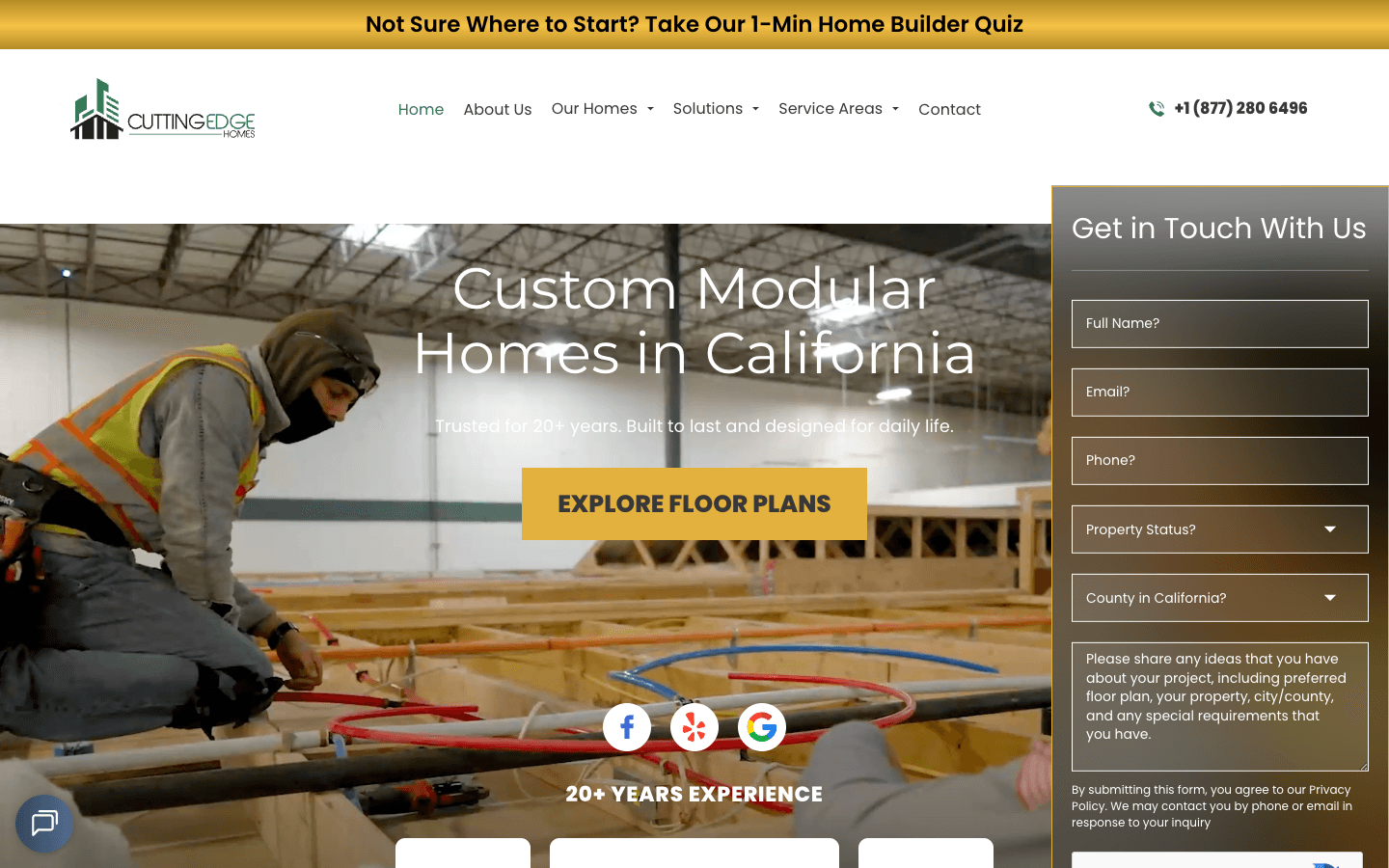
Healthcare Construction — questions we hear
What do hospital systems look for when qualifying contractors?
Evidence you can build inside a functioning healthcare environment without endangering it. That means demonstrated ICRA fluency, occupied-facility phasing experience, regulatory track record with health department review and life safety compliance, healthcare references, and named superintendents and PMs with healthcare résumés. System capital teams score all of it formally — and they read your website for the same evidence months before the qualification package is ever requested.
How important is ICRA experience in healthcare construction marketing?
It’s the vocabulary of the vertical, and its absence is disqualifying. Infection control risk assessment — containment, negative air, above-ceiling protocols — is how healthcare owners judge whether you’ve actually worked in their environment. A website that demonstrates lived ICRA experience through specific project narratives reads as healthcare-native. One that doesn’t reads as a commercial GC trying to cross over, and gets filtered accordingly.
Do facility directors really research contractors online?
Yes — and they’re some of the most thorough researchers in construction, because their risk tolerance is the lowest. Before a facilities director or owner’s rep shortlists you, they’ve read your project pages for phasing and infection control evidence, checked your team’s healthcare histories, and often called a peer at another system whose project appears on your site. Your visible project record is what prompts that reference call.
How do healthcare contractors show up in AI search?
By publishing the compliance-rich content answer engines cite. When a capital team asks an AI tool who builds healthcare facilities in a market, the tools surface firms with substantive, specific content — ICRA protocols, phased renovations in occupied hospitals, ASC and MOB project detail. Generic healthcare services pages don’t get cited. The specificity that convinces a facilities director is the same specificity that gets you named.
How do we break into healthcare construction from commercial work?
Lead with the closest evidence you have and be honest about the gap. Occupied-facility work, phased renovations, medical office buildings, and outpatient projects are the realistic entry points — hospital systems rarely hand an inpatient renovation to an unproven firm. Position the healthcare-adjacent experience you genuinely hold, hire or partner for ICRA credibility, and build the qualification-grade proof layer before pursuing system-level work. Owners can smell a costume.
What should a healthcare contractor’s website include?
It should read like your qualification package. Project pages specifying the clinical environment, phasing approach, infection control measures, and the outcome — care delivered without disruption. A healthcare-specific safety and compliance section. Team pages with healthcare project histories, because systems buy crews, not logos. The committee that eventually scores your qualification submission is the same audience reading your website eight months earlier.
Related
Website Design & Development
Construction website design and development engineered for trust and conversion, built for how owners, developers, and procurement teams actually vet builders.
Learn moreConstruction SEO
Construction SEO built around how owners research builders: vertical pages, technical SEO, and answer-engine optimization that reach buyers before the RFP.
Learn moreGoogle Ads
Google Ads management for construction companies: vertical campaigns, landing pages built to convert, and reporting measured on qualified pipeline, not clicks.
Learn moreCRM & Automation
CRM and automation for construction firms: instant lead response, staged nurture across long sales cycles, and pipeline visibility your leadership can trust.
Learn moreAI Systems
AI systems for construction businesses: content engines, lead qualification, AI workflows, BI dashboards, and internal operating systems measured on results.
Learn moreTalk to the team that speaks your vertical.
A 30-minute strategy call. We’ll map where trust, conversion, or follow-up is costing you work in your vertical.