
IND.12 — REMODELING & DESIGN-BUILD
Turn renovation anxiety into signed agreements
BoxBuild helps remodeling and design-build firms win homeowner trust in a market where the buyer’s core emotion is anxiety. Homeowner improvement spending is projected to reach $518 billion in 2026 (Harvard JCHS), but every project starts with a homeowner afraid of budget drift, timeline slip, and living through the mess. We build before-and-after proof systems, process transparency, review engines, and fast follow-up that convert that anxiety into consultations.
Homeowners fear remodels more than they fear the price tag — the mess, the timeline, the contractor horror story. We build the trust, proof, and follow-up system that makes your firm the safe choice in a $518 billion market.
The market moment
Remodeling is the steadiest large market in residential construction. Harvard's Joint Center for Housing Studies projects homeowner improvement spending to reach $518 billion in 2026, with slow but continued growth through the year (JCHS LIRA, 2026). The drivers are durable: an aging housing stock, owners locked into low mortgage rates choosing to improve rather than move, and equity levels that fund major projects. When moving is expensive, remodeling is the market.
Design-build sits in the strongest position within it. Homeowners increasingly prefer one accountable firm over the architect-then-bidding gauntlet — one contract, one team, one throat to choke. But the model has a marketing problem: most homeowners do not know what design-build means, and the firms that practice it rarely explain it. The firm that educates its market on why design-build de-risks a remodel converts clients its competitors never even understood they were losing.
Because here is the truth about this vertical: the competitor is not the other remodeler. It is the homeowner's fear. Every remodeling decision is shadowed by the industry's reputation — the horror stories of vanished contractors, doubled budgets, kitchens unusable for a year. The buyer is not comparing your portfolio against another firm's; they are deciding whether remodeling is survivable at all, and with whom.
THE SHORT ANSWER
THE RESIDENTIAL MOMENT
Projected homeowner improvement spending in 2026
SRC — HARVARD JCHS LIRA, 2026
Builders who say generating quality leads is their biggest sales challenge
SRC — BUILDERTREND, 2026
More likely to convert when you respond within five minutes
SRC — INDUSTRY RESEARCH
“Your competitor isn’t the other remodeler. It’s the homeowner’s fear — and the firm that answers it first gets the consultation.”
How buyers in this space vet you
Remodeling clients vet for safety. The house they are risking is the one they live in, and their research behavior is defensive from the first search.
- Reviews above everything. They read every review on every platform, and they weight the negative ones. What they are looking for is not perfection — it is how you handled problems, because they assume there will be problems.
- Before-and-after proof. Transformations of homes like theirs, with scope described honestly. A kitchen gallery is nice; a kitchen story — existing conditions, design intent, what it took — is persuasive.
- Process and communication. Their nightmare is the unknown. Firms that publish their process — design phase, fixed-scope proposal, schedule, weekly communication rhythm — answer the fear directly.
- Budget honesty. They know remodels are expensive; what they fear is open-endedness. Ranges by project type and what drives them beat silence, which reads as a trap.
- The design-build case. If you are design-build, explain it: single accountability, integrated budget-and-design, fewer surprises. The homeowner who understands the model prefers it — but almost nobody explains it.
All of this happens on a phone before you know they exist — 58% of construction site traffic is now mobile (2026 benchmark) — and among buyers who say generating quality leads is harder than ever, the firms winning are the ones the anxious homeowner decides are safe.
What a growth system looks like here
Traffic
Remodeling demand is local and project-shaped: kitchen remodel plus city, home addition contractor, what a bathroom remodel costs in your metro. Construction SEO here means owning those project-and-place searches, plus the education queries where anxious homeowners live — cost guides, process explainers, design-build versus general contractor. Those pages rank, get cited by AI answer engines, and pre-sell the safety the buyer is searching for. Google Ads performs strongly in this vertical when campaigns are structured by project type with dedicated landing pages, because remodeling intent is legible and geography is tight.
Trust
The trust layer converts fear into confidence. Before-and-after project stories with honest scope. A process page that makes the unknown knowable. Reviews surfaced, including the imperfect ones with your response visible. Budget ranges with drivers. Team pages that make the people entering their home real. This is the same buyer-vetting discipline we build across the construction industry — commercial owners score contractors on evidence; homeowners score remodelers on safety signals. The mechanics differ, the principle does not: the decision happens during research, on your website.
Conversion & follow-up
Remodeling inquiries are precious — high intent, high value, and highly perishable. The conversion system offers low-threat first steps: a project inquiry, a cost guide, a design consultation. Then speed decides. Respond within minutes and the anxious homeowner exhales; respond in days and they have booked two competitors. CRM automation guarantees the instant response, nurtures the projects that stall in family deliberation, and keeps past clients warm — because in remodeling, the repeat-and-referral engine is the business, and it runs on systematic follow-up, not memory.
Generic agency vs. a vertical-built system
| Generic agency | BoxBuild vertical-built system | |
|---|---|---|
| Answers the fear | Pretty galleries | Proof, process, and people as safety signals |
| Design-build education | Assumes they know | Explains the model that de-risks the remodel |
| Budget honesty | Silence on price | Ranges by project type, with drivers |
| Speed on precious leads | Next business day | Instant response, stall-proof nurture |
Where to start
Start with a website that answers the fear — proof, process, and people arranged for a buyer whose core question is "will I regret this?" Then construction SEO to own your metro's project searches, Google Ads for immediate coverage where intent is sharpest, and CRM automation so every precious inquiry gets an instant response and every stalled project a patient nurture.
The full residential strategy is in our residential construction marketing playbook. Remodelers share their buyer with custom home builders — same homeowner psychology, larger canvas — and many design-build firms add ADU construction as a product line; both pages go deeper on those adjacent plays.
How we build the vertical
- 01
Scope the buyer
We map how remodeling owners actually source and vet — the formal gates and the quiet online research that decides who gets invited.
- 02
Build the evidence
Project pages organized by scope, delivery method, and outcome — the documentary proof this buyer checks before your name moves forward.
- 03
Engineer the trust layer
Safety, capacity, certifications, and key personnel made visible in the buyer’s own language, so the silent evaluation lands in your favor.
- 04
Make it findable
SEO, answer-engine visibility, and paid coverage aimed at the searches and AI queries that precede a shortlist, not vanity keywords.
SCOPE OF WORK — REMODELING & DESIGN-BUILD
- 01Trust & Review Engine
- 02Before/After Proof
- 03Design-Build Education
- 04Local Demand Capture
- 05Instant-Response Follow-Up
- 06Reporting
PROOF — CASE STUDY
Cutting Edge Homes
Cutting Edge Homes — a California custom modular home builder with more than twenty years of delivery behind it — had demand reaching it, but nothing behind the website was built to capture it. In the quarter before the engagement, the site produced 13 tracked conversions. Paid traffic had no dedicated pages to land on, and inquiries lived in inboxes instead of a pipeline.
Read the full case study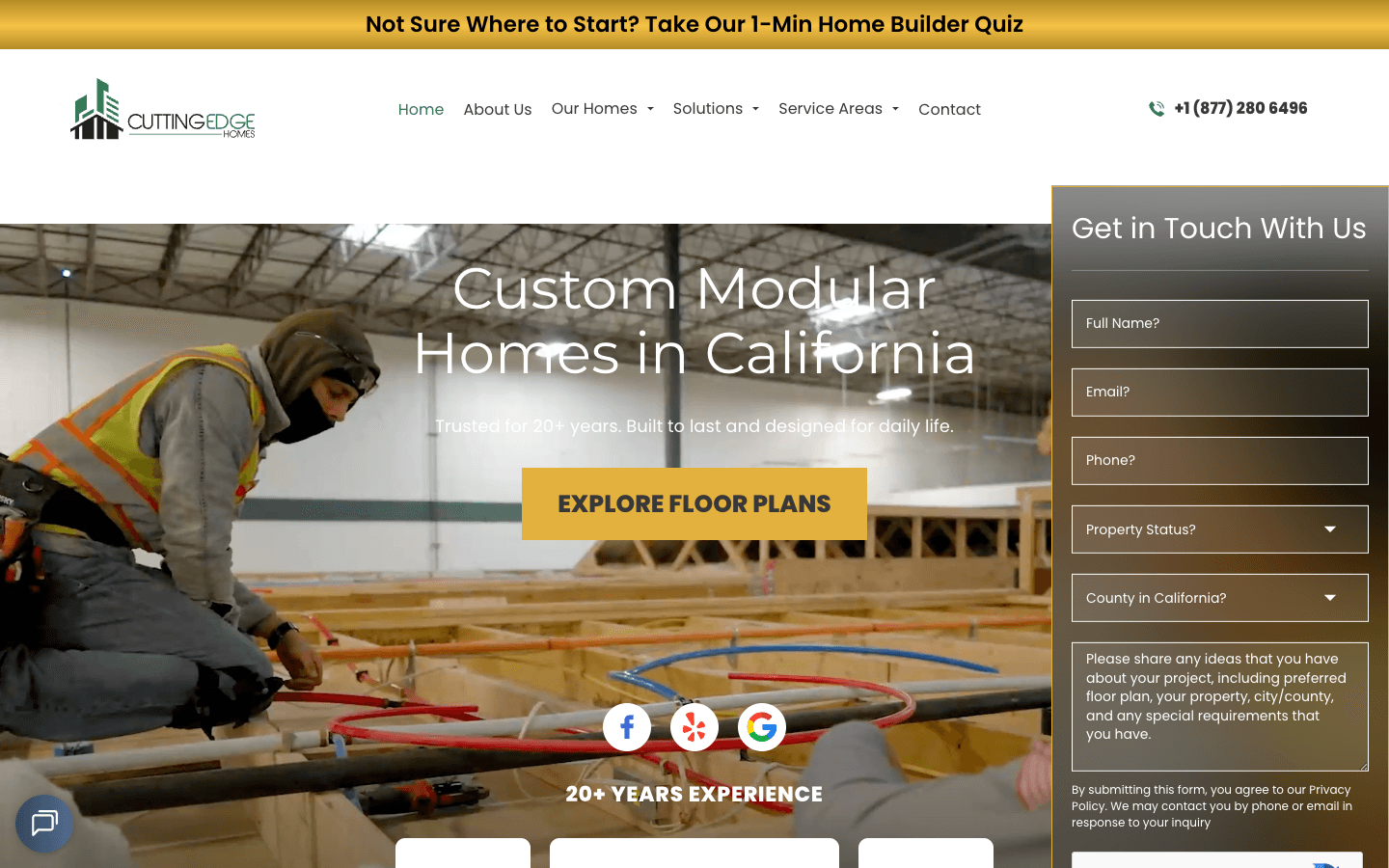
Remodeling & Design-Build — questions we hear
How do remodeling companies get more leads?
By being the visibly safe choice in their metro. Remodeling demand is local and project-shaped — kitchen remodel plus city, addition contractor near me — and the buyer is anxious by default. Firms that rank for those searches and answer the fear on arrival (reviews surfaced, process published, honest budget ranges) convert research into consultations. The firms that stay invisible or vague lose to whoever made the homeowner exhale first.
What is design-build and why should marketing explain it?
Design-build puts design and construction under one contract and one accountable team — no architect-then-bidding gauntlet, fewer surprises, integrated budget and design. Most homeowners have never heard the term, which makes it a marketing asset: the firm that educates its market on why single accountability de-risks a remodel converts clients who never realized there was an alternative to the process they feared. Unexplained, the label means nothing to the buyer.
How important are reviews for remodelers?
Decisive — they are the first thing anxious homeowners check and the last thing they re-read before contacting you. Buyers weight negative reviews heavily, but what they are really studying is how you handled problems, because they assume there will be problems. Surface reviews on your site, respond to the imperfect ones visibly, and build a systematic ask into project closeout. A remodeler’s review profile is their bid.
Should remodelers publish pricing or budget ranges?
Ranges, yes — silence costs more than honesty. Homeowners fear open-ended budgets more than high ones, and a site that says nothing about cost reads as a trap. Publish realistic ranges by project type with the drivers that move them: scope, structural surprises, finishes, permits. The buyers this filters out were never viable; the ones it reassures arrive pre-qualified and already trusting you more than the firm that made them ask.
What makes remodeling leads different from other construction leads?
They are precious and perishable. Each inquiry is high-intent — a specific project, in your service area, from an owner ready to talk — and it decays in hours, because the anxious homeowner keeps contacting firms until one responds well. Instant response, a low-threat first step, and a scheduled consultation convert them; a next-day reply usually means you were the third conversation. Volume thinking fails here; speed and trust thinking wins.
How do remodelers keep past clients generating new work?
Systematically, because repeat-and-referral is the real engine of a remodeling business. Past clients remodel again, and their dinner-party recommendations carry more weight than any ad — but only if the relationship stays warm. CRM automation handles it: project anniversaries, seasonal check-ins, new project stories, and a painless referral path. Firms that finish a job and vanish rebuild their pipeline from zero every year; firms that stay present compound.
Related
Website Design & Development
Construction website design and development engineered for trust and conversion, built for how owners, developers, and procurement teams actually vet builders.
Learn moreConstruction SEO
Construction SEO built around how owners research builders: vertical pages, technical SEO, and answer-engine optimization that reach buyers before the RFP.
Learn moreGoogle Ads
Google Ads management for construction companies: vertical campaigns, landing pages built to convert, and reporting measured on qualified pipeline, not clicks.
Learn moreCRM & Automation
CRM and automation for construction firms: instant lead response, staged nurture across long sales cycles, and pipeline visibility your leadership can trust.
Learn moreAI Systems
AI systems for construction businesses: content engines, lead qualification, AI workflows, BI dashboards, and internal operating systems measured on results.
Learn moreTalk to the team that speaks your vertical.
A 30-minute strategy call. We’ll map where trust, conversion, or follow-up is costing you work in your vertical.