
IND.09 — CONTAINER CONSTRUCTION
Legitimize the product. Convert the curiosity.
BoxBuild helps container construction companies convert massive public curiosity into serious pipeline. Container builders face the sharpest legitimacy gap in off-site construction — buyers arrive fascinated and doubtful at once — so we build websites that answer durability, financing, and code doubts head-on, capture the method’s enormous search demand, and qualify inquiries so sales time goes to real buyers, not daydreamers.
Container construction gets attention no other method can buy — and skepticism no other method must answer. We build the web presence that turns container curiosity into qualified inquiries, for builders who are tired of being treated as a novelty.
The market moment
No off-site method generates attention like container construction. The imagery is irresistible, the sustainability story is intuitive, and the global market is substantial — Fortune Business Insights sizes the container homes market at roughly $72 billion in 2026, with steady growth projected through the next decade. Container builders get organic curiosity that panelized manufacturers would pay dearly for.
The problem is what arrives with the attention. Container construction carries the sharpest legitimacy gap in off-site building: buyers are curious and doubtful in the same breath. Is a container building durable or a gimmick? Will a lender finance it and an appraiser value it? Will the county even permit it? Is this firm a construction company or a content creator with a welder? Every container builder inherits these questions on every inquiry — and most container websites, heavy on drone shots and light on evidence, make the doubts worse.
There is also a qualification problem unique to this vertical. Container curiosity produces inquiry volume, but much of it is unfinanceable, unpermittable, or purely aspirational. A container builder without a qualification system spends sales hours on daydreams while the serious commercial buyer — the developer exploring container multifamily, the brand wanting a container venue, the municipality piloting container housing — waits in the same undifferentiated queue.
The winning move is to be the adult in the category: the firm whose web presence reads like a construction company that happens to master containers, not a novelty act that happens to sell buildings.
THE SHORT ANSWER
THE OFF-SITE MOMENT
Global container homes market in 2026
SRC — FORTUNE BUSINESS INSIGHTS
Net new workers construction must attract in 2026 (456K in 2027)
SRC — ASSOCIATED BUILDERS & CONTRACTORS, 2026
More likely to convert when you respond within five minutes
SRC — INDUSTRY RESEARCH
“Be the adult in the category: a construction company that masters containers, not a novelty act that sells buildings.”
How buyers in this space vet you
Container buyers vet legitimacy first, capability second, and both against a higher bar of skepticism than any adjacent method.
- Structural honesty. Buyers want the real engineering story — what container modification involves, where the method shines, and where it does not. Overselling reads as a red flag; candor reads as competence.
- Code and permitting fluency. The buyer has usually already met a skeptical building department. A builder who publishes real permitting knowledge by jurisdiction type becomes the firm that clearly knows the path.
- Financing reality. Container financing is the number-one stall point. Firms that explain lender treatment, appraisal comparables, and realistic budgets convert the buyers who can actually close.
- Built proof. Finished, occupied, photographed-in-use projects — commercial and residential — with real specs and timelines. One documented occupied building beats fifty renders.
- Construction company signals. Licensing, insurance, a real team, a real process. The buyer is silently sorting container firms into "construction company" and "content brand," and only one gets the deposit.
We built this exact system for Elite Container Homes: a site structured to answer the doubts container buyers actually carry — durability, financing, legitimacy — before asking for the inquiry, with lead capture matched to buyer readiness so interest had somewhere real to go.
What a growth system looks like here
Traffic
Container search demand is enormous and messy — a mix of dreamers, researchers, and genuine buyers using the same vocabulary. Construction SEO in this vertical does two jobs: capture the high-volume method queries with education content that ranks and gets cited by AI answer engines, and own the commercial-intent queries — container office building, container restaurant builder, multi-unit container housing — where the financeable projects live. Google Ads works when it is aimed at the commercial and high-intent residential segments with dedicated landing pages, never at the undifferentiated curiosity traffic.
Trust
Container trust is built by answering doubts in public. Durability engineering explained without spin. Financing content a buyer can take to their bank. Permitting guidance that demonstrates real jurisdictional experience. Project pages showing occupied buildings with specifications, budget ranges expressed honestly, and timelines. This is legitimacy-first architecture — the same discipline the rest of construction marketing calls trust-building, tuned for a category where the baseline doubt is existential.
Conversion & follow-up
Qualification is the container builder's survival skill. The system needs conversion paths that sort inquiry types at the door — project type, land status, budget reality, timeline — so CRM automation can route serious buyers to fast human follow-up and keep early-stage dreamers in a nurture track that either matures them or costs you nothing. Speed matters most on the commercial side, where a developer comparing container against conventional delivery is usually talking to conventional builders at the same time.
Generic agency vs. a vertical-built system
| Generic agency | BoxBuild vertical-built system | |
|---|---|---|
| Handles the legitimacy gap | Drone shots | Durability, code, financing answered |
| Qualifies the daydream traffic | Counts every lead | Sorts financeable projects at the door |
| Commercial buyer paths | Consumer-only funnel | Developer, brand, municipal routes |
| Findable in AI + search | Vanity keywords | Method + commercial-intent queries |
Where to start
Start with a legitimacy-first website that converts curiosity into qualified inquiry — it is the single highest-leverage asset a container builder can own. Layer construction SEO to capture the method's search demand, and CRM automation to protect your sales hours from the daydream queue.
The full off-site strategy is in our off-site construction marketing playbook. Adjacent methods have their own pages — modular construction, prefab construction, and ADU builders — and for container firms expanding into ADU work, that page is the natural next read. Container work is one wing of a construction-wide practice: the same trust engineering we run across the industry, applied to the category with the steepest skepticism.
How we build the vertical
- 01
Scope the buyer
We map how container owners actually source and vet — the formal gates and the quiet online research that decides who gets invited.
- 02
Build the evidence
Project pages organized by scope, delivery method, and outcome — the documentary proof this buyer checks before your name moves forward.
- 03
Engineer the trust layer
Safety, capacity, certifications, and key personnel made visible in the buyer’s own language, so the silent evaluation lands in your favor.
- 04
Make it findable
SEO, answer-engine visibility, and paid coverage aimed at the searches and AI queries that precede a shortlist, not vanity keywords.
SCOPE OF WORK — CONTAINER CONSTRUCTION
- 01Legitimacy Positioning
- 02Doubt-First Content
- 03Lead Qualification
- 04Demand Capture
- 05Commercial Follow-Up
- 06Reporting
PROOF — CASE STUDY
Elite Container Homes
Container homes sell against skepticism. Buyers are curious, but they arrive with doubts about durability, financing, and whether the product is a real house or a novelty. Elite Container Homes needed a web presence that did two jobs at once: legitimize the product and convert interest into inquiries.
Read the full case study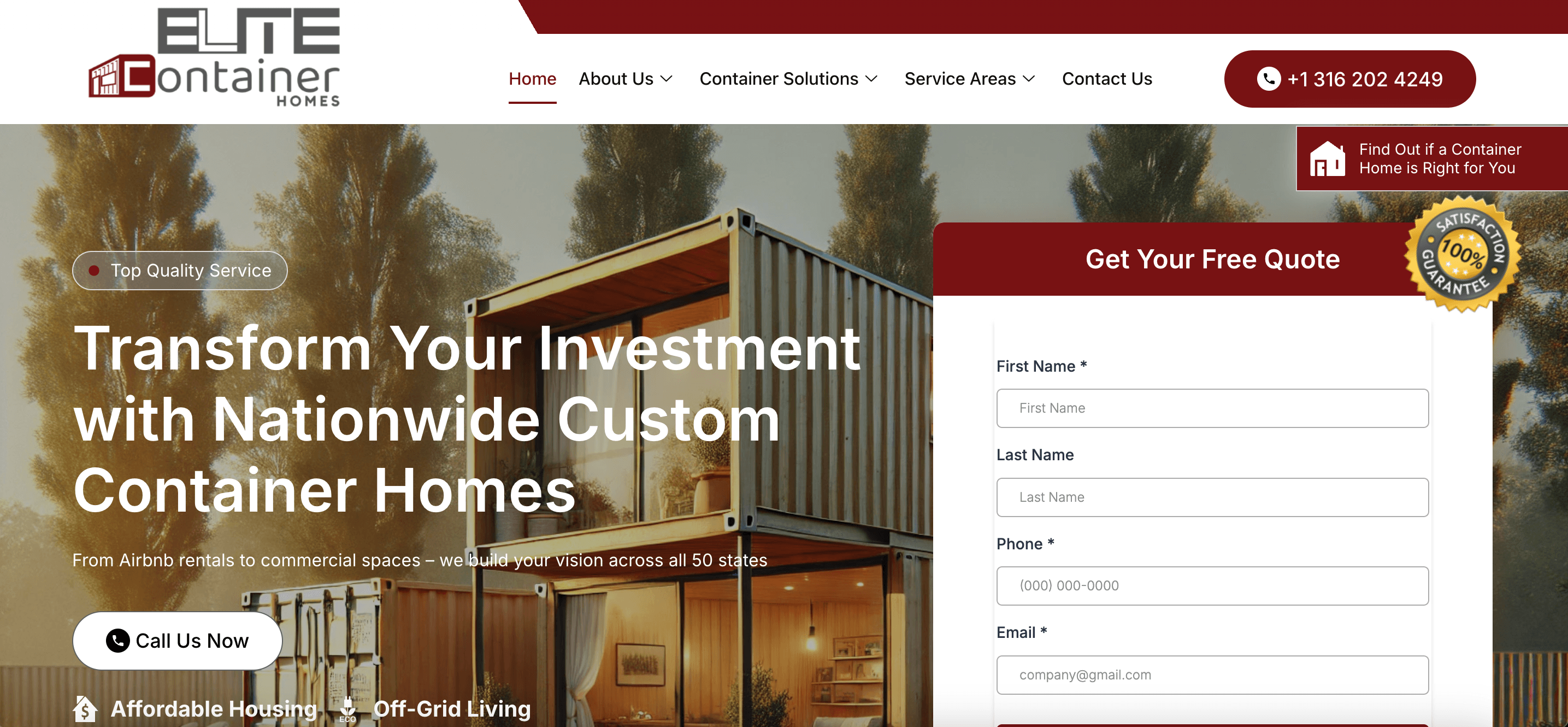
Container Construction — questions we hear
How do container construction companies deal with unqualified leads?
By qualifying at the door instead of in the sales call. Container curiosity produces huge inquiry volume, much of it unfinanceable or purely aspirational. The conversion system should sort inquiries by project type, land status, budget reality, and timeline, so automation routes financeable projects to fast human follow-up and keeps dreamers in a low-cost nurture track. Sales hours go to the developer and the funded homeowner, not the mood board.
How do container builders overcome the novelty perception?
By out-documenting every doubt. The buyer silently sorts container firms into construction companies and content brands — and only construction companies get deposits. Publish the structural engineering honestly, the permitting path by jurisdiction type, the financing reality a buyer can take to a bank, and occupied finished projects with specs and timelines. Candor about where containers are not the right answer builds more trust than any showcase reel.
Does SEO or paid advertising work better for container construction?
SEO carries the education load; paid works only when aimed carefully. Container search demand is enormous but mixed — dreamers and buyers use the same words — so organic education content captures and sorts that interest affordably. Paid spend belongs on commercial-intent queries like container office building or multi-unit container housing, landing on dedicated pages. Broad paid campaigns against the curiosity demand burn budget on traffic that can never close.
How should container companies market to commercial buyers?
With a separate, professional track. Developers, brands, and municipalities exploring container projects vet like commercial buyers: feasibility, code path, budget certainty, delivered examples. Give them their own pages — container multifamily, hospitality, municipal housing — with case-study depth and a direct route to a capable conversation. Commercial container work is where the serious revenue lives, and it converts on evidence, not aesthetics.
What content converts container home buyers?
Doubt-answering content, in the order buyers doubt. Durability and engineering first, financing second, permitting third, then cost ranges with honest drivers, then finished occupied projects. The container buyer arrives fascinated and suspicious at once; content that names the doubts openly reads as competence. A site that leads with drone footage and skips the hard questions confirms the suspicion instead of dissolving it.
How do you finance a modular or container-based building project?
Financing works differently enough that transparency wins buyers. Explain how lenders treat modular and container projects, what the appraisal looks like, and how payment milestones map to a factory build rather than a site build. You do not need to be a lender, only the firm that explains the landscape clearly. Silence on financing reads as a hidden problem, so addressing it head-on becomes a trust signal.
Related
Website Design & Development
Construction website design and development engineered for trust and conversion, built for how owners, developers, and procurement teams actually vet builders.
Learn moreConstruction SEO
Construction SEO built around how owners research builders: vertical pages, technical SEO, and answer-engine optimization that reach buyers before the RFP.
Learn moreGoogle Ads
Google Ads management for construction companies: vertical campaigns, landing pages built to convert, and reporting measured on qualified pipeline, not clicks.
Learn moreCRM & Automation
CRM and automation for construction firms: instant lead response, staged nurture across long sales cycles, and pipeline visibility your leadership can trust.
Learn moreAI Systems
AI systems for construction businesses: content engines, lead qualification, AI workflows, BI dashboards, and internal operating systems measured on results.
Learn moreTalk to the team that speaks your vertical.
A 30-minute strategy call. We’ll map where trust, conversion, or follow-up is costing you work in your vertical.