
IND.02 — POWER & ENERGY INFRASTRUCTURE
Positioning for the buildout of the century
BoxBuild helps power and energy infrastructure contractors win work by building the digital trust layer that utility, developer, and EPC procurement checks before contact — safety record, project history, workforce capacity, and prequalification readiness — then converting that surging demand into signed backlog with vertical content, precise search visibility, and disciplined follow-up systems.
Generation, transmission, and grid modernization work is surging, and it goes to firms that look credible to utilities, developers, and EPCs before the first call. We build that credibility where their research happens.
The market moment
Load growth is back. After decades of flat electricity demand, data centers, electrification, and reshored manufacturing are pulling the grid in three directions at once: more generation, more transmission, and a modernization backlog that utilities can no longer defer.
For contractors, that translates into an unusual buyer's landscape. Utilities are expanding their approved-contractor pools because their incumbent partners are at capacity. Independent power producers and renewables developers are standing up projects in markets where they have no builder relationships at all. EPCs are subcontracting scope they would have self-performed five years ago. Substation work, transmission line construction, generation balance-of-plant, battery storage sites — the awarding organizations are actively looking for qualified firms, and many of them are looking in places where relationships do not yet exist. That means they are looking online.
The constraint here, as everywhere in construction right now, is people. Owners are scoring workforce capacity as heavily as price, because a low bid from a crew that does not exist is worthless. Firms that can demonstrate craft depth and safety culture have real leverage — if the demonstration is visible.
Delivery method is shifting under the same pressure. Modular substations, prefabricated e-houses, and skid-mounted balance-of-plant packages are becoming standard tools for compressing schedules that interconnection timelines have already stretched to the limit. Contractors who can credibly present off-site capability alongside field execution are answering the exact question utilities and developers are now asking: how do we get energized sooner with the labor that actually exists?
THE SHORT ANSWER
THE MARKET MOMENT
U.S. construction spending, annualized in 2026
SRC — U.S. CENSUS BUREAU
Construction clients who prioritize brand recognition when selecting a contractor
SRC — CMA
Leads a builder needs to close one contract
SRC — BUILDERTREND, 2026
“Prequalification is the gate, not the decision. The decision happens earlier and more quietly, on your website.”
How buyers in this space vet you
Power sector procurement is the most formalized in construction. Utilities and EPCs run prequalification through third-party platforms and internal vendor management systems, and the entry criteria are unforgiving: safety statistics, insurance, financial capacity, references, and program documentation. But prequalification is the gate, not the decision. The decision about which prequalified firms actually get invited to bid happens earlier and more quietly.
Here is the sequence. A utility sourcing lead or an EPC procurement manager needs coverage in a region or a scope. They pull names from their platform, from peers, from industry contacts — and then they research. Your website, your project history, your people. What they are checking:
- Scope-specific evidence. Substations, transmission, distribution, generation, storage — buyers want proof in their exact scope, not a generic power services page.
- Safety, front and center. In this vertical a thin safety page is disqualifying. They expect to see program depth, training culture, and performance history.
- Workforce reality. Named crews, self-perform capability, union or open-shop clarity, and geographic reach. Can you actually show up?
- EPC and utility literacy. Do you write like a firm that has worked under utility specifications and EPC contract structures, or like a commercial GC hoping to cross over?
Firms that clear the silent check get the bid invitation. Firms that do not get silence, and never learn why.
What a growth system looks like here
Traffic
Search behavior in this vertical is scope-and-geography specific: substation contractor plus state, transmission line construction plus region, BESS installation contractor. Construction SEO built for power means owning those combinations in your operating footprint and being the answer AI research tools cite when a developer asks who builds this scope in a given market. Paid search has a real role here too — when a developer is standing up a project in a new market on a compressed timeline, Google Ads puts you in front of them at the exact moment they are looking for local capacity.
Trust
The trust layer for power buyers is documentary. Project pages organized by scope with voltage classes, interconnection context, and schedule performance. A safety section that reads like it was written by people who run the program, not the marketing team. Certifications, prequalification platform standing, and key personnel with utility-side experience made visible. Every element should anticipate the question a sourcing lead is trying to answer: can this firm execute this scope, in this region, without hurting anyone?
Conversion & follow-up
Power pursuits move on two clocks — utility framework agreements that take a year, and developer projects that need mobilization in months. Your conversion system has to serve both: a fast, structured path for urgent capacity inquiries, and long-cycle nurture for framework and alliance opportunities. CRM automation keeps every prequalification renewal, bid list contact, and dormant developer relationship from going cold, because in this market the firm that follows up in an organized way is rarer than the firm that can do the work.
Generic agency vs. a vertical-built system
| Generic agency | BoxBuild vertical-built system | |
|---|---|---|
| Documentary trust layer | Adjectives | Voltage classes, interconnection, schedule |
| Safety section that reads real | Marketing tone | Written like the program is run |
| Regional scope evidence | Generic map | Project history by region and scope |
| Findable in AI + search | Broad keywords | The sourcing queries that matter |
Where to start
Start with the layer buyers check first: a website that survives owner vetting, structured around scope, safety, and workforce proof. Make it findable with construction SEO across your scope-geography combinations, and put CRM and follow-up automation underneath so utility frameworks and developer pursuits are tracked with the same discipline you bring to a jobsite. Firms chasing developer-driven work in new markets add Google Ads for immediate visibility while the organic footprint builds.
The demand driving this vertical is the same demand driving two adjacent ones. The load growth comes substantially from data center construction, and the electrification of industry runs through industrial and manufacturing construction. Contractors positioned across that seam — power plus the facilities the power feeds — are compounding one buildout into three.
How we build the vertical
- 01
Scope the buyer
We map how power and energy owners actually source and vet — the formal gates and the quiet online research that decides who gets invited.
- 02
Build the evidence
Project pages organized by scope, delivery method, and outcome — the documentary proof this buyer checks before your name moves forward.
- 03
Engineer the trust layer
Safety, capacity, certifications, and key personnel made visible in the buyer’s own language, so the silent evaluation lands in your favor.
- 04
Make it findable
SEO, answer-engine visibility, and paid coverage aimed at the searches and AI queries that precede a shortlist, not vanity keywords.
SCOPE OF WORK — POWER & ENERGY INFRASTRUCTURE
- 01Vertical Audit
- 02Utility & EPC Positioning
- 03Prequal-Ready Trust Build
- 04Demand Capture
- 05Pipeline Follow-Up
- 06Reporting
PROOF — CASE STUDY
Cutting Edge Homes
Cutting Edge Homes — a California custom modular home builder with more than twenty years of delivery behind it — had demand reaching it, but nothing behind the website was built to capture it. In the quarter before the engagement, the site produced 13 tracked conversions. Paid traffic had no dedicated pages to land on, and inquiries lived in inboxes instead of a pipeline.
Read the full case study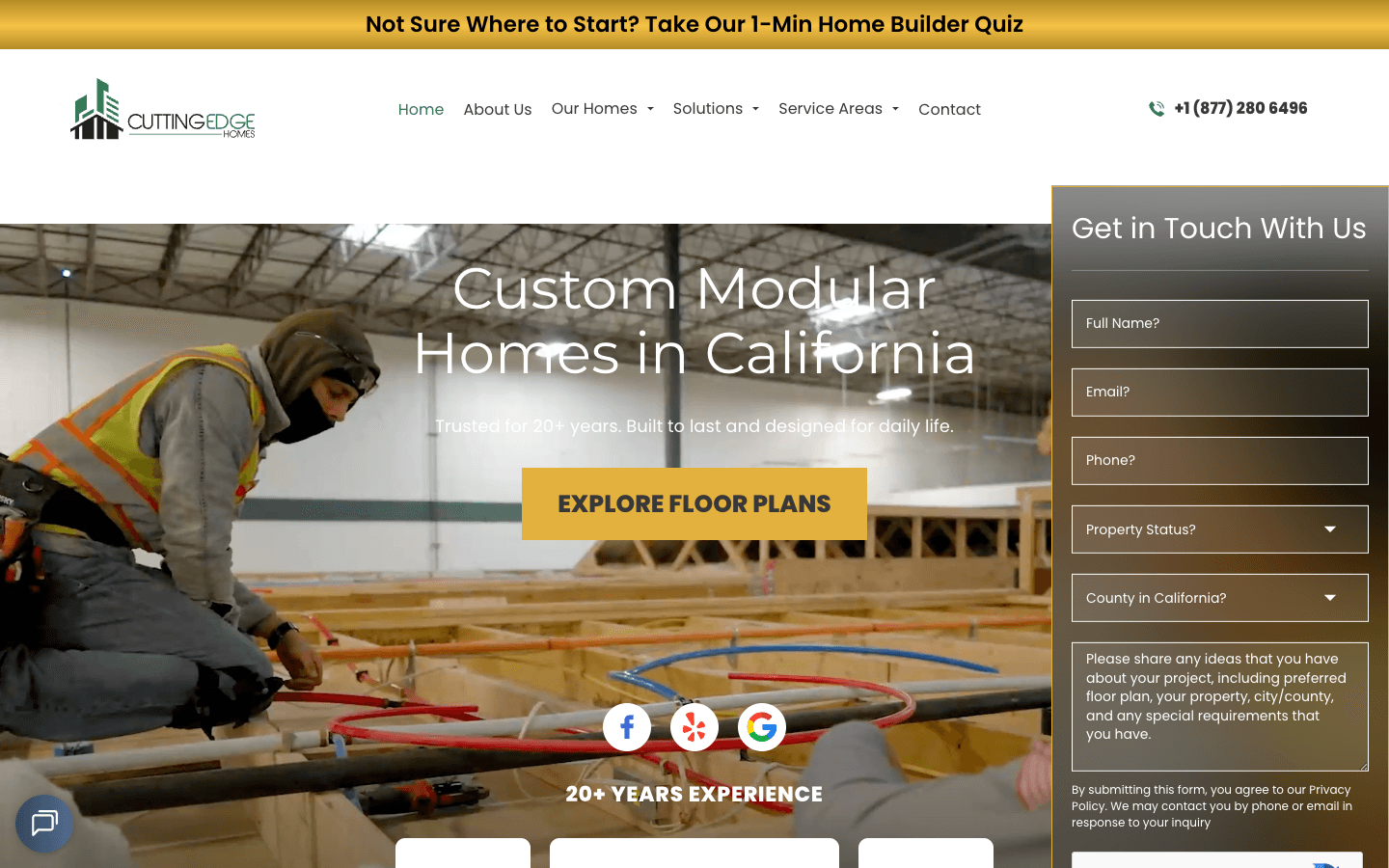
Power & Energy Infrastructure — questions we hear
How do utilities prequalify contractors?
Through formal gates: third-party prequalification platforms, internal vendor systems, safety statistics, insurance, financial capacity, and references. But prequalification only makes you eligible. The decision about which prequalified firms actually get bid invitations happens earlier and more quietly — sourcing leads research your scope experience, workforce depth, and safety culture online before your name moves forward. Both layers have to hold up.
We’re prequalified but never get invited to bid. Why?
Because prequalification is the gate, not the shortlist. Utility and EPC sourcing teams pull from a pool of eligible firms, and they choose who to invite based on visible evidence — scope-specific project history, safety substance, crews they believe exist, and regional presence. If your website shows a generic power services page instead of substations, transmission, or storage proof, the invitation goes to the firm whose evidence is easier to verify.
Does SEO work for power and energy contractors?
Yes — search behavior in this vertical is unusually specific, which favors focused firms. Buyers search scope plus geography: substation contractor in a state, transmission line construction in a region, BESS installer. Owning those combinations in your footprint puts you in front of developers and EPCs standing up projects in markets where they lack relationships. That’s increasingly common, because the buildout is outrunning the incumbent bench.
How do power contractors show up in AI search?
By being the citable source for their scope and territory. Developers and EPC procurement teams now ask answer engines who builds a given scope in a given market, and the tools cite firms with substantive, well-structured content — voltage classes, named scopes, service territories, safety programs. A thin site is invisible to that research. Detailed scope pages and consistent public information are what get you named.
How do renewables developers find contractors in new markets?
Research first, relationships second — usually because they have no relationships there yet. A developer standing up a solar, storage, or generation project in an unfamiliar region builds a contractor list from EPC contacts, prequalification platforms, search, and AI tools, then vets it online. Regional contractors with visible scope evidence get calls their larger competitors assume are locked up. It’s one of the clearest openings in the market right now.
How important is safety content on our website?
In this vertical, it’s disqualifying to get it wrong. Power sector buyers weight safety more heavily than any other owner group, and a thin safety page reads as a thin safety program. Your site should show program depth, training culture, and performance history the way your prequalification package does. Buyers cross-check the two — and when the website says nothing, they assume the package is overstating.
Related
Website Design & Development
Construction website design and development engineered for trust and conversion, built for how owners, developers, and procurement teams actually vet builders.
Learn moreConstruction SEO
Construction SEO built around how owners research builders: vertical pages, technical SEO, and answer-engine optimization that reach buyers before the RFP.
Learn moreGoogle Ads
Google Ads management for construction companies: vertical campaigns, landing pages built to convert, and reporting measured on qualified pipeline, not clicks.
Learn moreCRM & Automation
CRM and automation for construction firms: instant lead response, staged nurture across long sales cycles, and pipeline visibility your leadership can trust.
Learn moreAI Systems
AI systems for construction businesses: content engines, lead qualification, AI workflows, BI dashboards, and internal operating systems measured on results.
Learn moreTalk to the team that speaks your vertical.
A 30-minute strategy call. We’ll map where trust, conversion, or follow-up is costing you work in your vertical.