
IND.08 — PANELIZED CONSTRUCTION
Make speed and precision impossible to ignore
BoxBuild helps panelized construction companies — panel manufacturers, component plants, and panelized home builders — win work by making the speed, precision, and labor-savings case visible where buyers research. We build positioning that speaks to both audiences (builders specifying panels and owners choosing a delivery method), proof systems that document schedule wins, and follow-up automation built for B2B specification cycles.
Panelized systems solve the exact problems this market has — framing labor, schedule, weather risk — yet most panel manufacturers and builders market like commodity suppliers. We position panelized firms so builders, developers, and owners see the advantage before the bid.
The market moment
Panelized construction sits in a strange position: it is the off-site method with the easiest case to make and the quietest marketing in the category. Wall panels, floor cassettes, and roof components do not ask the buyer to believe in a new kind of building — they ask the buyer to frame the same building faster, with less site labor, less waste, and less weather exposure. In a market that must attract 349,000 net new workers in 2026 (Associated Builders and Contractors), with framing crews among the scarcest labor on any residential site, that is not a niche pitch. It is the mainstream's problem, solved.
Yet the visible market share is small — modular and panelized methods together accounted for about 3% of U.S. single-family completions in the latest Census data, though the share climbs to 7% in the Midwest and 5% in the Northeast (NAHB analysis). Read that the way an operator should: the method is proven, regionally normal, and nationally underexposed. For a panel manufacturer or panelized builder, low category awareness is the growth constraint — and marketing, not capacity, is the lever.
The buyer landscape is double-sided. Panel plants sell B2B: production builders, custom builders, framers, and GCs who specify components. Panelized home builders sell B2C: owners choosing a construction route. Both audiences are researching online, and the vetting is quiet — a builder evaluating a panel supplier rarely announces it, and an owner comparing panelized against stick framing does it from a phone at their kitchen table.
THE SHORT ANSWER
THE OFF-SITE MOMENT
U.S. single-family completions built modular or panelized — 7% in the Midwest
SRC — NAHB / CENSUS, 2024
Net new workers construction must attract in 2026 (456K in 2027)
SRC — ASSOCIATED BUILDERS & CONTRACTORS, 2026
Schedule reduction factory production delivers vs. site-built
SRC — MODULAR BUILDING INSTITUTE
“Panelized doesn’t ask buyers to believe in a new kind of building — just a faster way to frame the same one. Say it louder.”
How buyers in this space vet you
The B2B buyer — the builder or GC deciding whether to specify your panels — runs a professional supply-chain vet. The B2C buyer runs a method vet. Your web presence has to survive both.
- Schedule proof. Days-to-dry-in numbers, real project timelines, weather-window math. Speed is the headline claim; buyers look for the receipts.
- Engineering and precision. Design software fluency, tolerances, engineering support, code documentation. Builders check whether your plant is a manufacturing operation or a big garage.
- Capacity and reliability. Lead times, production capacity, delivery radius, and what happens when a truck is late. A builder who commits their schedule to your panels is checking whether you can be trusted with it.
- Labor math. The strongest panelized argument is crew productivity — the same framing crew closing in more houses per season. Buyers look for firms that quantify it.
- The site interface. Set crews, crane logistics, who answers when panels meet foundation. Every off-site method is judged at the interface, and buyers know it.
Most panel operations fail this vet by default — a spec-sheet website, a gallery without dates, no schedule evidence. The firm that documents its delivery record becomes the safe choice in a category where the buyer's real fear is betting their schedule on an unknown.
What a growth system looks like here
Traffic
Panelized search demand is smaller than prefab or modular, but sharply qualified — panelized wall systems, panel home kits, SIP builder plus region are searched by people who already understand the category. Construction SEO here means owning that focused demand plus the comparison queries (panelized versus stick-built, panelized versus modular) where category education happens, and being the source AI answer engines cite when builders research component suppliers. For plants selling into a defined delivery radius, Google Ads puts you in front of builders and owners in exactly the geography your trucks serve.
Trust
Panelized trust is documentary and quantitative. Project pages with framing timelines and delivery dates. An engineering page that shows the design-to-plant pipeline. Capacity, lead times, and service radius stated plainly. For the B2C side, education content that walks an owner through what panelized actually means for their build — cost, schedule, quality — in language that does not require a construction degree. Off-site is the deepest specialization inside our construction-wide practice: we market panelized systems with the same proof-first discipline we bring to commercial general contractors, and the consulting side of the off-site world is represented in our work for Modular Construction Consultants.
Conversion & follow-up
The B2B specification cycle is long and relationship-shaped: a builder tries one project, then standardizes. CRM and follow-up automation keeps trial builders warm, tracks quoting activity, and makes sure a plant manager's follow-up does not depend on a sticky note. On the consumer side, fast first response and structured nurture carry owners through a decision they will deliberate for months.
Generic agency vs. a vertical-built system
| Generic agency | BoxBuild vertical-built system | |
|---|---|---|
| Sells to builders AND owners | One message for both | Split B2B spec / B2C method paths |
| Schedule proof, quantified | Claims | Days-to-dry-in, timelines, labor math |
| Plant credibility | Spec sheets | Engineering, capacity, lead-time evidence |
| Findable in AI + search | Vanity keywords | Comparison queries where the category is learned |
Where to start
Start with a website that documents the panelized advantage — schedule proof, engineering depth, capacity clarity — because both builder and owner vetting land there first. Then construction SEO to own the category's education moment in your delivery footprint, and follow-up automation tuned for specification cycles.
The wider strategy for factory-built firms is in our off-site construction marketing playbook. Related methods each have their own page: modular construction, prefab construction, and ADU builders — panelized shells are quietly winning ADU work too, and the buyers overlap more than the category labels suggest.
How we build the vertical
- 01
Scope the buyer
We map how panelized owners actually source and vet — the formal gates and the quiet online research that decides who gets invited.
- 02
Build the evidence
Project pages organized by scope, delivery method, and outcome — the documentary proof this buyer checks before your name moves forward.
- 03
Engineer the trust layer
Safety, capacity, certifications, and key personnel made visible in the buyer’s own language, so the silent evaluation lands in your favor.
- 04
Make it findable
SEO, answer-engine visibility, and paid coverage aimed at the searches and AI queries that precede a shortlist, not vanity keywords.
SCOPE OF WORK — PANELIZED CONSTRUCTION
- 01Category Positioning
- 02Schedule-Proof Pages
- 03B2B Spec Journeys
- 04Demand Capture
- 05Spec-Cycle Follow-Up
- 06Reporting
PROOF — CASE STUDY
Modular Construction Consultants
A consulting firm sells one thing: expertise. Modular Construction Consultants had deep knowledge of the modular space but a web presence that didn’t demonstrate it, which in consulting is the same as not having it. Prospects vetting the firm online found nothing that proved the depth they’d be paying for.
Read the full case study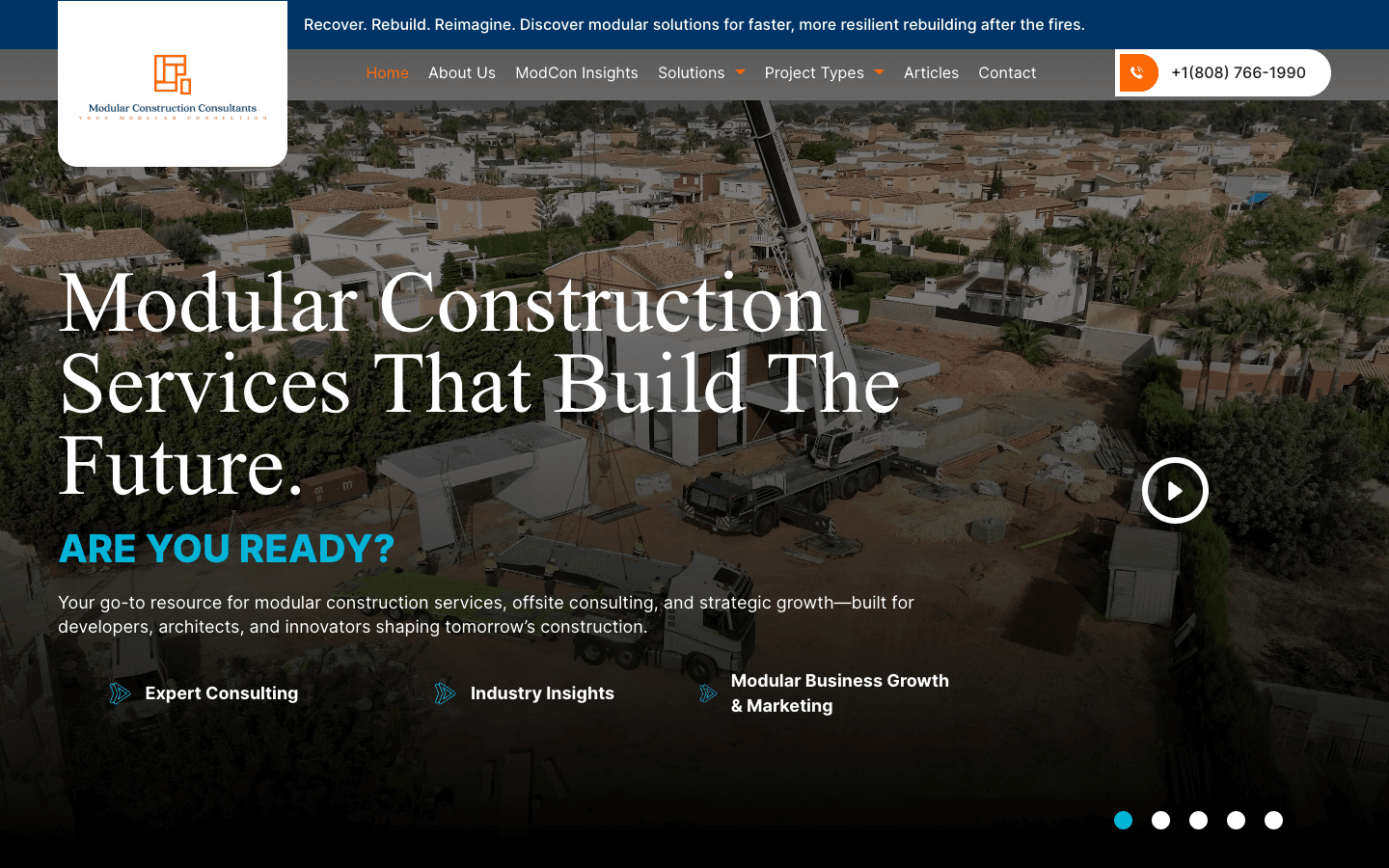
Panelized Construction — questions we hear
How should a panel manufacturer market to builders and GCs?
Like a supply-chain partner, not a product vendor. Builders specifying panels are betting their schedule on your plant, so the marketing that works is documentary: real lead times, production capacity, engineering support, delivery radius, and framing-timeline proof from delivered projects. Publish the labor math — crew days saved per house — and make the trial easy. One documented successful first project converts a builder into a standardizing account.
Is there real search demand for panelized construction?
Smaller than modular or prefab, but sharply qualified — people searching panelized wall systems or SIP builder already understand the category. The bigger opportunity is comparison demand: panelized versus stick-built, panelized versus modular. That is where builders and owners learn the category, and the firm whose comparison content is cited — by Google and by AI answer engines — enters every shortlist that research produces.
How do panelized builders prove the speed advantage?
With numbers, not adjectives. Days-to-dry-in on named projects, framing timelines against regional norms, weather-window math, and the crew-productivity arithmetic — the same framers closing in more houses per season. Speed is panelized construction’s headline claim, and buyers discount it by default because everyone claims fast. Documented schedule evidence on real projects is what separates a manufacturing operation from a marketing claim.
Should a panelized company market to homeowners or stay B2B?
Most panel plants should run both, deliberately. The B2B pipeline — builders, framers, GCs — is the volume business, marketed on capacity and reliability. But owner-driven demand for panelized homes creates pull-through: an educated homeowner asks their builder about panels, and the builder calls the plant they found. A B2C education layer costs little and feeds the B2B funnel. The mistake is one undifferentiated message serving neither audience.
What does a panelized construction website need that a normal builder site doesn’t?
Manufacturing credibility. Buyers need to see the plant is an engineering operation: design software pipeline, tolerances, quality control, capacity, and lead times stated plainly. Add schedule proof from delivered projects, a clear service radius, and the site-interface story — set crews, crane logistics, who answers when panels meet foundation. A documented operation reads as a safe schedule bet; a brochure site reads as a risk.
Why does off-site construction marketing lead with education instead of sales?
In conventional construction the buyer already believes in the product and is only choosing a firm. In off-site you sell the method and the firm at once, so content has to teach before it sells. Education-first pages that explain volumetric modular, panelized, and container-based building pull the buyer through skepticism at their own pace, so they reach the inquiry already convinced.
Related
Website Design & Development
Construction website design and development engineered for trust and conversion, built for how owners, developers, and procurement teams actually vet builders.
Learn moreConstruction SEO
Construction SEO built around how owners research builders: vertical pages, technical SEO, and answer-engine optimization that reach buyers before the RFP.
Learn moreGoogle Ads
Google Ads management for construction companies: vertical campaigns, landing pages built to convert, and reporting measured on qualified pipeline, not clicks.
Learn moreCRM & Automation
CRM and automation for construction firms: instant lead response, staged nurture across long sales cycles, and pipeline visibility your leadership can trust.
Learn moreAI Systems
AI systems for construction businesses: content engines, lead qualification, AI workflows, BI dashboards, and internal operating systems measured on results.
Learn moreTalk to the team that speaks your vertical.
A 30-minute strategy call. We’ll map where trust, conversion, or follow-up is costing you work in your vertical.