
IND.11 — CUSTOM HOME BUILDERS
Win the client before the first meeting
BoxBuild helps custom home builders win high-trust clients by matching how those clients actually decide: months of quiet online research before any contact. We build portfolio-first websites that carry referral credibility, process transparency that answers the anxiety behind a seven-figure decision, local search visibility for the moments wealth researches a builder, and follow-up systems that keep year-long deliberations warm until the contract.
Custom home clients research for months before they contact anyone — and most builders lose the job during that silence. We build the portfolio, process, and follow-up system that makes your firm the one they were always going to call.
The market moment
Custom home building is the bright spot in a soft residential market. While overall single-family construction declined through early 2026, custom starts grew 3% — 188,000 homes over the trailing four quarters — and custom building now holds roughly 20% of single-family starts, its strongest share position in years (NAHB, 2026). The reason is structural: custom clients are wealth-driven rather than rate-driven, and household wealth has held up while financed spec demand has not.
That resilience attracts competition. Production builders are courting the semi-custom buyer, design-build firms are moving upmarket, and every builder in a wealthy metro claims the word custom. The clients — affluent families, land owners, relocating executives — have more options that look identical from the outside than ever before. Differentiation has moved online, into the research phase nobody sees.
And the research phase is long. A custom home client deliberates for months, sometimes years: assembling ideas, watching builders' work, reading reviews, asking their architect and their friends, quietly checking whether a firm feels like the kind of operation that can be trusted with the largest purchase of their life. By the time they contact a builder, most of the decision is already made. The firms that win consistently are the ones whose web presence worked on the client during all those silent months.
THE SHORT ANSWER
THE RESIDENTIAL MOMENT
Custom building’s share of single-family starts — its strongest position in years
SRC — NAHB, 2026
Custom home starts over the trailing four quarters, up 3% year over year
SRC — NAHB, 2026
Leads a builder needs to close one contract
SRC — BUILDERTREND, 2026
“By the time a custom home client contacts a builder, most of the decision is made. Your website did the pitch — or failed it.”
How buyers in this space vet you
The custom home client is making an emotional, high-stakes, once-in-a-lifetime purchase — and their vetting behavior reflects it. They are not comparing bids; they are deciding whom to trust.
- The portfolio is the argument. They study your finished homes the way they will study their own: light, detail, craft, coherence. A dated gallery with dark photos reads as a dated builder.
- Process transparency. Their biggest fear is the unknown — budget drift, timeline slip, decision overload. Builders who publish how the process works, step by step, dissolve the fear that stalls inquiries.
- The people. They are buying a multi-year relationship. Named team, real bios, the principal visible. Anonymous firms lose to builders the client feels they already know.
- Reviews and reputation. They will read everything — and they weigh how past clients describe communication and problem-solving above how the finished house looks.
- Referral verification. Even a strong referral gets checked. The architect says your name; the client looks you up that evening. A weak web presence quietly kills strong referrals — the introduction cools before the meeting.
This is a vet your website either survives or fails. There is no pitch meeting at this stage — just a family on a sofa with a tablet, deciding whether you feel right.
What a growth system looks like here
Traffic
Custom home demand is local, high-value, and lower-volume — precision matters more than reach. Construction SEO for custom builders means owning your metro's custom-builder searches, the neighborhood and community names where you build, and the research queries that precede contact: cost per square foot in your market, design-build versus architect-led, how long a custom build takes. AI answer engines matter here because affluent researchers use them heavily — when someone asks which custom builders work in a region, the cited firms get the visit. Google Ads adds coverage on the high-intent local terms, with landing pages that match the polish the client expects.
Trust
The trust layer is the portfolio plus the process. Project pages shot and written like the homes deserve — not photo dumps, but stories: the site, the brief, the craft decisions, the outcome. A process page that walks the client from first conversation through design, budget, build, and warranty, honestly. Team pages with faces and history. We rebuilt exactly this system for Cutting Edge Homes, a California custom builder with twenty years of delivery: demand was reaching the site, but nothing behind it was built to convert that interest — the rebuild turned quiet research traffic into tracked, qualified conversations.
Conversion & follow-up
Custom home decisions mature on the client's timeline, not yours. The conversion system offers steps matched to readiness — a portfolio download, a land question, a budget conversation — and CRM automation keeps the long deliberation warm: useful touches about your work and process, instant response when the inquiry finally comes, and pipeline discipline so a client who first wrote eight months ago is greeted like the serious prospect they always were. In a referral-driven business, follow-up quality is reputation.
Generic agency vs. a vertical-built system
| Generic agency | BoxBuild vertical-built system | |
|---|---|---|
| Portfolio treated as the argument | Photo dump | Project stories: brief, craft, outcome |
| Process transparency | “Contact us to learn more” | The unknown made knowable, step by step |
| Referral survival | Untested | A site that confirms what the architect said |
| Year-long deliberations | Inbox and memory | Nurture that stays warm to contract |
Where to start
Start with a website worthy of the homes you build — portfolio-first, process-transparent, personal. That single asset amplifies every referral you already earn. Then construction SEO to own your metro's research moments, and CRM automation so long deliberations end in signed agreements instead of polite silence.
The full residential strategy is in our residential construction marketing playbook. Custom builders increasingly sell adjacent products too — ADUs as guest houses and rental units, and remodeling and design-build work between ground-up projects. Each has its own buyer psychology, and its own page.
How we build the vertical
- 01
Scope the buyer
We map how custom home owners actually source and vet — the formal gates and the quiet online research that decides who gets invited.
- 02
Build the evidence
Project pages organized by scope, delivery method, and outcome — the documentary proof this buyer checks before your name moves forward.
- 03
Engineer the trust layer
Safety, capacity, certifications, and key personnel made visible in the buyer’s own language, so the silent evaluation lands in your favor.
- 04
Make it findable
SEO, answer-engine visibility, and paid coverage aimed at the searches and AI queries that precede a shortlist, not vanity keywords.
SCOPE OF WORK — CUSTOM HOME BUILDERS
- 01Portfolio Architecture
- 02Process Transparency
- 03Local Visibility
- 04Referral-Proof Trust
- 05Long-Cycle Follow-Up
- 06Reporting
PROOF — CASE STUDY
Cutting Edge Homes
Cutting Edge Homes — a California custom modular home builder with more than twenty years of delivery behind it — had demand reaching it, but nothing behind the website was built to capture it. In the quarter before the engagement, the site produced 13 tracked conversions. Paid traffic had no dedicated pages to land on, and inquiries lived in inboxes instead of a pipeline.
Read the full case study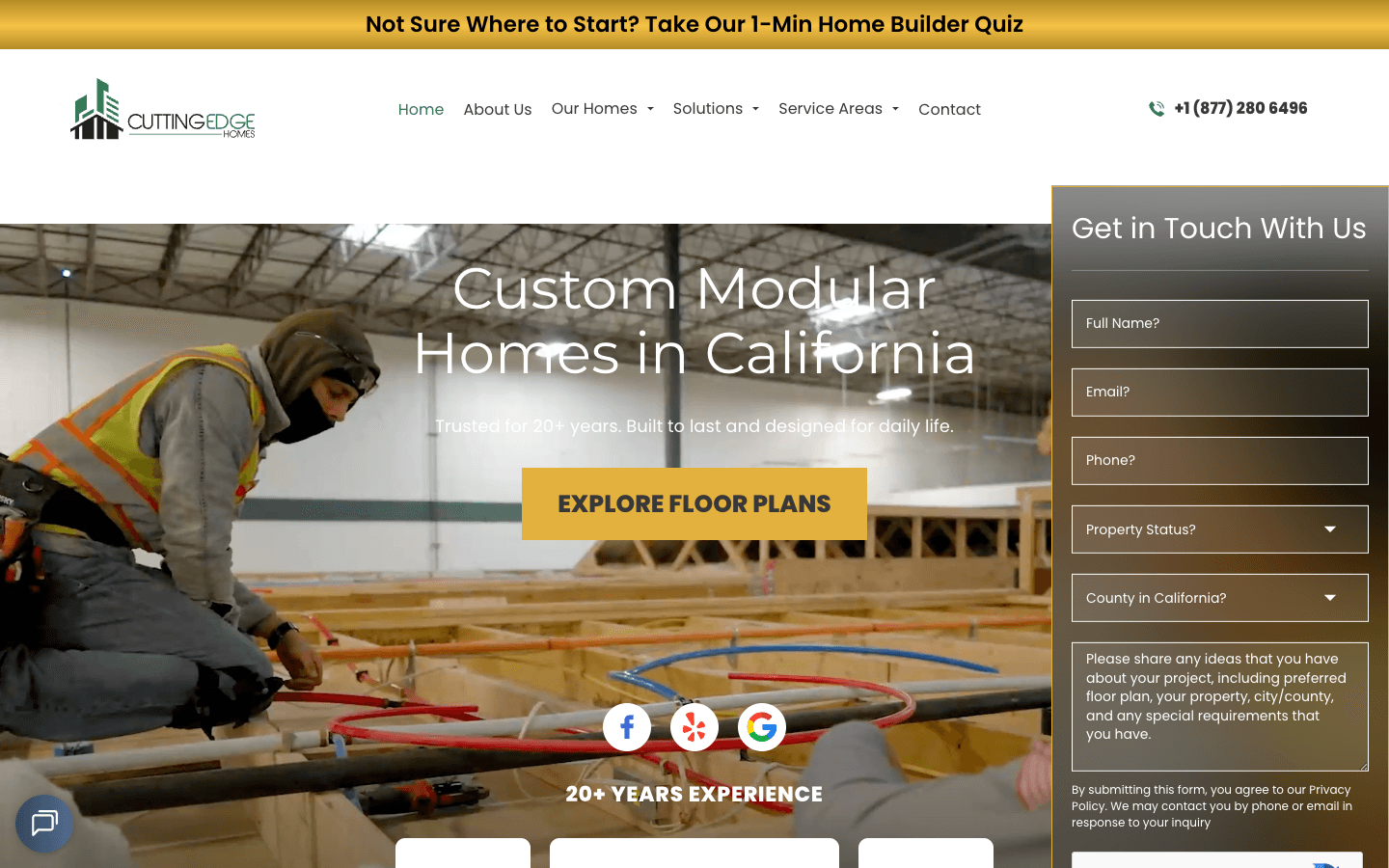
Custom Home Builders — questions we hear
How do custom home builders get more qualified leads?
By winning the silent research phase. Custom clients deliberate for months before contacting anyone — studying portfolios, reading reviews, checking whether a firm feels trustworthy enough for a seven-figure decision. Builders who publish portfolio depth, process transparency, and named people convert that research into inquiries, and local search visibility puts them in front of it. More traffic without that trust layer just produces more silence.
Why do referrals to custom builders go quiet before the first meeting?
Because every referral gets verified online, and weak web presences kill strong introductions. The architect mentions your name at dinner; the client looks you up that evening. If the portfolio is dated, the process opaque, and the team anonymous, the referral cools before the meeting is booked — and you never learn why. A referral gets a buyer to your website. The website decides whether they go further.
What should a custom home builder’s website include?
The three things the client is silently vetting: work, process, and people. Project pages written as stories — the site, the brief, the craft decisions — photographed like the homes deserve. A step-by-step process page that makes the unknown knowable, from first conversation through design, budget, build, and warranty. And real bios with faces, because the client is choosing a multi-year relationship, not a contractor.
Does SEO matter for custom home builders when most work comes from referrals?
Yes — because search is where referrals get verified and where unattached buyers start. Local visibility on your metro’s custom-builder searches, the communities where you build, and research queries like cost per square foot captures the client who has no architect yet. And when someone asks an AI tool which custom builders work in your area, the firms with substantive, structured content are the ones cited. Referrals fill this year; search fills the next one.
How should custom builders handle clients who take a year to decide?
With patient, systematic follow-up that respects the timeline. A custom client who inquired eight months ago and went quiet is usually still deciding, not lost. CRM automation keeps the relationship warm with useful touches — new project stories, process insights — and guarantees an instant, personal-feeling response when they resurface. Builders who rely on memory lose slow deciders to whoever stayed present; in a referral business, that follow-up quality is reputation.
How do custom home builders stand out from production and semi-custom competitors?
By selling what production builders structurally cannot: the process and the relationship. Production competitors win on price certainty and speed; custom builders win on craft, flexibility, and trust — but only if those are visible. Publish the design journey, show the decisions a spec builder never offers, name the people who will stand in the client’s kitchen for a year. Positioning that says custom without showing the difference is just a higher price tag.
Related
Website Design & Development
Construction website design and development engineered for trust and conversion, built for how owners, developers, and procurement teams actually vet builders.
Learn moreConstruction SEO
Construction SEO built around how owners research builders: vertical pages, technical SEO, and answer-engine optimization that reach buyers before the RFP.
Learn moreGoogle Ads
Google Ads management for construction companies: vertical campaigns, landing pages built to convert, and reporting measured on qualified pipeline, not clicks.
Learn moreCRM & Automation
CRM and automation for construction firms: instant lead response, staged nurture across long sales cycles, and pipeline visibility your leadership can trust.
Learn moreAI Systems
AI systems for construction businesses: content engines, lead qualification, AI workflows, BI dashboards, and internal operating systems measured on results.
Learn moreTalk to the team that speaks your vertical.
A 30-minute strategy call. We’ll map where trust, conversion, or follow-up is costing you work in your vertical.