
IND.10 — ADU BUILDERS
Win the backyard boom, one homeowner at a time
BoxBuild helps ADU builders win the backyard-unit boom by matching how homeowners actually buy: local research, heavy doubt about cost and permits, and slow deliberation. We build education-first websites that answer feasibility, cost, and financing questions honestly, local SEO that owns your service-area searches, and follow-up automation that keeps a six-month homeowner decision alive — so the consultation calendar stays full.
ADUs are the most permission-friendly housing product in a generation — roughly one in five new California homes is now an ADU. We build the local visibility, education, and follow-up systems that turn homeowner research into signed backyard projects.
The market moment
The ADU boom is policy-made and durable. California now permits ADUs at such volume that they account for roughly one in five new housing units in the state (California HCD), and the legislative direction — there and in the growing list of states copying the playbook — keeps tilting toward by-right approval, faster permitting, and fewer local vetoes. Washington, Oregon, Colorado, and a widening set of municipalities have moved the same direction. For builders, this is the rare residential product with government-issued tailwind.
The buyer, though, is unlike any other construction client. The typical ADU buyer is a homeowner making the largest discretionary construction decision of their life — often for family housing or rental income — with no construction literacy, high anxiety about cost and permits, and a research process that lives entirely online and local. They do not know what an ADU should cost, whether their lot qualifies, how long permitting takes, or whether to choose site-built, panelized, or a factory-built unit craned over the fence. Every one of those unknowns is a marketing opportunity for the builder willing to answer it plainly.
Competition has noticed. ADU-focused builders, modular manufacturers with ADU lines, and general remodelers are all bidding for the same homeowner attention, and the market is fragmenting by metro. In a product category this local and this education-hungry, the builder who owns the research moment in their service area owns the pipeline.
THE SHORT ANSWER
THE BACKYARD BOOM
New California housing units that are now ADUs
SRC — CALIFORNIA HCD
Net new workers construction must attract in 2026 (456K in 2027)
SRC — ASSOCIATED BUILDERS & CONTRACTORS, 2026
More likely to convert when you respond within five minutes
SRC — INDUSTRY RESEARCH
“The ADU buyer has one backyard and one budget. The builder who answers “can I build, what will it cost” first gets the consultation.”
How buyers in this space vet you
ADU vetting is homeowner vetting: emotional, local, and thorough in ways professionals underestimate. The homeowner has one project and one backyard — they cannot afford to choose wrong, and they know it.
- Feasibility first. Their opening question is not who builds ADUs — it is can I even build one on my lot. Builders who offer a real feasibility answer capture the buyer at the very top of the decision.
- Cost honesty. Homeowners are terrified of open-ended budgets. Honest cost ranges with what drives them beat silence — silence sends them to a competitor or a cost-guide site that will happily collect the lead.
- Permit navigation. The buyer has heard permitting horror stories. Proof that you know their city's process — timelines, fees, the local quirks — is among the strongest trust signals an ADU builder can publish.
- Finished projects nearby. Local proof with neighborhoods named, honest budget brackets, and owner outcomes: rental income realized, parents housed. Proximity is proof in this category.
- Reviews and responsiveness. They will read every review, and they will notice how fast you answer. For a homeowner spending retirement savings, a slow reply reads as a preview of the project.
This entire vet happens on a phone, locally, and mostly before any contact — which is why the ADU marketing system is local search plus education plus speed.
What a growth system looks like here
Traffic
ADU demand is local and question-shaped: ADU builder near me, ADU cost in your metro, backyard home permit rules by city. Construction SEO for ADU builders is local SEO with an education engine — service-area pages, city-specific permit guides, cost explainers — built to rank in map results and be the source AI tools cite when a homeowner asks what an ADU costs in their city. Google Ads performs well in this vertical because intent is legible and geography is tight: high-intent local searches, dedicated landing pages, and conversion tracking down to the consultation.
Trust
ADU trust is feasibility, cost, and permits answered before the ask. An interactive or guided feasibility path. Cost content with real ranges and real drivers. Permit guides per city in your footprint. Project galleries organized by neighborhood and use case — rental, family, home office — because the homeowner is buying an outcome, not a structure. Factory-built ADU lines add the modular legitimacy layer: show the unit, the crane day, and the finished backyard. The education-first system this page describes is the one we run for ADU companies today — one specialization inside a practice that spans the full construction industry.
Conversion & follow-up
Homeowner decisions mature slowly — six months from first search to signed contract is normal. The conversion system offers low-commitment first steps (a feasibility check, a cost guide, a consultation) and CRM automation nurtures the long middle: useful education touches, not pestering, with instant first response when the inquiry lands. Response speed is decisive with homeowners — the firm that answers the same evening books the consultation; the firm that answers Thursday gets compared to the firm that already visited.
Generic agency vs. a vertical-built system
| Generic agency | BoxBuild vertical-built system | |
|---|---|---|
| Feasibility-first capture | Generic contact form | “Can I build on my lot” path |
| Cost & permit honesty | Silence on price | Ranges, drivers, city-by-city guides |
| Local proof | Mixed gallery | Projects by neighborhood and use case |
| Homeowner-speed follow-up | Next business day | Instant response, six-month nurture |
Where to start
Start with a website that answers the homeowner's three questions — can I build, what will it cost, who handles the permits — because every ADU buyer in your service area is asking them right now. Add local construction SEO to own your cities' searches, Google Ads for immediate local coverage, and follow-up automation so six-month deliberations end on your calendar.
The broader factory-built strategy is in our off-site construction marketing playbook. If your ADU product is factory-built, the adjacent pages go deeper: modular construction, prefab construction, and container construction. The backyard boom is real, policy-backed, and local — the builders who systematize their marketing now will own their metros for the decade.
How we build the vertical
- 01
Scope the buyer
We map how ADU owners actually source and vet — the formal gates and the quiet online research that decides who gets invited.
- 02
Build the evidence
Project pages organized by scope, delivery method, and outcome — the documentary proof this buyer checks before your name moves forward.
- 03
Engineer the trust layer
Safety, capacity, certifications, and key personnel made visible in the buyer’s own language, so the silent evaluation lands in your favor.
- 04
Make it findable
SEO, answer-engine visibility, and paid coverage aimed at the searches and AI queries that precede a shortlist, not vanity keywords.
SCOPE OF WORK — ADU BUILDERS
- 01Local Visibility
- 02Feasibility Capture
- 03Cost & Permit Guides
- 04Neighborhood Proof
- 05Homeowner Follow-Up
- 06Reporting
PROOF — CASE STUDY
Cutting Edge Homes
Cutting Edge Homes — a California custom modular home builder with more than twenty years of delivery behind it — had demand reaching it, but nothing behind the website was built to capture it. In the quarter before the engagement, the site produced 13 tracked conversions. Paid traffic had no dedicated pages to land on, and inquiries lived in inboxes instead of a pipeline.
Read the full case study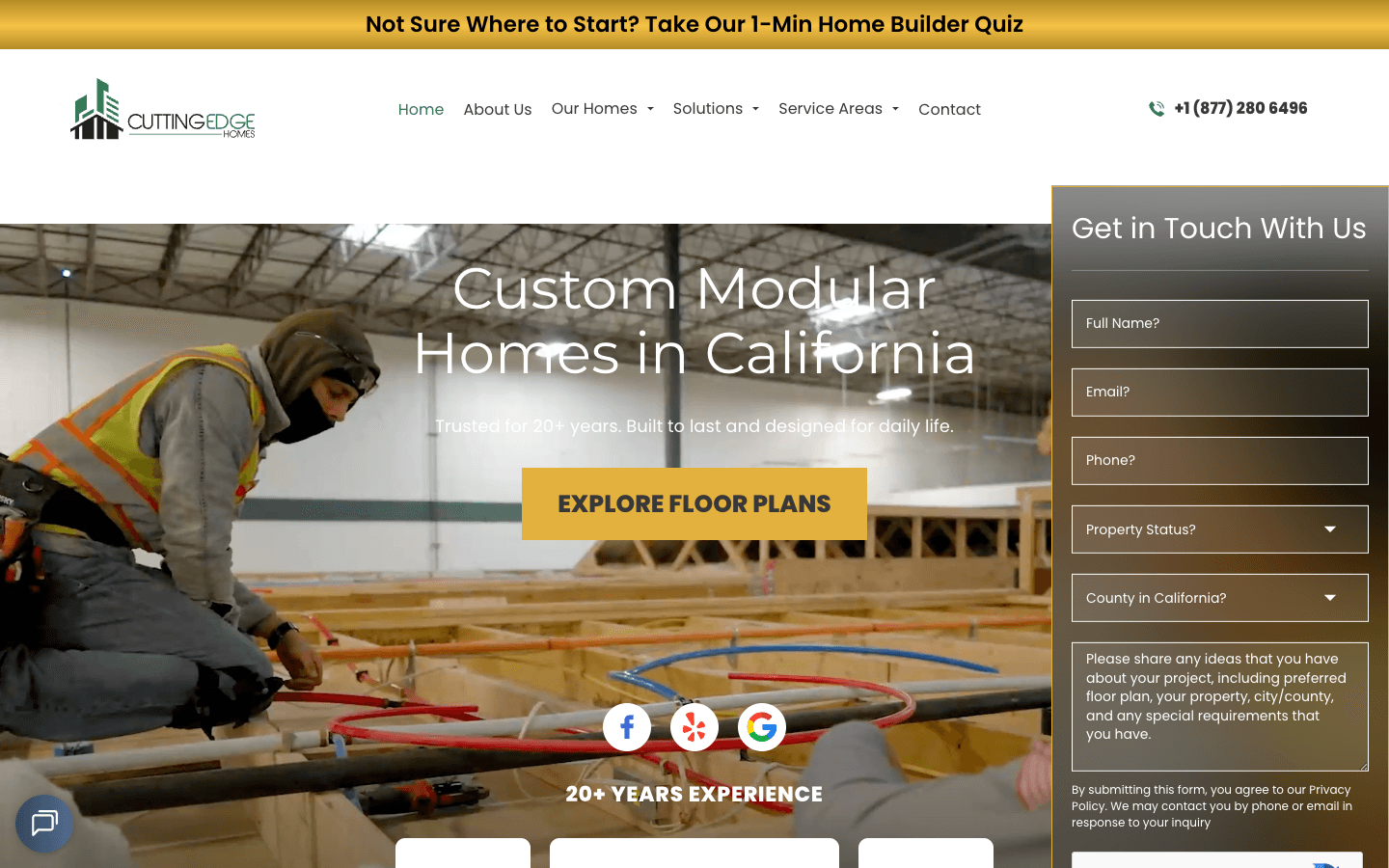
ADU Builders — questions we hear
How do ADU builders get more leads?
Own the local research moment. ADU demand is city-by-city and question-shaped — can I build one, what will it cost, how does permitting work here. Builders who publish feasibility paths, honest cost ranges, and city-specific permit guides capture homeowners at the start of the decision, rank in local and AI search, and convert with fast response. Chasing more traffic before fixing education and responsiveness just leaks more of the same demand.
What should ADU marketing say about cost?
Real ranges with real drivers — silence is the conversion killer. Homeowners fear open-ended budgets more than high budgets, and when a builder’s site says nothing about price, the buyer assumes the worst and keeps searching. Publish honest brackets by unit type, explain what moves the number — site conditions, utilities, finishes, fees — and the cautious middle of the market rewards the candor with consultations.
Do ADU builders need local SEO or regular SEO?
Local-first, education-powered. The searches that matter are tied to your service area — ADU builder near me, ADU cost in your metro, city permit rules — so map-pack presence, service-area pages, and city-specific content do the heavy lifting. The education layer doubles as AI-search fuel: when a homeowner asks a tool what an ADU costs in their city, the cited source wins the click. Generic national keywords add nothing to a builder who serves three counties.
How fast should an ADU builder respond to inquiries?
Same hour — ideally within minutes. The ADU buyer is a homeowner making the biggest discretionary construction decision of their life, and response speed reads as a preview of the project. The firm that answers the same evening books the consultation; the firm that answers Thursday gets compared to the builder who already visited. Automated instant response plus structured scheduling keeps the calendar full without anyone watching the inbox.
Should ADU builders publish permit information for their cities?
Yes — it is among the strongest trust signals in the vertical. The homeowner has heard permitting horror stories, and a builder who publishes each city’s process, realistic timelines, fees, and local quirks proves navigation ability before the first call. Permit guides also rank for the exact searches anxious homeowners run and get cited by AI tools answering those questions, turning regulatory knowledge into pipeline.
How do ADU builders handle a six-month homeowner decision cycle?
With follow-up automation that teaches instead of pesters. Homeowner ADU decisions mature slowly — financing conversations, family discussions, permit anxiety — and a salesperson’s memory cannot carry dozens of six-month deliberations. The system should respond instantly, then nurture with useful touches: cost explainers, permit updates, neighborhood project stories. When the household is finally ready, the builder who stayed usefully present gets the call.
Related
Website Design & Development
Construction website design and development engineered for trust and conversion, built for how owners, developers, and procurement teams actually vet builders.
Learn moreConstruction SEO
Construction SEO built around how owners research builders: vertical pages, technical SEO, and answer-engine optimization that reach buyers before the RFP.
Learn moreGoogle Ads
Google Ads management for construction companies: vertical campaigns, landing pages built to convert, and reporting measured on qualified pipeline, not clicks.
Learn moreCRM & Automation
CRM and automation for construction firms: instant lead response, staged nurture across long sales cycles, and pipeline visibility your leadership can trust.
Learn moreAI Systems
AI systems for construction businesses: content engines, lead qualification, AI workflows, BI dashboards, and internal operating systems measured on results.
Learn moreTalk to the team that speaks your vertical.
A 30-minute strategy call. We’ll map where trust, conversion, or follow-up is costing you work in your vertical.