
IND.01 — DATA CENTER CONSTRUCTION
Win data center work before the shortlist exists
BoxBuild helps data center construction firms win work by making them findable and credible during owner research — before the RFQ. We build positioning around what hyperscale and colocation procurement actually vets: mission-critical track record, speed-to-power capability, safety performance, and commissioning experience, then back it with follow-up systems built for long pursuit cycles.
Hyperscale and colocation owners vet builders months before procurement ever calls. We position data center contractors and their trade partners where that vetting actually happens.
The market moment
The AI infrastructure buildout is the largest concentrated construction opportunity most contractors will see in their careers. Hyperscalers are racing to add compute capacity, colocation operators are expanding into secondary markets, and the constraint has shifted from demand to delivery — available power, available land, and available builders.
Here is what that means on the ground. The established mission-critical builders are running full backlogs. Owners and their consultants are actively qualifying new general contractors, CM firms, electrical and mechanical trades, and modular specialists because the incumbent bench cannot absorb the pipeline. Firms that were doing distribution centers or industrial shell work three years ago are now bidding data halls. The door is open wider than it has ever been.
It will not stay that way. Every data center owner is building a preferred-builder list right now, and the firms that get on those lists early will ride multi-site programs for years. The firms that wait will be bidding against them as outsiders. The skilled-labor market makes this sharper: owners know craft capacity is tight, so proof that you can actually staff a job carries as much weight as proof that you can price one.
Off-site delivery is part of this story too. Prefabricated electrical rooms, modular data halls, and skid-built mechanical plant have moved from experiment to schedule strategy, because factory hours are easier to secure than field hours and speed-to-power rewards anything that compresses the critical path. Contractors and manufacturers with genuine off-site capability have a differentiator owners are actively screening for — provided the capability is visible where the screening happens.
THE SHORT ANSWER
THE MARKET MOMENT
Contractors who expect the data center construction market to grow in 2026
SRC — AGC
U.S. construction spending, annualized in 2026
SRC — U.S. CENSUS BUREAU
Construction clients who prioritize brand recognition when selecting a contractor
SRC — CMA
“The shortlist forms during the buyer’s research, not after your first call. Your website is either evidence or it’s absent.”
How buyers in this space vet you
Hyperscaler procurement is structured, quiet, and mostly finished before you hear about it. Owner-side preconstruction teams, program managers, and owner's reps maintain qualification pipelines. They gather names from consultants, from trade partners already on their programs, and from their own research. Then they verify — and the verification happens on your website, your project record, and your people's profiles, not on a phone call.
By the time an RFQ or a qualification portal invite lands, the silent vetting is done. What they checked before anyone contacted you:
- Mission-critical track record. Named project types, delivered scope, and evidence you understand data halls, not just big boxes.
- Speed-to-power fluency. Do you talk about schedule the way they do — energization dates, commissioning sequences, long-lead procurement — or in generic on-time language?
- Commissioning experience. Owners want builders who have lived through Level 4 and Level 5 commissioning, and it shows in how you write about it.
- Safety performance. Recordable rates and safety program depth get pulled into qualification scoring. If your site says nothing, they assume the worst.
- Capacity and preconstruction capability. Can you self-perform or reliably staff the critical trades, and can your precon team keep pace with a program owner's cadence?
A referral gets you researched. The research decides whether you get contacted. That is the mechanic most data center contractors are losing on — not the work, the verification layer above the work.
What a growth system looks like here
Traffic
This is not a volume game. The number of people who award data center work is small, and the search behavior is precise: capability plus market, delivery method plus region, problem plus solution. Construction SEO here means owning a tight set of high-intent queries — data center general contractor in your markets, mission-critical electrical contractor, data hall fit-out — and being the cited answer when owner-side researchers ask AI tools who builds this work in a given region. Answer-engine visibility matters more in this vertical than almost any other, because the researchers are sophisticated and they have moved to AI-assisted shortlisting early.
Trust
Your website has to survive a procurement professional reading it with a scoring sheet in mind. That means project pages with real delivery specifics — megawatts, schedule performance, commissioning scope, phasing under live adjacent operations — not gallery photos with two-line captions. It means a safety page with substance, named leadership with mission-critical résumés, and a capability statement an owner's rep can forward internally without apologizing for it. Silence on any of these reads as absence of the capability.
Conversion & follow-up
Data center pursuits run long. The contact that matters may come eighteen months before an award, and it usually starts as a quiet capability inquiry, not a bid invitation. The system has to capture that inquiry properly — a qualification-ready response path, not a generic contact form — and then keep the relationship warm through the entire cycle. CRM discipline, structured follow-up, and fast response to portal and prequalification requests are the difference between being in the room and being a name someone once considered.
Generic agency vs. a vertical-built system
| Generic agency | BoxBuild vertical-built system | |
|---|---|---|
| Speaks the buyer’s scope | Generic services list | MW, uptime, commissioning, delivery method |
| Anticipates the silent vet | Brochure copy | Evidence built for sourcing research |
| Prequalification fluency | None | Safety, capacity, references made visible |
| Findable in AI + search | Vanity keywords | The queries that precede a shortlist |
Where to start
Most data center contractors we talk to need the trust layer first: a website that survives owner vetting, built around delivery proof rather than brand language. From there, construction SEO makes that proof findable during the silent research phase, and CRM and follow-up automation makes sure an eighteen-month pursuit never dies of neglect. Firms already fielding inbound interest often add AI systems to qualify and route inquiries the moment they arrive.
Data center work also borders two markets moving for the same underlying reason. If you build the power side of the equation, see power and energy infrastructure. If your clients are manufacturers expanding alongside their compute, see industrial and manufacturing construction. The firms winning across all three are treating them as one connected buildout — and positioning accordingly.
How we build the vertical
- 01
Scope the buyer
We map how data center owners actually source and vet — the formal gates and the quiet online research that decides who gets invited.
- 02
Build the evidence
Project pages organized by scope, delivery method, and outcome — the documentary proof this buyer checks before your name moves forward.
- 03
Engineer the trust layer
Safety, capacity, certifications, and key personnel made visible in the buyer’s own language, so the silent evaluation lands in your favor.
- 04
Make it findable
SEO, answer-engine visibility, and paid coverage aimed at the searches and AI queries that precede a shortlist, not vanity keywords.
SCOPE OF WORK — DATA CENTER CONSTRUCTION
- 01Vertical Audit
- 02Mission-Critical Positioning
- 03Proof Architecture
- 04Demand Capture
- 05Pursuit Follow-Up
- 06Reporting
PROOF — CASE STUDY
Cutting Edge Homes
Cutting Edge Homes — a California custom modular home builder with more than twenty years of delivery behind it — had demand reaching it, but nothing behind the website was built to capture it. In the quarter before the engagement, the site produced 13 tracked conversions. Paid traffic had no dedicated pages to land on, and inquiries lived in inboxes instead of a pipeline.
Read the full case study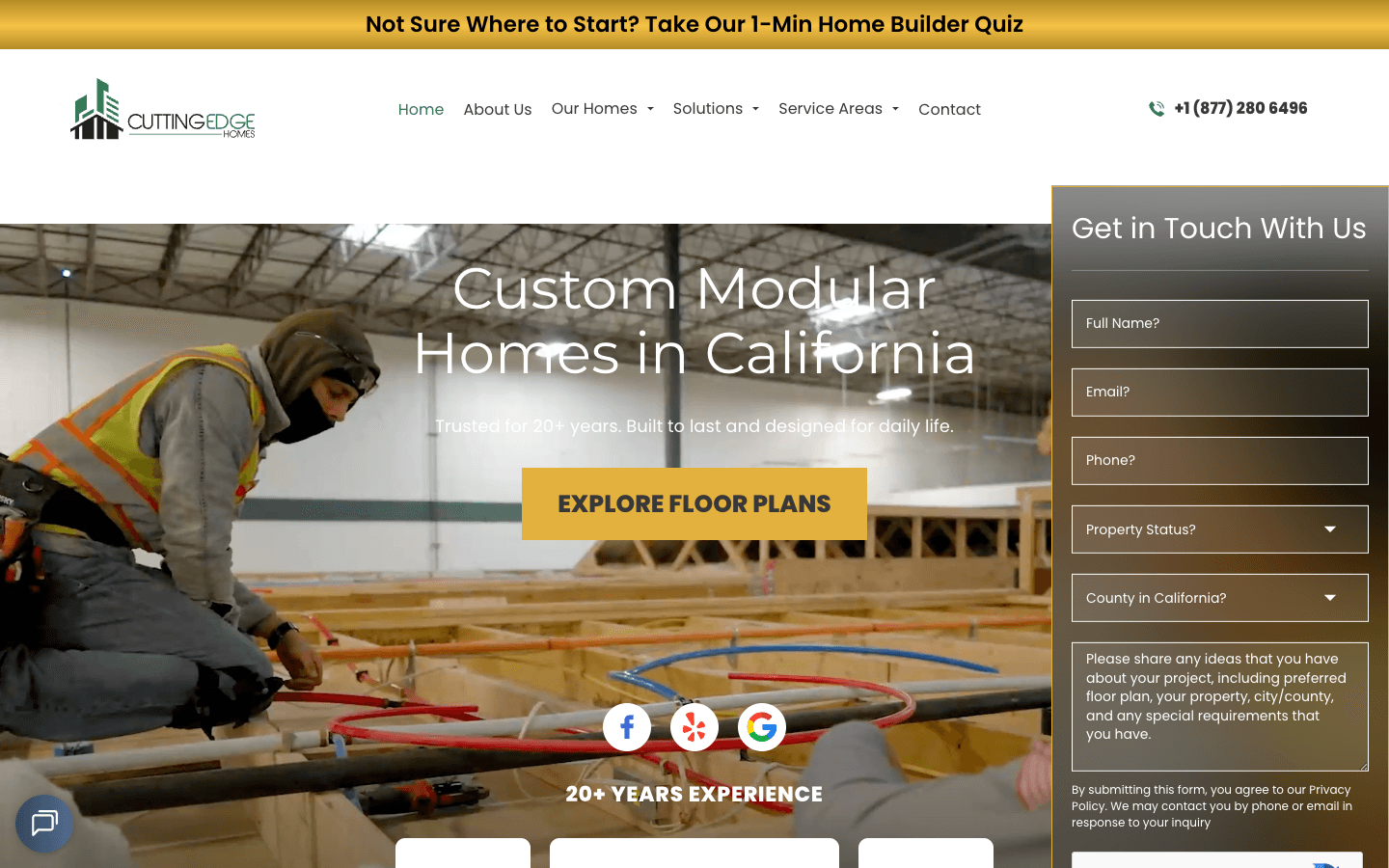
Data Center Construction — questions we hear
What do hyperscalers look for when qualifying a GC?
Delivery proof in mission-critical environments, first and foremost. Hyperscaler procurement checks your project record, speed-to-power fluency, commissioning experience, safety performance, and whether you can actually staff the critical trades. Most of that verification happens on your website and your team’s public profiles before anyone contacts you. If the evidence isn’t visible, you don’t get the qualification invite — and you never find out why.
How do data center contractors get on owner bid lists?
Through referrals that survive research. Owner-side precon teams and owner’s reps gather names from consultants and trade partners, then verify each firm online before it goes on a list. You influence the referral with relationships and the verification with positioning — project pages with real delivery specifics, safety substance, and commissioning experience. Firms that only work the relationship side lose at the research step without ever knowing it.
Does SEO work for data center contractors?
Yes, but it’s a precision game, not a volume game. The people who award data center work search with specific intent — capability plus market, scope plus region — and there are few of them. SEO for this vertical means owning a tight set of high-intent queries in your operating footprint and being the answer cited when owner researchers use AI tools to build first-pass lists. Rankings on generic terms are worthless here.
How do data center contractors show up in AI search?
By publishing the substantive content answer engines cite. When an owner’s rep asks an AI tool who builds data centers in a region, the tools pull from firms with detailed, verifiable content — named project types, commissioning scope, market presence. Thin brochure sites don’t get cited. Structured pages, real specifics, and consistent entity signals across your site and profiles are what put you in those answers.
What should a data center contractor’s website include?
Everything a procurement professional would score you on. Project pages with megawatts, schedule performance, and commissioning levels. A safety section with program depth, not a paragraph. Named leadership with mission-critical résumés. A capability statement an owner’s rep can forward internally. The test is simple: could someone qualify you from your website alone? If not, the site is costing you invitations.
Is Google Ads worth it for data center construction?
Sometimes, in a supporting role. The buying group is small and much of the research is done through consultants and AI tools rather than commercial searches, so paid search rarely carries a data center pipeline alone. Where it earns its keep is defending your branded searches and capturing scope-specific queries in markets where you’re expanding. Positioning and organic visibility do the heavy lifting in this vertical.
Related
Website Design & Development
Construction website design and development engineered for trust and conversion, built for how owners, developers, and procurement teams actually vet builders.
Learn moreConstruction SEO
Construction SEO built around how owners research builders: vertical pages, technical SEO, and answer-engine optimization that reach buyers before the RFP.
Learn moreGoogle Ads
Google Ads management for construction companies: vertical campaigns, landing pages built to convert, and reporting measured on qualified pipeline, not clicks.
Learn moreCRM & Automation
CRM and automation for construction firms: instant lead response, staged nurture across long sales cycles, and pipeline visibility your leadership can trust.
Learn moreAI Systems
AI systems for construction businesses: content engines, lead qualification, AI workflows, BI dashboards, and internal operating systems measured on results.
Learn moreTalk to the team that speaks your vertical.
A 30-minute strategy call. We’ll map where trust, conversion, or follow-up is costing you work in your vertical.