
IND.05 — COMMERCIAL GENERAL CONTRACTORS
Stand out in construction’s most crowded market
BoxBuild helps commercial general contractors win more of the right work by sharpening positioning around their strongest sectors and delivery methods, building proof-driven web presence that survives owner and developer vetting, and installing follow-up systems that keep relationship pipelines warm between pursuits. The goal is a better bid-hit ratio, not a bigger bid list.
Every commercial GC claims quality, safety, and on-time delivery. Differentiation is what moves your bid-hit ratio — and differentiation is built, not claimed.
The market moment
Commercial construction is a mixed market right now, and that is exactly why positioning matters more than it has in years. Office remains selective, but the broader commercial landscape is active: mixed-use, multifamily-adjacent retail, municipal and education work, tenant improvements driven by workplace reconfiguration, and the ripple effects of the industrial and data center buildout — the hotels, service buildings, and commercial infrastructure that follow major projects into a region.
In a market like this, generalist volume bidding is a losing strategy. Margins compress, bid lists lengthen, and every GC on the list makes identical claims. The firms growing are the ones that have picked their ground — sectors, delivery methods, project sizes, geographies — and built visible, verifiable depth there. A GC known for design-build municipal work, or fast-track TI, or ground-up neighborhood retail wins at a rate a generalist cannot touch, because owners shortlist specialists and negotiate with them earlier.
The math every commercial GC already knows: moving your bid-hit ratio matters more than adding bids. Better positioning is how the ratio moves.
There is one more shift worth naming. The way owners research builders has changed faster than most GCs’ marketing has. Developers, brokers, and owner’s reps now run first-pass research through AI tools as well as search engines, and those tools reward firms with specific, verifiable, well-structured information. The GC whose website still reads like a 2018 brochure is invisible to a growing share of the research that builds shortlists.
THE SHORT ANSWER
THE MARKET MOMENT
Builders who say generating quality leads is their biggest sales challenge
SRC — BUILDERTREND, 2026
U.S. construction spending, annualized in 2026
SRC — U.S. CENSUS BUREAU
Leads a builder needs to close one contract
SRC — BUILDERTREND, 2026
“A referral gets a buyer to your website. It doesn’t get them past it — the vetting still happens there.”
How buyers in this space vet you
Commercial work flows through relationship networks — developers, owner's reps, brokers, architects, repeat institutional owners. That leads many GCs to conclude that digital presence does not matter in their world. The conclusion is wrong, and it is costing them work in a way they never see.
Relationships generate the referral. Research decides whether the referral survives. When a developer's partner mentions your name, when an architect suggests three GCs for a negotiated job, when an owner's rep builds an RFP list — every one of those people, or someone on their team, looks you up before your name goes forward. What they check:
- Sector evidence. Projects like their project — type, size, complexity. A developer doing a $20M mixed-use building wants to see you have delivered comparable work, not a mosaic of everything.
- The team. Named PMs and superintendents with relevant track records. Commercial owners have learned that they hire the team, not the firm.
- Delivery method depth. Real design-build and negotiated-work capability, demonstrated through process and precon content, not a services list.
- Financial and operational stability signals. Longevity, bonding capacity mentioned appropriately, active recent work. Silence creates doubt.
- Current activity. A website last touched three years ago tells an owner's rep exactly one thing, and it is not the thing you want.
This is the silent vetting problem in its purest form. Commercial GCs rarely lose work in the meeting. They lose it in the ten minutes of research that decided whether the meeting happened.
What a growth system looks like here
Traffic
For commercial GCs, traffic strategy is about qualified visibility in your chosen ground: sector plus geography searches, delivery method searches, and the branded searches that referrals trigger — because a referral searching your name is the highest-intent visitor you will ever get. Construction SEO builds the sector-depth content that ranks and converts, and increasingly earns you citations when owners ask AI tools which GCs handle a project type in your market. For firms pushing into a new sector or geography, Google Ads buys immediate presence while organic authority builds.
Trust
The trust layer is where commercial GCs differentiate or die. Everyone claims safety, quality, and schedule; almost no one proves them. Proof looks like project pages with delivery specifics and owner outcomes, precon and self-perform capability shown as process, team pages that make an owner comfortable with the people, and positioning language that stakes a claim — the sectors and methods where you are genuinely strong — instead of promising everything to everyone. Narrower positioning, visibly proven, beats broader positioning every time an owner compares two websites.
Conversion & follow-up
Commercial pipelines are relationship pipelines, and relationships decay without a system. The GCs with the best negotiated-work ratios are systematic: every developer contact, broker relationship, architect ally, and past client lives in a CRM with structured touchpoints — project completions, market notes, qualification updates. Follow-up automation does not replace the relationship; it makes sure the relationship never goes quiet during the two years between an owner's projects. Add fast, professional handling of inbound inquiries and referral traffic, and the pipeline compounds.
Generic agency vs. a vertical-built system
| Generic agency | BoxBuild vertical-built system | |
|---|---|---|
| Carries referral credibility | Generic brochure | Proof that survives the vet |
| Project evidence by market | Mixed gallery | Organized by sector and delivery method |
| Preconstruction positioning | Absent | Made visible and specific |
| Findable in AI + search | Vanity keywords | The searches owners actually run |
Where to start
For most commercial GCs the order is clear. First, a website that survives owner vetting — positioned around your strongest sectors with proof to match, because that is what every referral and RFP-list decision checks. Second, CRM and follow-up automation, because relationship-driven pipelines leak more revenue through weak follow-up than through weak marketing. Third, construction SEO to compound visibility in your chosen sectors, with Google Ads where you need presence now.
We run this exact system for commercial contractors today — the positioning work, the proof-driven rebuild, the follow-up discipline — and we run our own business on the same stack we sell. See what it looks like in the field in our case studies.
How we build the vertical
- 01
Scope the buyer
We map how commercial general contracting owners actually source and vet — the formal gates and the quiet online research that decides who gets invited.
- 02
Build the evidence
Project pages organized by scope, delivery method, and outcome — the documentary proof this buyer checks before your name moves forward.
- 03
Engineer the trust layer
Safety, capacity, certifications, and key personnel made visible in the buyer’s own language, so the silent evaluation lands in your favor.
- 04
Make it findable
SEO, answer-engine visibility, and paid coverage aimed at the searches and AI queries that precede a shortlist, not vanity keywords.
SCOPE OF WORK — COMMERCIAL GENERAL CONTRACTORS
- 01Differentiation Audit
- 02Vertical Positioning
- 03Proof Architecture
- 04Demand Capture
- 05Relationship Follow-Up
- 06Reporting
PROOF — CASE STUDY
Cutting Edge Homes
Cutting Edge Homes — a California custom modular home builder with more than twenty years of delivery behind it — had demand reaching it, but nothing behind the website was built to capture it. In the quarter before the engagement, the site produced 13 tracked conversions. Paid traffic had no dedicated pages to land on, and inquiries lived in inboxes instead of a pipeline.
Read the full case study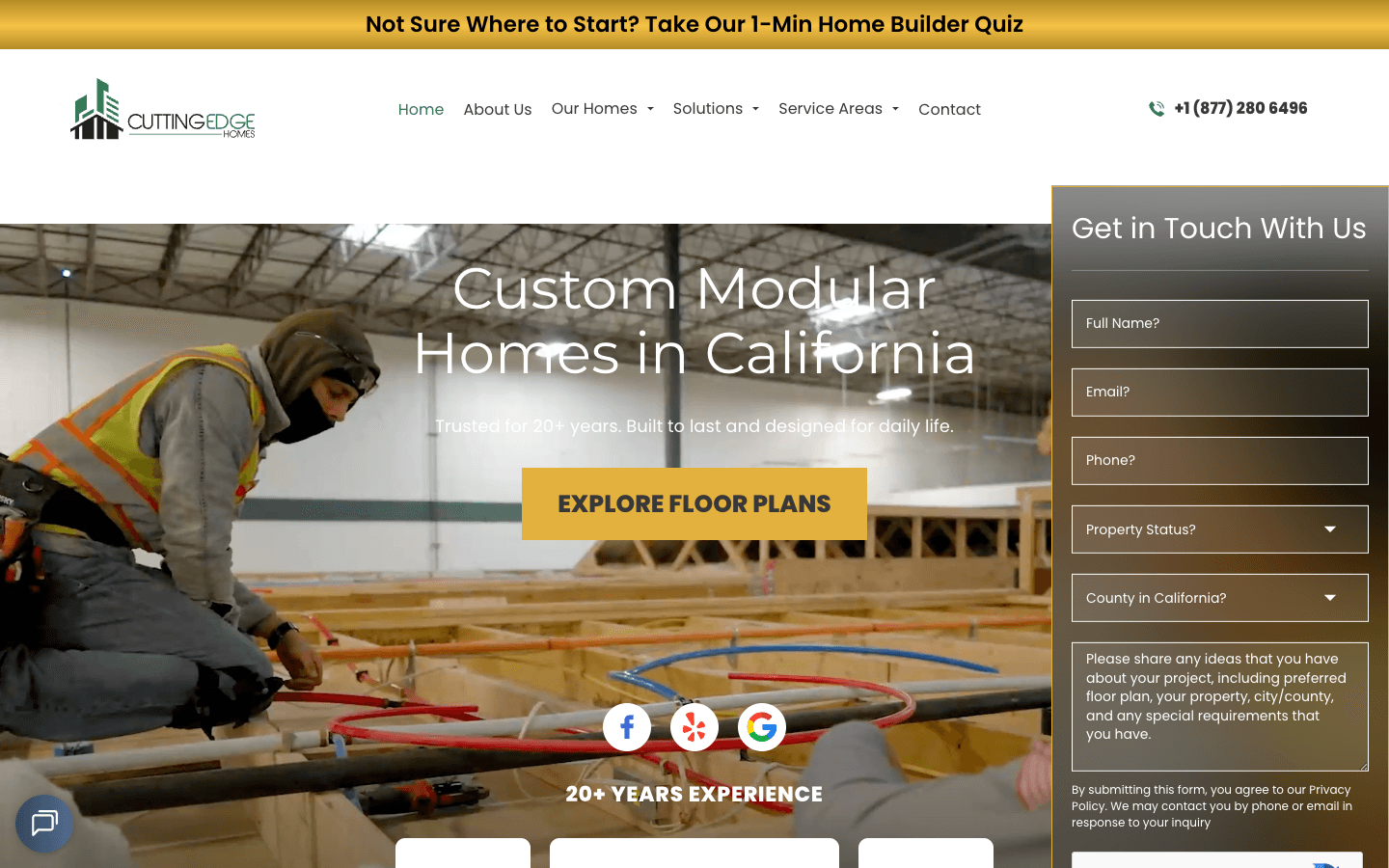
Commercial General Contractors — questions we hear
How do commercial GCs stand out when every firm claims the same things?
Stop claiming and start proving, on narrower ground. Every GC says quality, safety, and on-time; almost none show delivery specifics, owner outcomes, named teams, and real precon process. Pick the sectors and delivery methods where you’re genuinely strong, position visibly around them, and back the position with proof. Narrower positioning, visibly proven, beats broad promises every time an owner compares two websites — and they always compare.
Do developers really check GC websites before shortlisting?
Someone on their team always does. Commercial work flows through referrals — developers, architects, owner’s reps, brokers — but every referral gets verified before the name goes forward. They check for comparable projects, the team they’d actually get, delivery method depth, and signs of current activity. Commercial GCs rarely lose work in the meeting; they lose it in the ten minutes of research that decided whether the meeting happened.
Does SEO work for commercial general contractors?
Yes, with the right expectations. The highest-value searches are sector plus geography, delivery method queries, and your own name — because every referral triggers a branded search, and that’s the highest-intent visitor you’ll ever get. Sector-depth content ranks, converts, and increasingly earns citations when owners ask AI tools which GCs handle a project type in a market. Chasing generic construction keywords is where GC SEO budgets go to die.
How do commercial GCs show up in AI search?
By being specific enough to cite. Answer engines name firms with structured, verifiable content — sectors served, project specifics, markets covered, named capabilities — when owners and brokers ask who builds a project type in a region. A generalist site claiming everything gives the tools nothing to anchor on. Clear sector positioning with real project detail is what turns AI-assisted research into your inbound inquiry.
Should a commercial GC niche down into specific sectors?
In your positioning, yes — even if you still take a broad range of work. Owners shortlist specialists and negotiate with them earlier, so the firms visibly known for something — design-build municipal, fast-track TI, ground-up retail — win at rates generalists can’t match. Positioning narrow doesn’t mean refusing work outside the niche. It means the market can finish the sentence about what you’re best at.
How do we win more negotiated work instead of hard bid?
Negotiated work goes to firms owners already trust, so the job is building trust before the project exists. That takes three things working together: positioning that makes you the obvious specialist for their project type, a proof layer that survives their research, and systematic relationship follow-up so you’re present when the project surfaces. Hard-bid dependence is usually a symptom of invisible positioning, not weak estimating.
Related
Website Design & Development
Construction website design and development engineered for trust and conversion, built for how owners, developers, and procurement teams actually vet builders.
Learn moreConstruction SEO
Construction SEO built around how owners research builders: vertical pages, technical SEO, and answer-engine optimization that reach buyers before the RFP.
Learn moreGoogle Ads
Google Ads management for construction companies: vertical campaigns, landing pages built to convert, and reporting measured on qualified pipeline, not clicks.
Learn moreCRM & Automation
CRM and automation for construction firms: instant lead response, staged nurture across long sales cycles, and pipeline visibility your leadership can trust.
Learn moreAI Systems
AI systems for construction businesses: content engines, lead qualification, AI workflows, BI dashboards, and internal operating systems measured on results.
Learn moreTalk to the team that speaks your vertical.
A 30-minute strategy call. We’ll map where trust, conversion, or follow-up is costing you work in your vertical.