
IND.15 — ARCHITECTS & DESIGNERS
Authority you can verify, work you can win
BoxBuild helps architecture and design firms convert reputation into pipeline. With the AIA/Deltek Architecture Billings Index below the 50-point growth threshold since January 2023 — 44.5 in May 2026 — differentiation decides who gets the shrinking discretionary work. We build portfolio-first authority, niche positioning that owners and referral partners can repeat, and follow-up systems for the long, relationship-driven cycles design work moves in.
Architecture is a reputation business in a soft market — firm billings have sat below the growth line for over three years. We build the visible authority that wins clients directly and makes your firm the one builders and owners recommend.
The market moment
Architecture is working through a long soft patch. The AIA/Deltek Architecture Billings Index has not crossed the 50-point growth threshold since January 2023, and 2026 has stayed below it — 44.5 in May, the year's low (AIA/Deltek). When billings are soft, the discretionary work that remains concentrates with the firms whose reputation is most visible, most specific, and easiest to verify. The firms treating marketing as beneath the profession are conceding exactly the projects they want most.
Design firms also occupy a unique position in the industry's referral economy: architects are simultaneously sellers, specifiers, and recommenders. You win commissions from owners and developers; you specify the products manufacturers fight to place; and you recommend — or quietly veto — the builders your clients ask about. That triple role means your web presence works three audiences at once: prospective clients vetting your portfolio, product and builder partners deciding whether you are worth investing in, and the owners who ask their architect first before hiring anyone else on the project.
Positioning is where design firms most underinvest. "Full-service architecture firm" is the design world's equivalent of "quality construction on time and on budget" — a claim that differentiates nothing. The firms winning soft markets are legible: known for a project type, a sector, a design philosophy, a delivery approach. Legible firms get remembered, recommended, and shortlisted; versatile-but-vague firms get considered and passed over.
THE SHORT ANSWER
THE DESIGN-MARKET MOMENT
Architecture Billings Index, May 2026 — below the 50 growth line since Jan 2023
SRC — AIA / DELTEK ABI
B2B buyers who used generative AI during their most recent purchase
SRC — 6SENSE
Construction clients who prioritize brand recognition when selecting a contractor
SRC — CMA
“In a soft market, legible firms get shortlisted. Versatile-but-vague firms get considered — and passed over.”
How buyers in this space vet you
Design clients — owners, developers, institutions, and the households behind high-end residential work — vet architects on authority and fit, and they do it before the first conversation.
- The portfolio, read for fit. Not "is this work good" but "have they done my project type, at my scale, in my world." Portfolios organized by sector and project type answer the fit question; chronological galleries make the client do the work.
- Design authority. Published thinking, awards in context, press, and the positions your firm takes. Clients buying judgment want evidence you have some — and AI search increasingly assembles that evidence for them from what you have published.
- Process and partnership. Sophisticated clients vet how you run projects: budget stewardship, consultant coordination, construction administration. The fear behind every architect selection is the beautiful building that cannot be built on budget.
- What builders say. Owners cross-reference: they ask their GC about your drawings, their developer friends about your change orders. Your reputation among commercial general contractors and builders is part of your marketing whether you manage it or not.
- Responsiveness. Design engagements start with a conversation, and firms that respond slowly to a first inquiry preview a frustrating partnership. Speed reads as respect.
What a growth system looks like here
Traffic
Design-firm demand is fit-shaped: project type plus market, sector plus firm, and the research queries owners run before shortlisting. Construction SEO for architects means owning your niche's searches — the sector-and-city combinations where you want commissions — and publishing the substantive thinking that AI answer engines cite when someone asks who designs your building type in your region. Authority content is not content marketing here; it is the product being sampled.
Trust
The trust layer is portfolio architecture plus published judgment. Project pages that tell the story — brief, constraints, design response, outcome — organized so every prospective client finds their project type in two clicks. A clear position: what the firm is for, in language a client can repeat to a colleague. Team visibility, because clients hire the people. And the professional-services proof discipline we brought to Modular Construction Consultants — a firm whose expertise had to be visible and systematized to convert — applies directly to design practices.
Conversion & follow-up
Commissions move slowly: a project inquiry can precede a signed agreement by a year of feasibility, funding, and board approvals. CRM automation keeps those long conversations warm without partners carrying them in memory, ensures fast first response to new inquiries, and maintains the referral network — past clients, builders, consultants — that generates the next commission. In a relationship business, systematic relationship maintenance is the growth engine.
Generic agency vs. a vertical-built system
| Generic agency | BoxBuild vertical-built system | |
|---|---|---|
| Portfolio organized for fit | Chronological gallery | By sector and project type, two clicks |
| Positioning a client can repeat | “Full-service firm” | Legible niche and point of view |
| Referral-hub awareness | Client-only messaging | Speaks to clients AND partners |
| Year-long pursuit follow-up | Partner’s memory | Systematic, warm, instant on inquiry |
Where to start
Start with a website that makes your authority legible — portfolio organized for fit, positioning a client can repeat, thinking that proves judgment. Then construction SEO to own your niche's research moments, and CRM automation so year-long pursuits and referral relationships never depend on a partner's inbox.
The full playbook is in our trades and suppliers marketing playbook. Your professional ecosystem runs through this site: the suppliers whose products you specify, the custom home builders who build your residential work, and the commercial contractors who deliver the rest — one connected industry, which is exactly how we market it.
How we build the vertical
- 01
Scope the buyer
We map how design owners actually source and vet — the formal gates and the quiet online research that decides who gets invited.
- 02
Build the evidence
Project pages organized by scope, delivery method, and outcome — the documentary proof this buyer checks before your name moves forward.
- 03
Engineer the trust layer
Safety, capacity, certifications, and key personnel made visible in the buyer’s own language, so the silent evaluation lands in your favor.
- 04
Make it findable
SEO, answer-engine visibility, and paid coverage aimed at the searches and AI queries that precede a shortlist, not vanity keywords.
SCOPE OF WORK — ARCHITECTS & DESIGNERS
- 01Positioning & Legibility
- 02Portfolio Architecture
- 03Authority Publishing
- 04Niche Demand Capture
- 05Long-Cycle Follow-Up
- 06Reporting
PROOF — CASE STUDY
Modular Construction Consultants
A consulting firm sells one thing: expertise. Modular Construction Consultants had deep knowledge of the modular space but a web presence that didn’t demonstrate it, which in consulting is the same as not having it. Prospects vetting the firm online found nothing that proved the depth they’d be paying for.
Read the full case study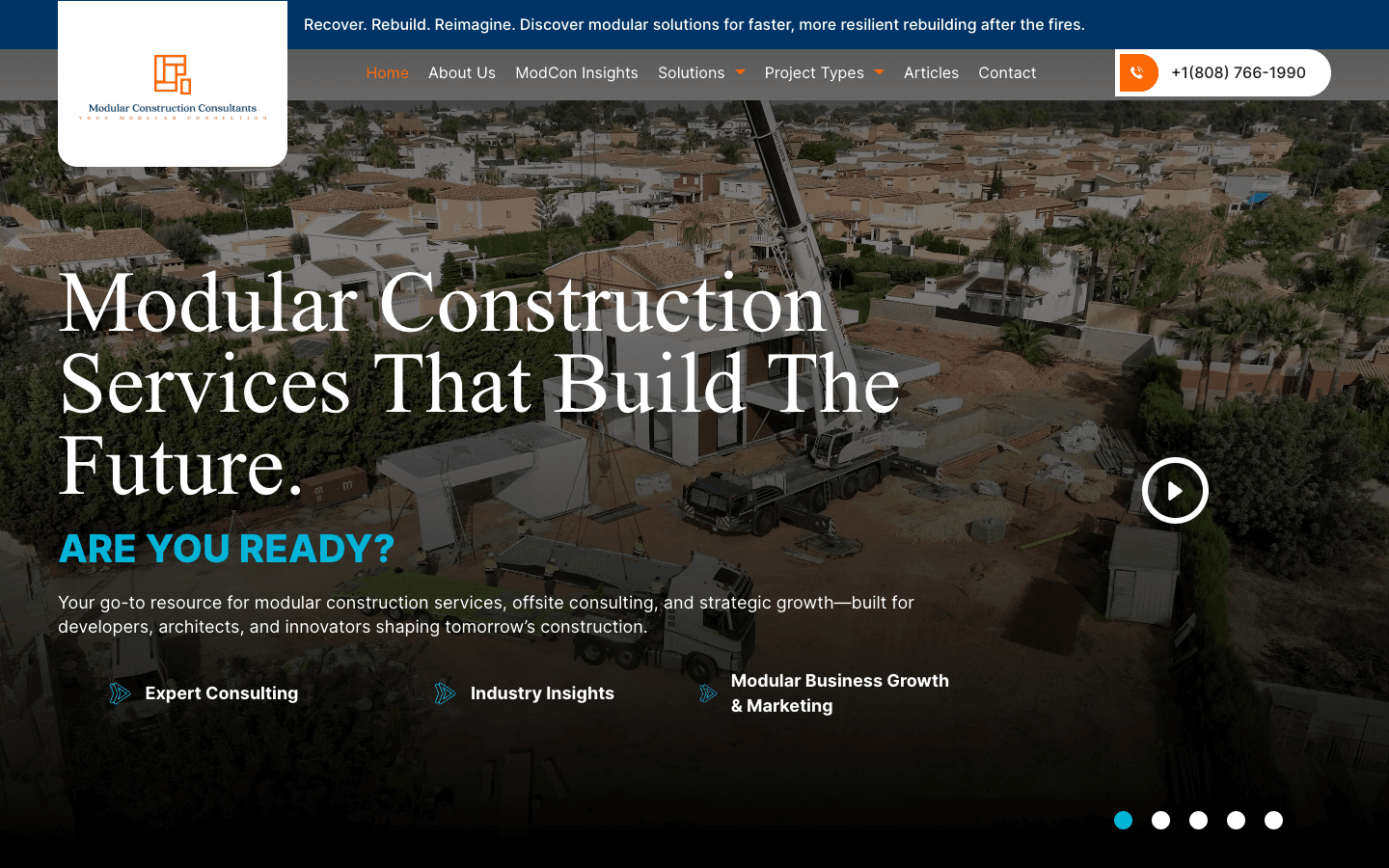
Architects & Designers — questions we hear
How do architecture firms win work in a soft market?
By being legible. With the Architecture Billings Index below the 50-point growth line since January 2023 (AIA/Deltek), the discretionary work that remains concentrates with firms whose authority is specific and verifiable: a clear niche, a portfolio organized by project type, published thinking that proves judgment. “Full-service firm” differentiates nothing. Legible firms get remembered and shortlisted; versatile-but-vague firms get considered and passed over.
How should an architecture firm’s portfolio be organized?
For fit, not chronology. Clients read portfolios asking one question — has this firm done my project type, at my scale, in my world — and a date-ordered gallery makes them dig for the answer. Organize by sector and project type so any prospect finds their world in two clicks, and write each project as a story: brief, constraints, design response, outcome. The portfolio is the sales meeting you were not in the room for.
Does SEO matter for architecture firms?
For the right queries, decisively. Owners and developers research sector-plus-city combinations — healthcare architect in a region, multifamily design firm in a metro — and AI assistants now assemble those shortlists from published, structured content. A firm invisible in that research forfeits the commissions that never reach a referral. Authority content does double duty here: it ranks, it earns citations, and it is the product being sampled.
How do architects turn their referral position into pipeline?
Deliberately, because architects sit at the industry’s referral hub: clients ask them first, builders court them, and manufacturers need them. Maintain the network systematically — past clients, contractors you trust, consultants — with useful touches rather than newsletters. Make your firm easy to recommend: a positioning colleagues can repeat in one sentence and a website that confirms it. Referrals decay without maintenance; a CRM keeps the hub warm.
What makes design clients choose one architect over another?
Verified fit plus trusted process. The portfolio answers fit; the process story answers the client’s deepest fear — the beautiful design that blows the budget. Show budget stewardship, consultant coordination, and construction administration as visibly as the design work, and make the people real, because clients hire the people. Firms that market only aesthetics lose to firms that also prove they can shepherd a project to a buildable, fundable end.
How long is the sales cycle for architecture commissions, and how should firms manage it?
Commonly a year or more — feasibility, funding, approvals, and boards all move before an agreement is signed. Managing that cycle on partners’ memories loses commissions to attrition, not competition. A CRM built for long pursuits keeps every conversation warm with substantive touches, guarantees fast response when a dormant prospect resurfaces, and gives the partnership a live view of the pipeline it is actually carrying into next year.
Related
Website Design & Development
Construction website design and development engineered for trust and conversion, built for how owners, developers, and procurement teams actually vet builders.
Learn moreConstruction SEO
Construction SEO built around how owners research builders: vertical pages, technical SEO, and answer-engine optimization that reach buyers before the RFP.
Learn moreGoogle Ads
Google Ads management for construction companies: vertical campaigns, landing pages built to convert, and reporting measured on qualified pipeline, not clicks.
Learn moreCRM & Automation
CRM and automation for construction firms: instant lead response, staged nurture across long sales cycles, and pipeline visibility your leadership can trust.
Learn moreAI Systems
AI systems for construction businesses: content engines, lead qualification, AI workflows, BI dashboards, and internal operating systems measured on results.
Learn moreTalk to the team that speaks your vertical.
A 30-minute strategy call. We’ll map where trust, conversion, or follow-up is costing you work in your vertical.