
IND.07 — PREFAB CONSTRUCTION
Turn method curiosity into signed contracts
BoxBuild helps prefab construction companies convert method curiosity into pipeline. Prefab is the search term buyers use while they are still learning, so we build education-first websites and content systems that capture that research moment, answer the durability and financing doubts that stall prefab decisions, and follow up across the long consideration cycle — positioning your firm as the obvious guide to the method.
Prefab is the term buyers search when they are still learning — which makes it the highest-leverage word in off-site marketing. We position prefab builders to capture that research moment and carry the buyer from curiosity to contract.
The market moment
Prefab is the front door of off-site construction — the word buyers actually type when they start researching factory-built anything. Volumetric modular, panelized shells, kit homes, factory-built components: to the researching buyer it is all "prefab" until someone teaches them the difference. That makes prefab search demand uniquely valuable, and uniquely underserved, because most firms in the space market their process taxonomy instead of the buyer's vocabulary.
The macro forces favor the method. U.S. construction spending runs about $2.17 trillion annualized in 2026 (U.S. Census Bureau), while the industry needs an estimated 349,000 net new workers this year to keep pace (Associated Builders and Contractors). Factory production compresses project timelines by 20–50% compared to site-built delivery, per the Modular Building Institute — and schedule certainty built on factory labor is exactly what a labor-constrained market is shopping for.
But the prefab buyer's journey has a shape most marketing ignores. It starts with method research — what does prefab cost, is prefab quality real, how does financing work. It narrows to product research — panelized versus volumetric, which floor plans, which markets. Only then does it become firm research. A prefab company whose website only speaks to the last stage has surrendered the first two, which is where the shortlist quietly forms.
The opportunity: the firm that educates the buyer owns the buyer. Answer the method questions publicly and generously, and you become the reference point every later comparison gets measured against.
THE SHORT ANSWER
THE OFF-SITE MOMENT
Schedule reduction factory production delivers vs. site-built
SRC — MODULAR BUILDING INSTITUTE
U.S. construction spending, annualized in 2026
SRC — U.S. CENSUS BUREAU
Net new workers construction must attract in 2026 (456K in 2027)
SRC — ASSOCIATED BUILDERS & CONTRACTORS, 2026
“The prefab buyer picks their guide before they pick their builder. Publish the education and you own the shortlist.”
How buyers in this space vet you
Prefab buyers — homeowners, developers, and land owners weighing a build route — vet in a distinctive sequence. They interrogate the method first, and they interrogate you through the method.
- Does your content teach or sell? Buyers in the research phase bounce off brochure language. A site that plainly explains what prefab is, costs, and requires earns the return visit.
- Is quality proven, not claimed? Finished homes photographed like real homes, factory process shown honestly, specifications available — the evidence that factory-built means precision, not shortcuts.
- Is financing addressed? Prefab financing differs enough from conventional construction loans that silence scares buyers. The firms that explain lender treatment, draw schedules, and appraisal reality convert the cautious middle of the market.
- Do you know your delivery footprint? Prefab economics are geographic. Buyers check whether you actually serve their region and what site work you take responsibility for.
- What happens at the site? The buyer has read horror stories about foundations, utilities, and finish work. They are checking whether you own the whole delivery or hand off the hard part.
This vetting happens on your website and in AI-assisted search — increasingly buyers ask the tools directly whether prefab is cheaper, faster, or riskier, and the tools answer by citing whoever published the clearest explanation.
What a growth system looks like here
Traffic
Prefab is a search-demand vertical. The method terms carry real volume, and the buyers behind them are early but genuine. Construction SEO here means building the education library that owns method queries — cost guides, comparison pages, financing explainers — structured so both Google and AI answer engines cite you as the source. That early-capture machine matters more than in any conventional vertical, because the prefab buyer picks their guide before they pick their builder. Google Ads layers onto the bottom of the funnel, capturing prefab homes plus region and product-specific searches where intent is already sharp.
Trust
Prefab trust is education plus evidence. The education answers the method doubts; the evidence proves your firm delivers. We rebuilt this system end to end for Cutting Edge Homes, a California custom modular builder with two decades of delivery: demand was already reaching the site, but nothing behind it was built to capture and convert that interest. The rebuild paired education-first structure with dedicated landing pages and CRM wiring underneath — the machine, not just the brochure.
Conversion & follow-up
Prefab inquiries arrive early in the decision and mature slowly. The conversion system has to offer low-commitment first steps — a feasibility question, a cost guide, a plan catalog — and then nurture systematically. CRM and follow-up automation carries the buyer through months of deliberation with useful touches, not check-ins, and ensures the first response arrives in minutes. In a market where every buyer is comparison shopping the method itself, the firm that responds first and teaches best wins the contract.
Generic agency vs. a vertical-built system
| Generic agency | BoxBuild vertical-built system | |
|---|---|---|
| Captures method-stage research | Bottom-funnel only | Education engine owns the top |
| Financing & cost honesty | Silence | Explainers a buyer can take to a lender |
| Proof that converts skeptics | Gallery + captions | Finished work beside the factory process |
| Findable in AI + search | Vanity keywords | Cited answers to prefab questions |
Where to start
Start with a website architected for the prefab buyer's journey — education at the front, proof in the middle, low-friction conversion throughout. Add construction SEO to own the method searches in your footprint, and follow-up automation so slow deliberations do not die in an inbox.
The full method-marketing strategy is laid out in our off-site construction marketing playbook. If your product is more specific than the umbrella term, go deeper: modular construction, panelized construction, container construction, or ADU builders. Off-site is the deepest specialization inside our construction practice — the same buyer-vetting system we run for commercial general contractors, tuned for a market that questions the method itself.
How we build the vertical
- 01
Scope the buyer
We map how prefab owners actually source and vet — the formal gates and the quiet online research that decides who gets invited.
- 02
Build the evidence
Project pages organized by scope, delivery method, and outcome — the documentary proof this buyer checks before your name moves forward.
- 03
Engineer the trust layer
Safety, capacity, certifications, and key personnel made visible in the buyer’s own language, so the silent evaluation lands in your favor.
- 04
Make it findable
SEO, answer-engine visibility, and paid coverage aimed at the searches and AI queries that precede a shortlist, not vanity keywords.
SCOPE OF WORK — PREFAB CONSTRUCTION
- 01Education Engine
- 02Method Positioning
- 03Financing Content
- 04Demand Capture
- 05Nurture Follow-Up
- 06Reporting
PROOF — CASE STUDY
Cutting Edge Homes
Cutting Edge Homes — a California custom modular home builder with more than twenty years of delivery behind it — had demand reaching it, but nothing behind the website was built to capture it. In the quarter before the engagement, the site produced 13 tracked conversions. Paid traffic had no dedicated pages to land on, and inquiries lived in inboxes instead of a pipeline.
Read the full case study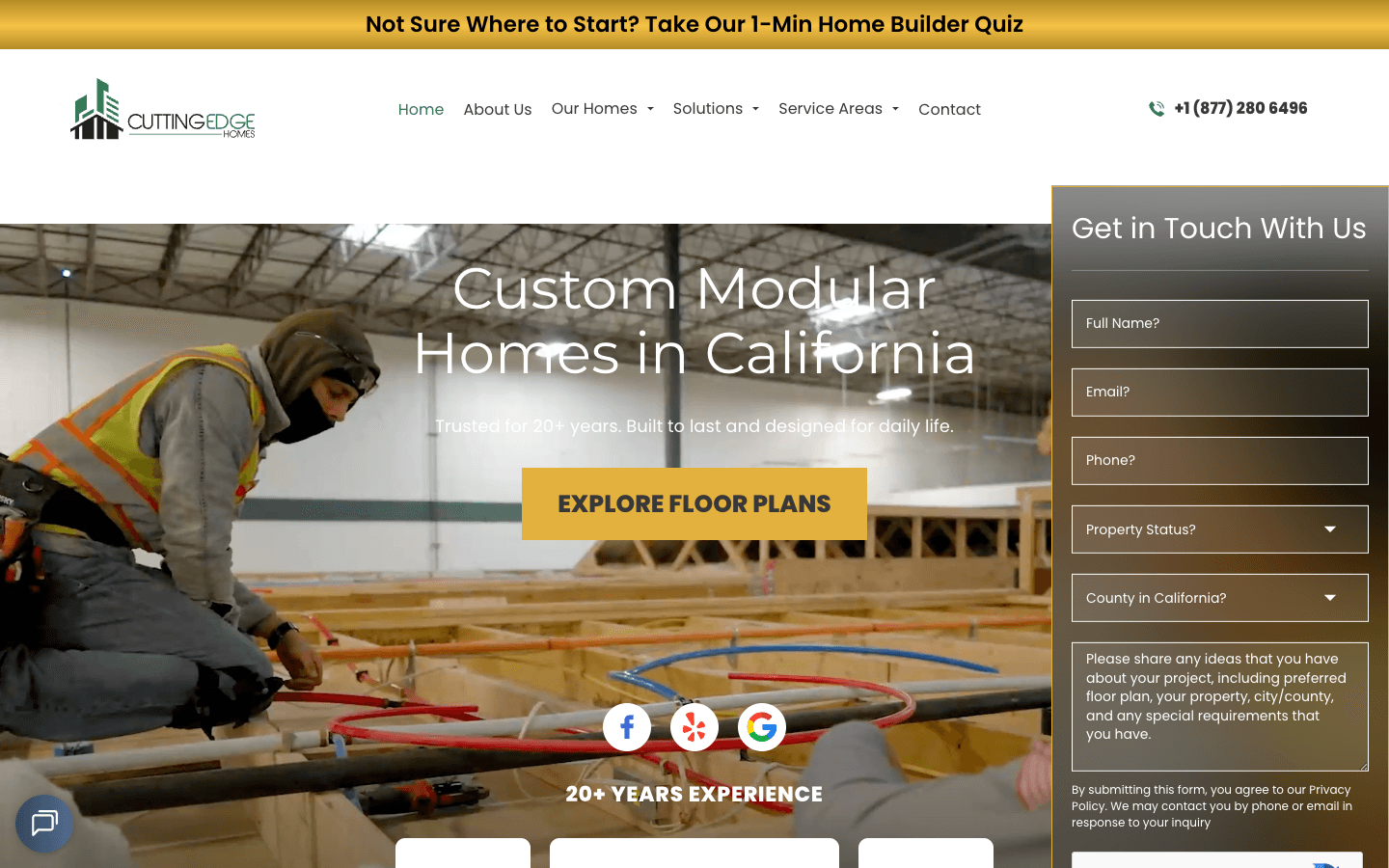
Prefab Construction — questions we hear
How do prefab companies capture buyers who are still researching the method?
By publishing the education those buyers are searching for — cost guides, prefab-versus-site-built comparisons, financing explainers — before asking for anything. Prefab buyers pick their guide before they pick their builder, and the firm whose content taught them becomes the standard every later option is compared against. Capture works best with low-commitment offers matched to research stage: a cost guide, a feasibility question, a plan catalog.
What is the difference between marketing prefab and marketing conventional construction?
In conventional construction the buyer already believes the product works and is only choosing a firm. In prefab you sell the method and the firm at once — the buyer needs convincing that factory-built is durable, financeable, and code-legitimate before your company is even relevant. That means education leads, proof pairs finished work with process, and financing gets addressed openly. Skip the method sale and no amount of brand polish will convert.
Do prefab builders need dedicated landing pages for ads?
Yes — sending paid traffic to a homepage wastes most of the spend. Prefab searches carry distinct intents: cost research, plan browsing, region-specific availability, financing questions. Each campaign needs a landing page matched to that intent with a conversion step that fits the buyer’s stage. Paid works in prefab when it captures the bottom of the method funnel; it fails when every click lands on the same generic page.
How long is the prefab sales cycle and how should follow-up handle it?
Months, commonly six or more — the buyer is deciding on a construction method, a budget, and a firm at once. Follow-up has to be systematic: instant first response, then a nurture sequence that keeps teaching — financing explainers, project stories, site-work reality — rather than checking in. Firms that rely on a salesperson’s memory lose slow deliberators to whoever stayed usefully present. The system, not the person, should own the timeline.
Why does off-site construction marketing lead with education instead of sales?
In conventional construction the buyer already believes in the product and is only choosing a firm. In off-site you sell the method and the firm at once, so content has to teach before it sells. Education-first pages that explain volumetric modular, panelized, and container-based building pull the buyer through skepticism at their own pace, so they reach the inquiry already convinced.
How do case studies convert doubtful off-site construction buyers?
Case studies dissolve skepticism by showing finished work next to the process that produced it. A buyer who doubts whether modular is real changes their mind when they see a completed project they would happily use, then see the disciplined factory process behind it. Proof answers is this good enough, and process answers can I trust how it gets made. Together they beat any written claim.
Related
Website Design & Development
Construction website design and development engineered for trust and conversion, built for how owners, developers, and procurement teams actually vet builders.
Learn moreConstruction SEO
Construction SEO built around how owners research builders: vertical pages, technical SEO, and answer-engine optimization that reach buyers before the RFP.
Learn moreGoogle Ads
Google Ads management for construction companies: vertical campaigns, landing pages built to convert, and reporting measured on qualified pipeline, not clicks.
Learn moreCRM & Automation
CRM and automation for construction firms: instant lead response, staged nurture across long sales cycles, and pipeline visibility your leadership can trust.
Learn moreAI Systems
AI systems for construction businesses: content engines, lead qualification, AI workflows, BI dashboards, and internal operating systems measured on results.
Learn moreTalk to the team that speaks your vertical.
A 30-minute strategy call. We’ll map where trust, conversion, or follow-up is costing you work in your vertical.