
S.01 — WEBSITE DESIGN & DEVELOPMENT
Websites that survive owner vetting
Construction website design and development from BoxBuild is for GCs, design-build firms, and off-site manufacturers whose website has to convince owners they can deliver. We build fast, secure sites on enterprise infrastructure, structured around trust signals, proof of capability, and conversion paths that feed every inquiry straight into your CRM.
Owners, developers, and procurement teams vet you online long before they call. We build construction websites engineered to pass that vetting and convert it into qualified pipeline.
Who this is for
General contractors pursuing data center, healthcare, and industrial work whose current website undercuts the qualifications package they send with it. Design-build firms with strong portfolios trapped inside templates that make them look like every other builder in the market. Modular and off-site manufacturers who have to educate developers on a delivery method while proving factory capacity and quality control at the same time. Specialty contractors moving from sub work toward direct-to-owner contracts, where procurement teams suddenly read every page.
If your revenue comes from negotiated work, invitations to bid, and shortlists rather than walk-in traffic, this service was built for you. If you win most work from a two-block service radius and a truck wrap, it probably wasn’t.
THE SHORT ANSWER
WHY THE SITE IS THE VET
Construction clients who prioritize brand recognition when selecting a contractor
SRC — CMA
Share of construction site traffic that is now mobile
SRC — 2026 BENCHMARK
Leads a builder needs to close one contract
SRC — BUILDERTREND, 2026
“Looking good is a side effect. The site’s real job is to survive a skeptical professional’s silent evaluation — and most fail it in under a minute.”
The problem, in your words
“I don’t want to send an owner to our website.” That is the sentence we hear most often. The site was built years ago by a generalist agency. The project gallery stops two cycles back. The safety page is one paragraph. Half the leadership photos show people who left. Meanwhile you are chasing eight-figure work, and a selection committee is quietly comparing your site against firms three times your size.
You know the website isn’t winning you work. What stings is the suspicion that it’s losing you shortlist spots you never hear about, because nobody calls to tell you why you didn’t make the cut. And when an inquiry does come through, it lands in a shared inbox where it waits until someone gets back from site.
What BoxBuild does differently
Most agencies treat a construction website as a brochure. We treat it as the trust layer of a revenue system. Construction companies don’t have a traffic problem; they have trust, conversion, positioning, and follow-up problems, and the website sits at the center of all four. So we build around the vetting sequence an owner actually runs: can this firm deliver in my vertical, at my scale, with my delivery method, safely, and on schedule. Every page exists to answer one of those questions with evidence — project pages organized by vertical, capability statements, team depth, safety culture, and a preconstruction process the buyer can picture themselves inside.
Then we wire the site into the rest of the machine. Forms route straight into your CRM and are never stored on the site database. The platform itself is enterprise-grade: Cloudflare at the edge, the application and Postgres database on Railway, media on Supabase, code on GitHub. MFA on every account, TLS 1.3 in transit, AES-256 at rest, a no-plugin architecture, and a 24-hour breach notification commitment, with providers that hold SOC 2 attestations. That matters when your buyers are data center operators and healthcare systems whose own IT departments review vendors before the first meeting.
We also build for how research happens now. Buyers ask ChatGPT, Claude, and Perplexity who builds what before they ever open a search results page. Sites we ship are structured so both people and answer engines can read exactly what you do, where, and for whom.
DIY vs. generalist agency vs. BoxBuild
| DIY / template | Generalist agency | BoxBuild | |
|---|---|---|---|
| Built for buyer vetting | No — looks, not trust | Rarely — generic funnels | Yes — trust-engineered first |
| Construction fluency | None | Learned on your budget | Native: delivery methods, backlog, bonding |
| Conversion paths by stage | One generic form | Sometimes | Matched to project type and readiness |
| Performance & security | Plugin roulette | Varies | Enterprise stack, no plugins |
| You own the asset | Sometimes | Often not | Always — code, domain, data |
What’s included
- Positioning and discovery sessions with your leadership and business development team
- Full sitemap and conversion architecture mapped to your target verticals and buyer roles
- Custom design built around your projects, not a recycled contractor template
- Copywriting in your firm’s voice: capability-led, specific, free of filler
- Project portfolio structured by vertical, delivery method, and contract size
- A CMS your marketing coordinator can actually update without calling a developer
- Forms wired directly into your CRM with routing and notification rules, never stored on the site database
- Technical foundations for search and answer engines: schema, performance, crawlability, clean structure
- Enterprise hosting and ongoing care, scoped with the engagement
- Analytics and conversion tracking from day one, so the site is accountable to pipeline
How it connects
A website is the conversion layer of a larger system, and it performs best with demand and follow-up built around it. We pair new builds with construction SEO that captures research-stage demand, so preconstruction teams and owners find you months before an RFP goes out, and with Google Ads campaigns that send high-intent searches to pages built to convert them when you need pipeline sooner than organic can deliver it.
Every form fill and phone call the site produces flows into CRM and automation that responds in minutes and follows up for months, because construction sales cycles are long and the firm that stays present wins the shortlist spot. Behind the scenes, AI systems that keep content production and lead qualification running turn the site from a one-time project into an asset that compounds. For vertical buyers, the site anchors dedicated pages like data center construction marketing and healthcare construction marketing that speak the owner’s language, vertical by vertical.
How we build it
- 01
Audit the vet
We evaluate your site the way a skeptical owner does, and find where trust leaks before an inquiry ever forms.
- 02
Architect for trust
Information structure, proof, and conversion paths designed around how construction buyers actually decide.
- 03
Build on the stack
A custom, no-plugin build on our enterprise stack — fast, secure, and yours to keep.
- 04
Wire the system
Forms route straight to your CRM; SEO, ads, and follow-up connect so the site is a machine, not a brochure.
SCOPE OF WORK — WEBSITE DESIGN & DEVELOPMENT
- 01Positioning & Architecture
- 02Design System
- 03Copy & Content
- 04Build & CMS
- 05CRM Wiring
- 06Launch & Care
PROOF — CASE STUDY
Cutting Edge Homes
Cutting Edge Homes — a California custom modular home builder with more than twenty years of delivery behind it — had demand reaching it, but nothing behind the website was built to capture it. In the quarter before the engagement, the site produced 13 tracked conversions. Paid traffic had no dedicated pages to land on, and inquiries lived in inboxes instead of a pipeline.
Read the full case study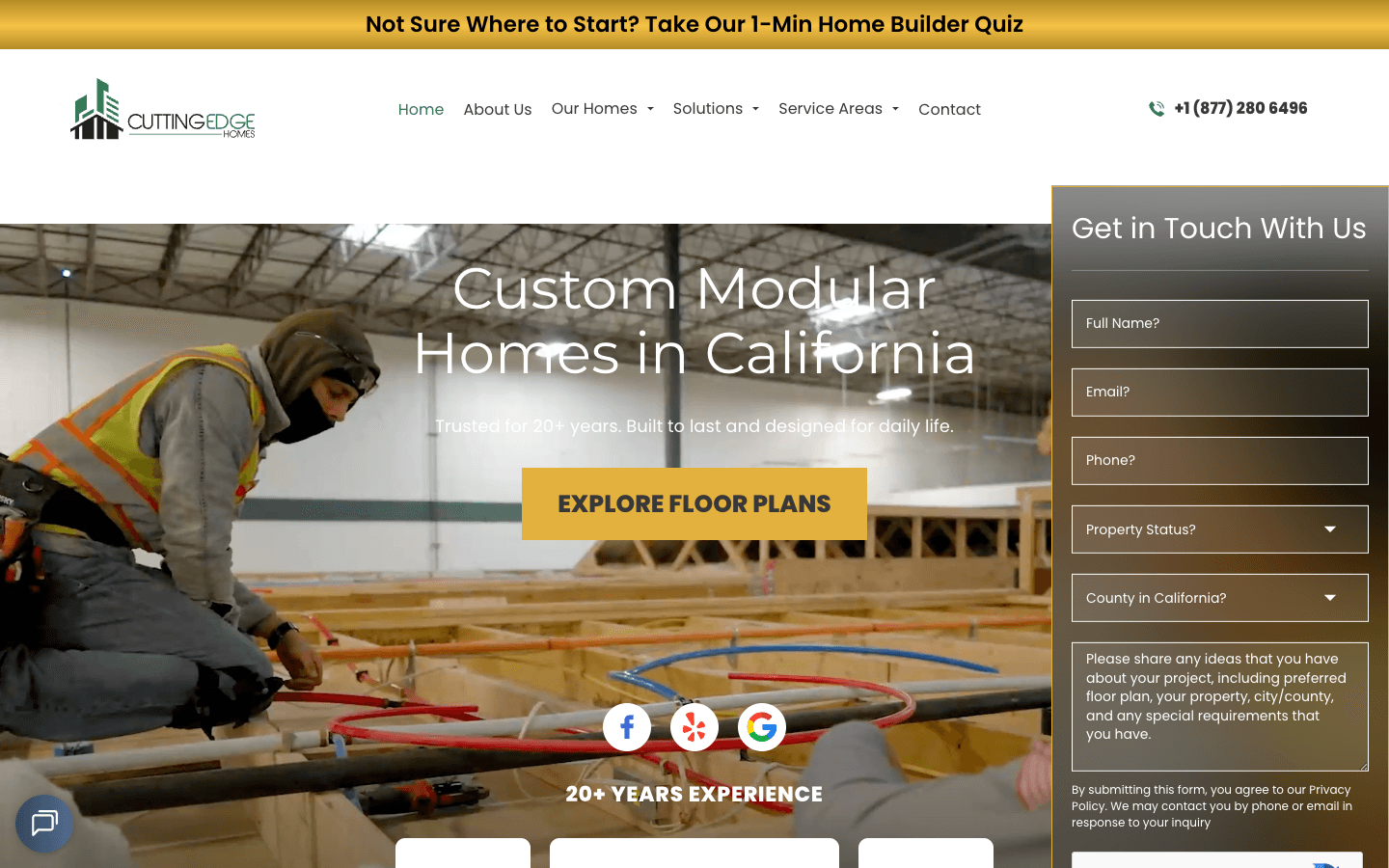
Website Design & Development — questions we hear
How much does a construction website cost?
BoxBuild doesn’t publish pricing, because that would mean guessing before understanding your business. Every build is scoped to the engagement: what the growth system needs to include, how many verticals and markets it serves, and what already exists. Scope is what drives cost — positioning work, page depth, integrations, content. You get a specific number in the first conversation, openly, before you commit to anything.
How long does it take to build a construction company website?
For a custom build done properly, plan on roughly two to four months from kickoff to launch. Discovery and positioning come first, then architecture, design, copy, build, and testing. The most common delay isn’t the agency; it’s gathering project photography, safety documentation, and team content from a busy firm. We structure collection early so your site doesn’t stall waiting on a hard-drive archaeology project.
What makes a construction website different from any other business website?
The buyer. Owners, developers, and procurement teams vet contractors like an investment: vertical experience, project scale, safety record, team depth, delivery method. A construction website has to survive that vetting, which is why project pages organized by vertical, capability detail, and proof matter more than clever animations. Generic agencies build brochures. Construction buyers are reading your site the way they read a qualifications package.
Do general contractors actually win work through their websites?
Yes, but rarely the way people imagine. Few owners find a GC cold on Google and award a project the same week. What happens constantly is silent vetting: you get referred or invited to bid, and the decision-makers check your site before the first call. A weak site costs you shortlist spots you never hear about. The website’s job is to confirm the referral, then convert research into a conversation.
What should a general contractor’s website include?
At minimum: project portfolio organized by vertical and delivery method, capability statements, safety information, leadership and team depth, your preconstruction process, and clear paths to contact. Add market and vertical pages if you pursue specific project types. Every element should answer a question a selection committee actually asks. What you can cut: stock photos of handshakes and filler copy about commitment to excellence.
Should we build on WordPress or go custom?
For firms pursuing serious commercial work, we recommend a custom build on modern infrastructure over plugin-dependent WordPress. Plugins are the leading attack surface and maintenance burden on contractor sites. BoxBuild builds on a no-plugin architecture with Cloudflare at the edge, the application and database on Railway, and media on Supabase, with TLS 1.3 in transit and AES-256 at rest. Your buyers’ IT teams notice these things.
Related
Data Center Construction
BoxBuild positions data center contractors for hyperscale and colo procurement — trust, vertical content, and conversion built around how owners vet builders.
Learn morePower & Energy Infrastructure
BoxBuild builds growth systems for power and energy contractors — positioning and conversion designed for utility, developer, and EPC procurement teams.
Learn moreIndustrial & Manufacturing
BoxBuild positions industrial and manufacturing builders for reshoring-era capital projects — sector-fluent content, trust signals, and conversion systems.
Learn moreHealthcare Construction
BoxBuild builds growth systems for healthcare contractors — compliance-first positioning and conversion for hospital systems and medical facility owners.
Learn moreCommercial General Contractors
BoxBuild helps commercial GCs differentiate — positioning, proof, and follow-up systems that improve bid-hit ratios in the most crowded market in construction.
Learn moreModular Construction
BoxBuild markets modular construction companies — education-first positioning, buyer-doubt content, and follow-up systems built for the volumetric sale.
Learn morePrefab Construction
BoxBuild markets prefab construction companies — capturing method-stage research, answering buyer doubts, and converting curiosity into contracts.
Learn morePanelized Construction
BoxBuild markets panelized construction firms — positioning speed, precision, and labor savings for the builders and owners who specify panels.
Learn moreContainer Construction
BoxBuild markets container construction companies — legitimacy-first positioning that converts container curiosity into qualified, financeable projects.
Learn moreADU Builders
BoxBuild markets ADU builders — local visibility, cost and permit education, and follow-up systems tuned to how homeowners buy backyard units.
Learn moreCustom Home Builders
BoxBuild markets custom home builders — portfolio-first trust, process transparency, and follow-up systems built for a seven-figure homeowner decision.
Learn moreRemodeling & Design-Build
BoxBuild markets remodeling and design-build firms — trust-first positioning and follow-up systems for a $518B market where homeowner anxiety decides.
Learn moreSpecialty Trades
BoxBuild markets specialty trade contractors — roofing, concrete, electrical, plumbing, HVAC, excavation — for GC bid lists and direct work alike.
Learn moreConstruction Suppliers
BoxBuild markets construction suppliers and building-product manufacturers — spec-ready content, specifier education, and lead systems that protect the spec.
Learn moreArchitects & Designers
BoxBuild markets architecture and design firms — visible authority, niche positioning, and referral-ready presence for a market where billings are soft.
Learn moreTalk to the team that speaks your vertical.
A 30-minute strategy call. We’ll map where trust, conversion, or follow-up is costing you work in your vertical.