
S.03 — GOOGLE ADS
Paid search that fills preconstruction pipelines
Google Ads management for construction companies means campaigns mapped to specific verticals and services, landing pages built to convert vetted buyers, and every lead routed into automated follow-up. BoxBuild runs paid search for GCs, design-build firms, and manufacturers, measured against qualified pipeline instead of clicks and impressions.
High-intent construction searches are expensive, and most contractor campaigns waste them. We make paid search pay by sending every click to a page built to convert it, and every lead into follow-up.
Who this is for
Contractors who need pipeline on a schedule organic growth can’t promise: a new division to fill, a new market to enter, a backlog gap opening two quarters out. Design-build firms and GCs targeting specific project types, where one signed contract pays for years of ad spend. Modular and off-site manufacturers whose buyers search with clear intent once they know the category exists. Specialty contractors in verticals where a handful of searches per month carry serious contract value.
This is also for firms that already ran Google Ads, watched money disappear, and concluded paid search doesn’t work in construction. Usually the channel wasn’t the problem. The system around it was.
THE SHORT ANSWER
THE ECONOMICS OF PAID
Average construction Google Ads cost-per-lead (roofing exceeds $228)
SRC — INDUSTRY BENCHMARKS, 2026
Builders who say generating quality leads is their biggest sales challenge
SRC — BUILDERTREND, 2026
More likely to convert when you respond within five minutes
SRC — INDUSTRY RESEARCH
“The cheapest lead isn’t the one with the lowest click cost. It’s the one with the best cost-per-won-job.”
The problem, in your words
“We spent thousands a month and got job applicants, students, and people looking for a handyman.” The campaign a previous agency built had one campaign, broad keywords, and every click pointed at your homepage. The leads that did arrive sat in an inbox until Friday, and by then the good ones had spoken to someone else. Reporting showed clicks and impressions; nobody could tell you what any of it did for backlog.
So now every conversation about paid search starts with justified skepticism, while a competitor with a tighter operation quietly buys the exact searches your future clients are typing.
What BoxBuild does differently
We run paid search as one component of a revenue machine, not as a faucet bolted to a leaking bucket. Construction companies don’t have a traffic problem; they have trust, conversion, positioning, and follow-up problems, and paid traffic exposes all of them faster than anything else because every wasted click has a receipt.
Structure comes first. Campaigns map to specific verticals and services, so budget concentrates on searches with contract value behind them. Negative keyword discipline strips out job seekers, DIY queries, and residential noise before they spend your money. Every ad points at a dedicated landing page that answers the searcher’s actual question with proof — projects, process, capability — rather than a homepage that asks them to go find it themselves.
Then, follow-up. A paid lead is the most expensive lead you own, and it loses value by the hour. Every form and call routes straight into your CRM with instant response and staged follow-up behind it, so the spend that produced the lead isn’t wasted by silence. Reporting runs on the same rail: we track leads through qualification to opportunity, and we judge the program on qualified pipeline. If a campaign produces clicks but no real conversations, it gets rebuilt or killed.
What’s included
- Account and campaign architecture mapped to your verticals, services, and markets
- Keyword and intent research focused on searches with contract value
- Negative keyword discipline that strips job seekers, DIY, and residential noise
- Ad copy written in construction language buyers recognize as credible
- Dedicated landing pages designed and written to convert each campaign’s audience
- Conversion tracking for forms and calls, wired into your CRM
- Ongoing bid, budget, and search-term management with a paper trail
- Reporting on cost per qualified lead and pipeline influenced, not clicks
Boosted posts vs. generalist PPC vs. BoxBuild
| Boosted posts | Generalist PPC | BoxBuild | |
|---|---|---|---|
| Dedicated landing pages | No | Sometimes | Always, by campaign |
| Lead-quality controls | None | Basic | Negative keywords, scoring, filters |
| Speed-to-lead | Manual | Manual | Automated, under five minutes |
| Routes into CRM | No | Rarely | Every lead, scored and staged |
| Reported against | Clicks | Cost-per-lead | Cost-per-won-job |
Where paid search fits
Paid search is a precision tool, not a strategy. It buys visibility at the moment of intent, which makes it the fastest channel in the kit and the least forgiving of weak foundations. We will tell you plainly when your budget is better spent fixing conversion before scaling traffic, because sending expensive clicks to a site that fails vetting just produces expensive proof of the real problem.
How it connects
Ads perform when the destination deserves the click, which is why campaigns lean on website design and development built to pass owner vetting and share landing-page infrastructure with it. Paid and organic work as a pair: construction SEO that captures research-stage demand compounds over quarters, while ads produce signal now, and each channel’s search data sharpens the other.
Every lead the campaigns generate lands in CRM and automation that responds instantly and nurtures long sales cycles, which is where paid leads either become meetings or die. AI systems for lead qualification and reporting score and route inquiries so your team spends time on buyers, not tire-kickers. And because budget follows contract value, campaigns typically target the verticals where our clients hunt, from commercial general contracting to industrial and manufacturing construction.
How campaigns run
- 01
Scope & structure
Account architecture around your services, verticals, and service areas — not one catch-all campaign.
- 02
Build landing pages
A dedicated page per campaign, matched to intent and built to convert serious buyers.
- 03
Launch & filter
Negative keywords, bid discipline, and scoring keep spend on buyers, not tire-kickers.
- 04
Route to CRM
Every lead flows into follow-up automation and gets a response before it cools.
SCOPE OF WORK — GOOGLE ADS
- 01Market & Keyword Research
- 02Campaign Architecture
- 03Landing Pages
- 04Conversion Tracking
- 05Qualification Rules
- 06Optimization Cadence
PROOF — CASE STUDY
Cutting Edge Homes
Cutting Edge Homes — a California custom modular home builder with more than twenty years of delivery behind it — had demand reaching it, but nothing behind the website was built to capture it. In the quarter before the engagement, the site produced 13 tracked conversions. Paid traffic had no dedicated pages to land on, and inquiries lived in inboxes instead of a pipeline.
Read the full case study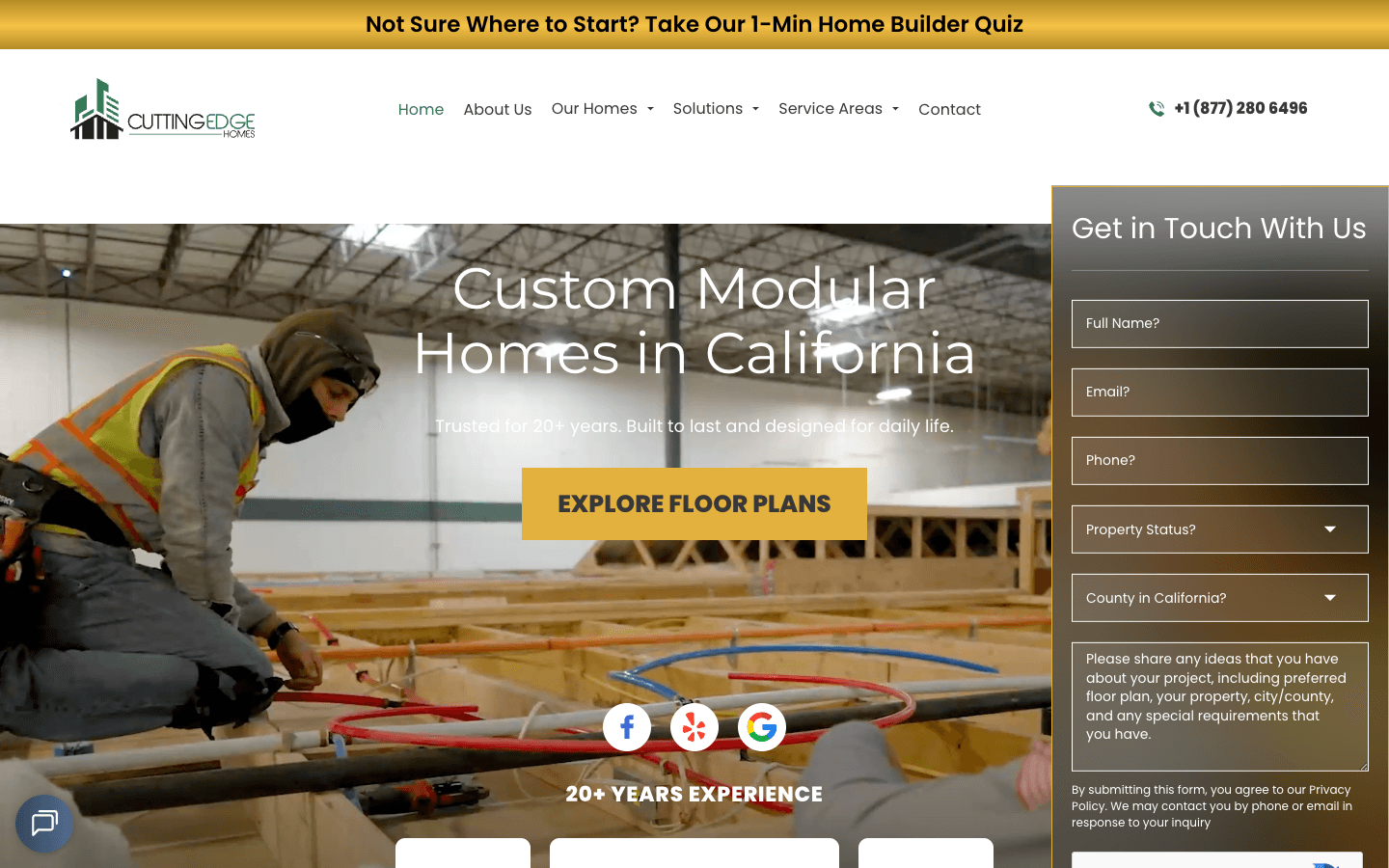
Google Ads — questions we hear
How much should a construction company spend on Google Ads?
Enough to buy meaningful data in your market — and that number comes from keyword and market research, not a rule of thumb. Search volume in your verticals, your geography, and your contract values determine it. We size the media budget from data before a dollar is spent, tell you honestly what it takes, and won’t run a budget too small to learn from. Management is scoped alongside it, on the call.
Do Google Ads work for commercial contractors, or just home services?
They work for commercial firms, but the playbook is completely different from home services. Search volumes are lower, click prices higher, and each click carries potential contract value that changes the math: one signed project can repay years of spend. Success requires tight vertical targeting, aggressive negative keywords to filter residential and job-seeker noise, and landing pages that speak to owners. Run a home-services playbook on commercial keywords and you’ll conclude ads don’t work.
Google Ads vs LinkedIn ads for construction: which is better?
Google Ads capture existing demand; LinkedIn ads interrupt people who weren’t searching. For most contractors, Google wins first because the buyer typed their intent: someone searching for a design-build industrial contractor is telling you what they need. LinkedIn can support brand and pursuit campaigns in tight vertical audiences, but it’s a slower, softer channel. Capture the demand that already exists before paying to create demand from scratch.
Why did our last Google Ads campaign fail?
Almost always one of three reasons: broad keywords that bought job seekers and DIY traffic, clicks sent to a homepage instead of a purpose-built landing page, or leads that sat unanswered while they went cold. Occasionally the market genuinely lacks search volume, but that’s rarer than agencies’ excuses suggest. The channel usually wasn’t the problem; the structure around it was. An account audit shows which failure you paid for.
How quickly do Google Ads generate construction leads?
Traffic starts within days of launch; a stable flow of qualified leads typically takes four to eight weeks of optimization as search-term data accumulates and weak keywords get cut. Expect the first month to include tuition: paying to learn which searches in your market carry real intent. That’s normal and temporary. What shouldn’t be normal is a campaign that still can’t name its cost per qualified lead after a quarter.
What’s a good cost per lead for construction Google Ads?
There’s no universal number, and anyone quoting one without knowing your vertical is guessing. Cost per lead varies enormously between, say, commercial roofing and data center general contracting, because click prices and competition differ by market. The better question is cost per qualified opportunity against contract value: paying hundreds per lead is excellent economics when a signed project carries seven or eight figures. We benchmark against your numbers, not industry folklore.
Related
Data Center Construction
BoxBuild positions data center contractors for hyperscale and colo procurement — trust, vertical content, and conversion built around how owners vet builders.
Learn morePower & Energy Infrastructure
BoxBuild builds growth systems for power and energy contractors — positioning and conversion designed for utility, developer, and EPC procurement teams.
Learn moreIndustrial & Manufacturing
BoxBuild positions industrial and manufacturing builders for reshoring-era capital projects — sector-fluent content, trust signals, and conversion systems.
Learn moreHealthcare Construction
BoxBuild builds growth systems for healthcare contractors — compliance-first positioning and conversion for hospital systems and medical facility owners.
Learn moreCommercial General Contractors
BoxBuild helps commercial GCs differentiate — positioning, proof, and follow-up systems that improve bid-hit ratios in the most crowded market in construction.
Learn moreModular Construction
BoxBuild markets modular construction companies — education-first positioning, buyer-doubt content, and follow-up systems built for the volumetric sale.
Learn morePrefab Construction
BoxBuild markets prefab construction companies — capturing method-stage research, answering buyer doubts, and converting curiosity into contracts.
Learn morePanelized Construction
BoxBuild markets panelized construction firms — positioning speed, precision, and labor savings for the builders and owners who specify panels.
Learn moreContainer Construction
BoxBuild markets container construction companies — legitimacy-first positioning that converts container curiosity into qualified, financeable projects.
Learn moreADU Builders
BoxBuild markets ADU builders — local visibility, cost and permit education, and follow-up systems tuned to how homeowners buy backyard units.
Learn moreCustom Home Builders
BoxBuild markets custom home builders — portfolio-first trust, process transparency, and follow-up systems built for a seven-figure homeowner decision.
Learn moreRemodeling & Design-Build
BoxBuild markets remodeling and design-build firms — trust-first positioning and follow-up systems for a $518B market where homeowner anxiety decides.
Learn moreSpecialty Trades
BoxBuild markets specialty trade contractors — roofing, concrete, electrical, plumbing, HVAC, excavation — for GC bid lists and direct work alike.
Learn moreConstruction Suppliers
BoxBuild markets construction suppliers and building-product manufacturers — spec-ready content, specifier education, and lead systems that protect the spec.
Learn moreArchitects & Designers
BoxBuild markets architecture and design firms — visible authority, niche positioning, and referral-ready presence for a market where billings are soft.
Learn moreTalk to the team that speaks your vertical.
A 30-minute strategy call. We’ll map where trust, conversion, or follow-up is costing you work in your vertical.