
Every project manager knows that outdated manual processes can slow down even the most skilled modular construction teams. As demand for faster timelines and improved quality grows across American, Canadian, and European markets, the need for smarter solutions becomes clear. By embracing smart construction technology, builders gain new levels of efficiency, safety, and real-time oversight—transforming traditional workflows into interconnected, data-driven systems that set new industry standards.
Table of Contents
- Defining Smart Construction Technology Today
- Major Types: IoT, Robotics, And AI Systems
- Key Features, Tools, And Integrated Processes
- Real-World Uses In Modular And Prefab Projects
- Risks, Costs, And Common Pitfalls To Avoid
Key Takeaways
| Point | Details |
|---|---|
| Smart Construction Technology Integration | Successful implementation requires a holistic approach that connects people, processes, and technology for optimized workflows. |
| Importance of Pilot Projects | Start small with phased rollouts of smart technologies to demonstrate ROI and facilitate workforce adaptation. |
| Risk Management Strategies | Address financial and operational challenges through comprehensive risk assessment and mitigation strategies, particularly for logistics and technology interoperability. |
| Continuous Training and Development | Invest in ongoing training programs to ensure teams effectively leverage new technologies and adapt to evolving construction methodologies. |
Defining Smart Construction Technology Today
Smart construction technology represents a profound digital transformation of traditional building processes, integrating advanced technological systems to reimagine how infrastructure gets designed, constructed, and managed. At its core, this technological revolution combines cutting-edge digital tools to enhance productivity, operational efficiency, and safety across construction lifecycles.
The fundamental components of smart construction technology include:
- Building Information Modeling (BIM) for comprehensive digital project visualization
- Internet of Things (IoT) sensors for real-time performance monitoring
- Robotics for precise and automated construction tasks
- Artificial Intelligence for predictive analytics and decision-making
Modern construction is moving beyond mere technological implementation toward integrated digital transformation strategies, which emphasize holistic approaches that connect people, processes, and technology. These advanced systems are not just about introducing new tools, but fundamentally redesigning how construction projects are conceived, executed, and maintained.
The global construction sector is experiencing a significant shift towards more intelligent, data-driven practices. By leveraging interconnected digital technologies, companies can achieve unprecedented levels of precision, safety, and efficiency. Smart construction goes beyond traditional methods, creating infrastructure that is not just built, but intelligently designed and managed.
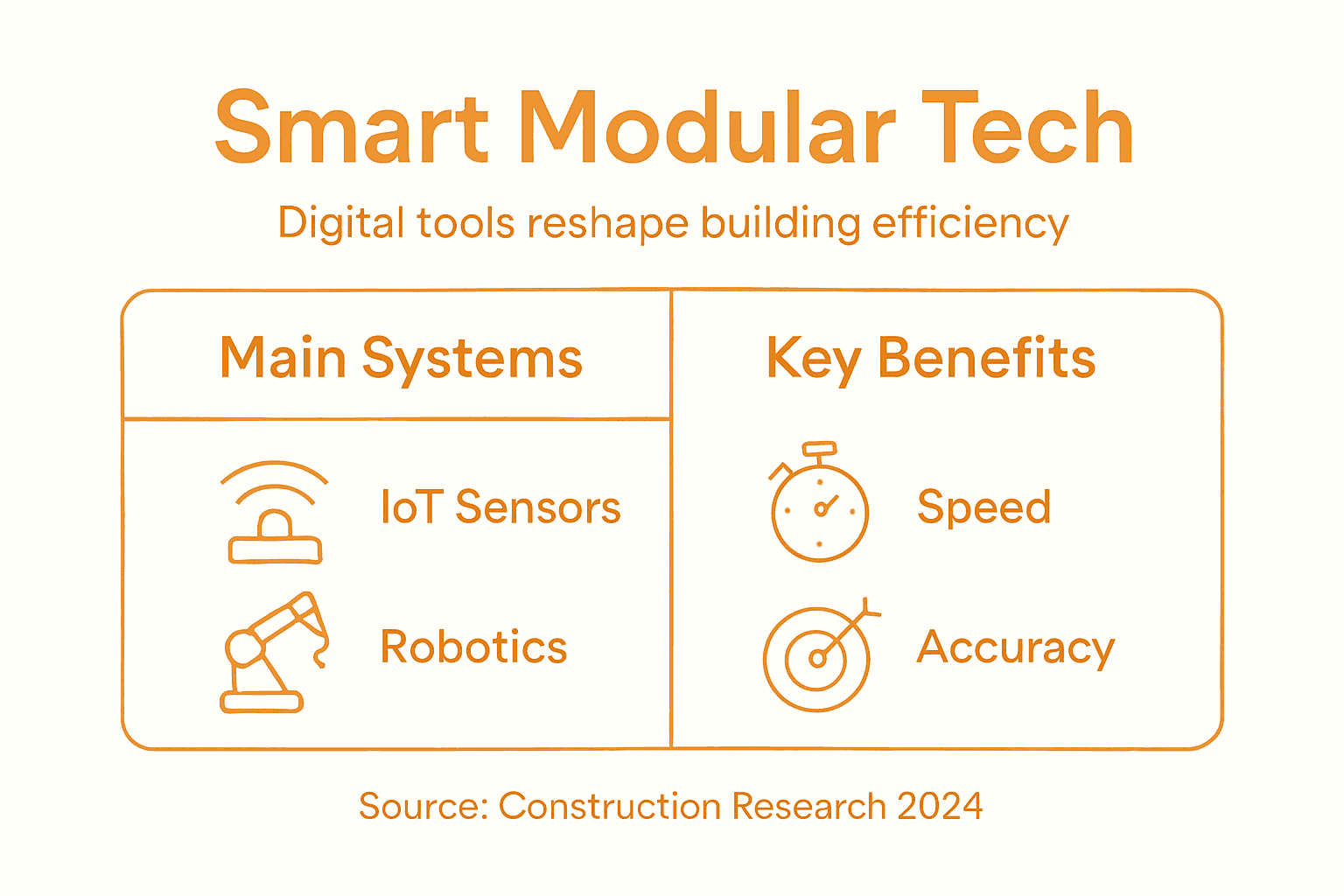
Pro tip: Start small by implementing one smart technology system at a time, focusing on areas with the most immediate potential for improvement in your current construction workflow.
Major Types: IoT, Robotics, and AI Systems
Smart construction technologies are revolutionizing the building industry through three transformative systems: Internet of Things (IoT), Robotics, and Artificial Intelligence (AI). These interconnected technological platforms are fundamentally reshaping how construction projects are designed, executed, and managed across global markets.
The Internet of Things (IoT) plays a critical role in modern construction by enabling real-time monitoring and automation capabilities. Key IoT applications include:
- Wireless sensor networks for environmental monitoring
- Equipment performance tracking
- Predictive maintenance systems
- Safety compliance management
- Real-time resource optimization
Robotics represents another breakthrough technology transforming construction workflows. Advanced robotic systems provide unprecedented capabilities in handling complex tasks, addressing labor shortages, and improving workplace safety. These technologies range from autonomous navigation systems to human-robot collaborative platforms that can perform precise, repetitive, or dangerous construction activities.

Artificial Intelligence (AI) serves as the intelligent backbone connecting IoT and robotic systems, enabling predictive analytics, intelligent decision-making, and adaptive control mechanisms. By processing vast amounts of construction data, AI helps project managers optimize resource allocation, predict potential risks, and enhance overall project efficiency.
Pro tip: Develop a phased implementation strategy for integrating smart technologies, starting with pilot projects that demonstrate clear return on investment and scalability.
Here’s a quick comparison of major smart construction technology systems and their impact on business outcomes:
| Technology System | Core Benefit | Example Application | Business Impact |
|---|---|---|---|
| IoT Sensors | Real-time data capture | Equipment monitoring | Enhanced operational efficiency |
| Robotics | Automated precision | Automated bricklaying | Faster project completion |
| Artificial Intelligence | Predictive analytics | Risk forecasting | Improved decision-making |
Key Features, Tools, and Integrated Processes
Smart construction technologies are revolutionizing modular building through sophisticated features and integrated processes that fundamentally transform traditional construction methodologies. Prefabricated component manufacturing and digital coordination represent the core innovations driving this technological transformation.
Key features of smart construction include:
- Precision off-site manufacturing in controlled environments
- Digital collaboration platforms
- Real-time performance monitoring systems
- Advanced visualization and simulation tools
- Predictive maintenance and risk assessment capabilities
- Automated quality control mechanisms
The integrated processes span the entire project lifecycle, connecting design, manufacturing, logistics, and on-site assembly through seamless technological platforms. Digital tools enable unprecedented levels of coordination, allowing project managers to track every aspect of construction with remarkable precision and efficiency.
Complex technological ecosystems now support modular construction by integrating multiple sophisticated tools. Drone surveillance, sensor networks, AI-powered analytics, and robotic assistance work together to optimize resource allocation, minimize waste, and dramatically reduce construction timelines. These interconnected systems transform traditional construction from a fragmented process into a synchronized, data-driven workflow.
Pro tip: Invest in comprehensive training programs that help your team understand and effectively leverage smart construction technologies across different project stages.
Real-World Uses in Modular and Prefab Projects
Modular construction is experiencing a technological revolution driven by innovative digital solutions that transform traditional building practices. Digital technologies like BIM and IoT are increasingly applied to address complex construction challenges and create more efficient, sustainable infrastructure projects worldwide.
Real-world applications of smart construction technologies span multiple critical domains:
- Healthcare facility rapid deployment
- Educational infrastructure development
- Emergency housing and disaster relief construction
- Commercial and residential complex building
- Sustainable urban development projects
- Remote workplace and infrastructure expansion
Advanced technologies such as blockchain, digital twins, generative design, virtual reality, and robotic systems are now actively integrated throughout the modular construction lifecycle. These innovations enable unprecedented levels of project management precision, allowing teams to optimize resource allocation, minimize waste, and dramatically reduce construction timelines.
Each technological intervention brings unique capabilities to modular construction. Robotic arms enable precise manufacturing, AI-powered analytics predict potential design challenges, and blockchain technologies ensure transparent, secure documentation throughout the entire project development process. By leveraging these interconnected systems, construction teams can transform traditional building methodologies into sophisticated, data-driven workflows.
Pro tip: Develop cross-functional teams with both technological and construction expertise to effectively implement and leverage smart construction technologies across project stages.
Risks, Costs, and Common Pitfalls to Avoid
Modular construction technologies present complex financial and operational challenges that require strategic planning and risk mitigation. High initial capital investments and technology adoption challenges can significantly impact project success and overall implementation effectiveness.
Critical risks in smart construction technology include:
- Substantial upfront technology investment costs
- Potential module damage during transportation
- Supply chain coordination complexities
- Technological interoperability issues
- Design inflexibility and scalability challenges
- Insurance and liability considerations
Transportation and logistics represent particularly vulnerable aspects of modular construction. Modules can experience structural damage, weather-related deterioration, or alignment issues that compromise project timelines and budgets. Comprehensive risk management strategies must account for potential transportation-related disruptions and include robust contingency planning.
Technological resistance within organizations can also derail smart construction implementations. Successful adoption requires not just financial investment, but comprehensive change management approaches that address workforce training, cultural adaptation, and systematic technology integration across existing workflows.
The following table summarizes common risks in smart modular construction and effective mitigation strategies:
| Risk Category | Typical Challenge | Mitigation Strategy |
|---|---|---|
| Investment Cost | High upfront expense | Pilot projects & phased rollout |
| Transportation | Module damage en route | Enhanced packaging & insurance |
| Tech Interoperability | Systems compatibility | Use standardized digital platforms |
| Workforce Adaptation | Change resistance | Ongoing training & support |
Pro tip: Conduct thorough pilot testing and develop comprehensive risk assessment protocols before full-scale implementation of smart construction technologies.
Unlock the Full Potential of Smart Construction Technology Today
Integrating smart construction technology into your modular building projects comes with challenges like technology adoption, workforce training, and precise digital coordination. If you want to overcome these obstacles while generating more qualified leads and closing high-value projects, strategic digital marketing tailored for the off-site construction industry is critical. Combining AI-driven solutions, data-driven funnels, and targeted Social Media strategies can position your company as an industry leader.

Accelerate your modular construction growth by partnering with the experts at BoxBuild Agency. Discover how our AI powered marketing and customized Funnels help you navigate industry complexities and achieve measurable results. Take the next step now to transform your digital presence and build smarter with us.
Frequently Asked Questions
What is smart construction technology?
Smart construction technology refers to the digital transformation of traditional building processes, utilizing advanced technologies like IoT, robotics, and AI to enhance productivity, efficiency, and safety throughout the construction lifecycle.
How does Building Information Modeling (BIM) enhance modular construction?
BIM provides comprehensive digital visualization of projects, allowing for better planning, collaboration, and coordination among all stakeholders, which ultimately leads to improved project outcomes and reduced errors.
What are the main benefits of using robotics in construction?
Robotics in construction can automate precise and repetitive tasks, address labor shortages, and improve workplace safety by performing dangerous activities, which enhances overall project efficiency and reduces completion times.
What risks and challenges are associated with smart construction technologies?
Key risks include high initial investment costs, potential transportation damages to modular units, interoperability issues among technologies, and resistance to change within the workforce. Effective risk management strategies are essential for successful implementation.
Recommended
- Sustainable Modular Construction: Transforming Eco-Building – BoxBuild
- Digital Transformation in Construction – Why It Matters – BoxBuild
- Automation in Construction: Boosting Modular Efficiency – BoxBuild
- Modular vs Traditional Building: Project Efficiency and Cost – BoxBuild
- Protective Coating Trends 2025: Innovations for Infrastructure