Choosing between modular and traditional building methods can shape the speed, budget, and quality of your next project. For many North American project managers, understanding the difference between assembling prefabricated modules in a factory setting and managing sequential on-site construction means better control over costly delays and unpredictable labor demands. This article will break down the unique workflows and benefits of each method, highlighting how modular construction’s factory-controlled process can deliver repeatable quality and greater efficiency for modern building needs.
Table of Contents
- Defining Modular And Traditional Building Methods
- Key Types And Variations In Construction Approaches
- How Modular Construction Works Step By Step
- Comparing Speed, Cost, And Quality Outcomes
- Project Risk, Compliance, And Common Pitfalls
- Real-World Applications In North America
Key Takeaways
| Point | Details |
|---|---|
| Modular Construction Advantages | Modular construction allows for faster project timelines, cost efficiency, and consistent quality due to factory-controlled conditions. |
| Types of Modular Approaches | Key types include volumetric modular, panelized construction, and container-based methods, each catering to specific needs. |
| Project Risks and Compliance | Unique risks associated with modular construction include transportation complexities and regulatory challenges that require careful planning to mitigate. |
| Real-World Applications | Diverse sectors such as housing, healthcare, and education increasingly adopt modular methods for their flexibility and efficiency in meeting market demands. |
Defining Modular And Traditional Building Methods
Modular and traditional building methods represent two fundamentally different approaches to construction, each with unique characteristics and workflow dynamics. Modular construction involves prefabricating building components in a controlled factory environment before transporting and assembling them on-site, while traditional construction involves sequential building processes directly at the project location.
According to systematic research on construction methodologies, modular construction is defined as a system involving prefabricated, volumetric modules produced under factory-controlled conditions. This approach contrasts sharply with traditional methods where construction occurs sequentially and primarily on-site.
Key differences between these methods include:
-
Production Environment
- Modular: Factory-controlled setting with standardized processes
- Traditional: Open construction site with variable conditions
-
Construction Timeline
- Modular: Shorter overall project duration
- Traditional: Longer, more sequential building process
-
Quality Control
- Modular: Consistent quality through controlled manufacturing
- Traditional: Quality dependent on on-site workers and conditions
The comparative analysis between modular and traditional construction technologies highlights several critical distinctions. Modular construction offers advantages like reduced construction time, higher work quality, and improved safety standards compared to traditional building methods.
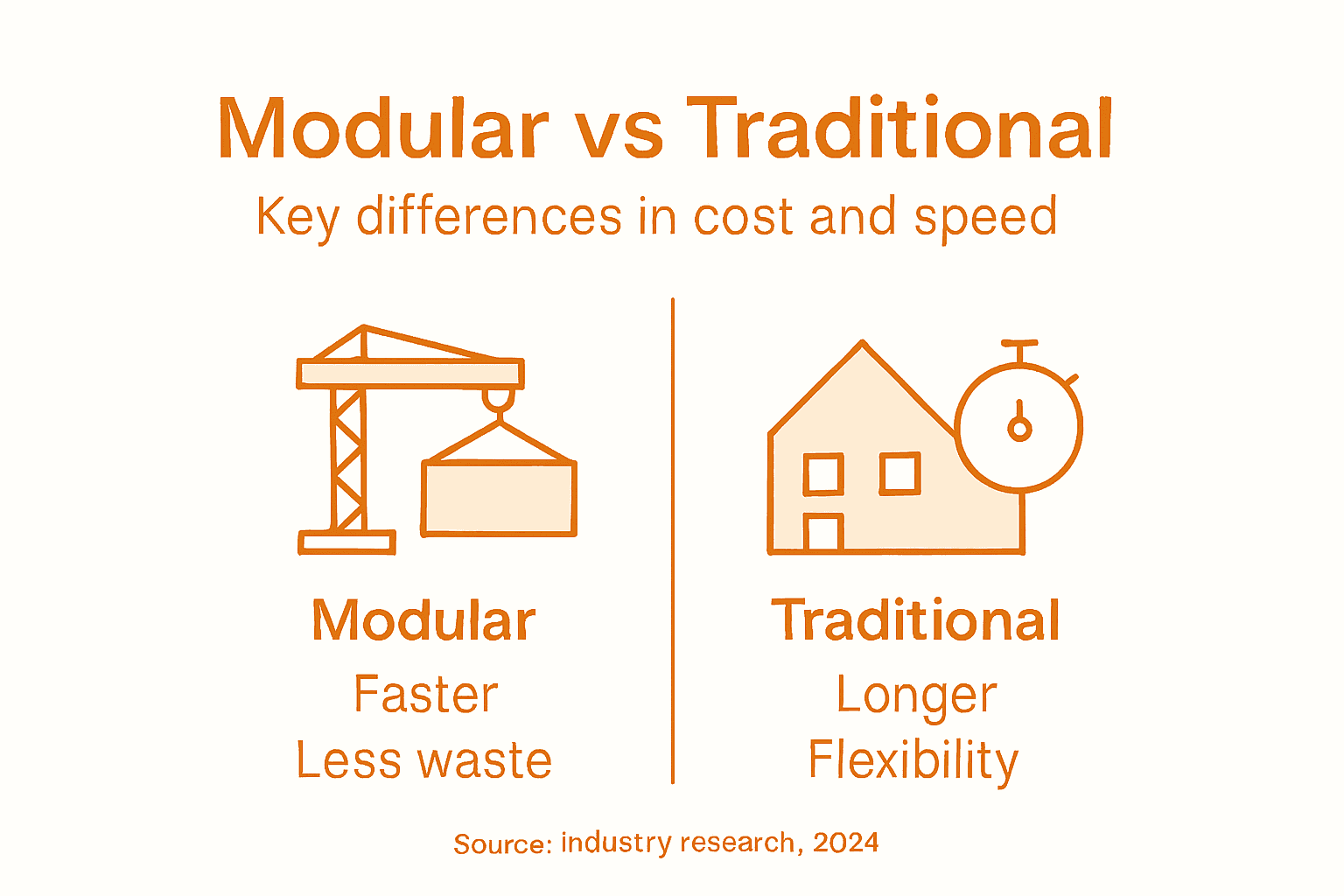
Here is a concise comparison of modular and traditional building methods across key business factors:
| Category | Modular Construction | Traditional Construction |
|---|---|---|
| Speed | Fast project timelines | Longer, sequential build phases |
| Workforce Needs | Smaller, specialized teams | Larger, general labor force |
| Weather Impact | Minimal weather delays | High exposure to weather |
| Budget Predictability | Fixed costs, fewer surprises | More variable and less predictable |
| Scalability | Easily replicable processes | More customization, less scalable |
Pro tip: When selecting a construction method, carefully evaluate your project’s specific requirements, timeline constraints, and budget to determine whether modular or traditional approaches best suit your needs.
Key Types And Variations In Construction Approaches
Modular construction encompasses a diverse range of approaches, each tailored to specific project requirements and architectural goals. Architectural modular construction strategies reveal a complex landscape of techniques that have evolved significantly with technological advancements and changing industry demands.
The primary variations in construction approaches can be categorized into several key types:
-
Volumetric Modular Construction
- Complete 3D modules manufactured off-site
- Entire room or building sections created in factory
- Ideal for residential and commercial spaces
-
Panelized Construction
- Flat panels manufactured in controlled environments
- Lightweight wall, floor, and roof components
- More flexible assembly compared to volumetric modules
-
Hybrid Modular Systems
- Combination of off-site and on-site construction techniques
- Leverages benefits of both modular and traditional methods
- Allows for greater design customization
Container-Based Construction represents another innovative approach, repurposing shipping containers into functional living or working spaces. This method has gained popularity in urban environments where space and cost efficiency are paramount.
UK housing modular approaches highlight how different construction techniques address unique market demands, demonstrating the adaptability of modern building strategies. Economic factors, labor availability, and project-specific requirements significantly influence the selection of construction methods.
Modular construction techniques continue to evolve, driven by technological innovation, sustainability goals, and the need for more efficient building processes.
Pro tip: Carefully assess your project’s specific requirements, site constraints, and budget to select the most appropriate modular construction approach that balances cost, speed, and design flexibility.
How Modular Construction Works Step By Step
Modular construction follows a systematic process that fundamentally differs from traditional building methods. Modular construction involves precise fabrication steps designed to maximize efficiency and quality control throughout the entire building process.
The comprehensive workflow typically includes the following key stages:
-
Design and Engineering
- Collaborative architectural planning
- Detailed 3D modeling and digital design
- Precision engineering for module specifications
-
Factory Fabrication
- Manufacturing building modules in controlled environment
- Quality control at each production stage
- Standardized construction techniques
-
Site Preparation
- Concurrent foundation and infrastructure development
- Precise ground leveling and utility connections
- Preparing installation area for module placement
-
Transportation and Logistics
- Specialized transportation of prefabricated modules
- Careful packaging and securing of components
- Efficient routing to minimize transportation costs
-
On-Site Assembly
- Rapid module placement using heavy equipment
- Precise connection and integration of modules
- Minimal on-site construction time
-
Finishing and Commissioning
- Interior and exterior final touches
- Systems integration and testing
- Final quality assurance inspections
Modular construction transforms traditional building processes by parallelizing design, fabrication, and site preparation, dramatically reducing overall project timelines.
The role of technology is critical in this process, with advanced software and precision manufacturing techniques enabling unprecedented levels of efficiency and quality control.
Pro tip: Invest in comprehensive upfront design and coordination to maximize the efficiency gains potential in modular construction approaches.
Comparing Speed, Cost, And Quality Outcomes
Modular construction offers significant advantages in project performance across speed, cost, and quality metrics. Comprehensive modular construction research demonstrates remarkable improvements over traditional building methods, with potential efficiency gains that transform project delivery.
Key comparative outcomes highlight the modular approach’s strengths:
-
Speed Performance
- Up to 50% faster project completion
- Parallel site preparation and module fabrication
- Reduced weather-related construction delays
-
Cost Efficiency
- Potential cost reductions of 22-25%
- Minimized labor expenses
- Reduced material waste
- Predictable budget controls
-
Quality Assurance
- Controlled factory production environment
- Consistent manufacturing standards
- Enhanced precision and repeatability
- Improved structural integrity
Bibliometric analysis of construction methods reveals that modular approaches can complete up to 80-95% of building construction off-site, dramatically reducing on-site complexity and potential error sources.
Modular construction represents a paradigm shift in building technology, offering unprecedented levels of efficiency, predictability, and performance.
The economic implications extend beyond immediate project costs. Reduced construction timelines translate to earlier project occupancy, lower financing expenses, and improved return on investment for developers and property owners.
Pro tip: Conduct a comprehensive cost-benefit analysis that considers total project lifecycle expenses, not just initial construction costs, when evaluating modular versus traditional building approaches.
Project Risk, Compliance, And Common Pitfalls
Modular construction introduces a unique set of risks and compliance challenges that differ significantly from traditional building approaches. Comparative construction risk analysis reveals critical considerations project managers must carefully navigate.
Key risk categories and potential pitfalls include:
-
Transportation and Logistics Risks
- Module transportation complexity
- Potential damage during transit
- Specialized equipment requirements
- Increased transportation cost variability
-
Regulatory Compliance Challenges
- Meeting local building codes
- Navigating diverse regional standards
- Ensuring structural integrity certifications
- Complex permitting processes
-
Design and Adaptation Limitations
- Restricted architectural flexibility
- Potential standardization constraints
- Module size and configuration restrictions
- Limited customization options
Engineering analysis of construction methods underscores the critical importance of upfront planning to mitigate potential risks associated with modular approaches.
Successful modular construction requires comprehensive risk management strategies that anticipate and address potential challenges before they impact project timelines and budgets.
The financial implications of these risks can be substantial. Upfront capital investments, potential transportation complications, and stringent compliance requirements demand meticulous planning and expert coordination.
Pro tip: Develop a comprehensive risk mitigation strategy that includes detailed contingency planning, thorough vendor vetting, and proactive compliance management to minimize potential modular construction challenges.
Real-World Applications In North America
Modular construction has emerged as a transformative approach across diverse sectors in North America. Modular construction applications demonstrate remarkable versatility in addressing complex building challenges across multiple industries.
Key sectors leveraging modular construction techniques include:
-
Multi-Family Housing
- Affordable apartment complexes
- Student dormitory developments
- Urban residential projects
- Rapid housing solutions
-
Healthcare Facilities
- Hospital expansion projects
- Medical clinic construction
- Temporary treatment centers
- Specialized medical units
-
Educational Infrastructure
- University classroom buildings
- Campus housing facilities
- Research laboratory complexes
- Specialized academic spaces
-
Hospitality Sector
- Hotel room construction
- Resort development
- Extended stay facilities
- Rapid hospitality infrastructure
Modular construction provides North American industries with unprecedented flexibility, enabling faster project delivery and more efficient resource utilization.
The approach addresses critical challenges such as labor shortages, supply chain disruptions, and increasing demand for rapid, high-quality construction solutions. By standardizing production and minimizing on-site complexities, modular methods offer a strategic advantage in competitive building markets.
This table summarizes typical modular construction applications and their unique benefits in North America:
| Sector | Typical Projects | Key Benefits |
|---|---|---|
| Multi-Family Housing | Apartments, dormitories | Rapid deployment, cost savings |
| Healthcare | Hospitals, clinics | Faster expansion, infection control |
| Education | Schools, labs | Quick build, minimal disruption |
| Hospitality | Hotels, resorts | Fast launch, high quality finish |
Pro tip: Conduct thorough site-specific feasibility studies to determine optimal modular construction strategies tailored to your project’s unique requirements and regional constraints.
Boost Your Modular Construction Growth With Strategic Digital Marketing
Navigating the challenges of modular versus traditional building demands more than just efficient project execution. You need a marketing partner who understands the unique pain points in lead generation, sales cycles, and market positioning for off-site construction businesses. If accelerating project timelines and maximizing cost efficiency are your goals, it is equally critical to drive qualified leads that match your innovative construction approach. At BoxBuild Agency, we specialize in helping modular, prefab, and container-based builders overcome these hurdles through precise digital strategies focused on your industry’s nuances.
Unlock powerful growth by leveraging customized Funnels – BoxBuild designed for modular construction projects. Visualize how our data-driven Google Ads – BoxBuild campaigns and cutting-edge AI – BoxBuild solutions fuel lead quality and high-value project acquisitions.
Ready to transform your modular construction marketing approach for faster, cost-effective project wins Discover how our expertise can position you as a market leader and deliver consistent growth. Visit BoxBuild Agency to learn more and start attracting your ideal clients today.
Frequently Asked Questions
What are the main differences between modular and traditional building methods?
Modular construction involves prefabricating components in a controlled factory setting, leading to shorter timelines and consistent quality. Traditional construction, on the other hand, takes place directly on-site, often resulting in longer completion times and variable quality due to environmental factors.
How does modular construction impact project timelines compared to traditional methods?
Modular construction can reduce project timelines by up to 50% due to parallel processes for site preparation and module fabrication. Traditional methods follow a sequential building process, which can extend project durations significantly.
What are the cost benefits of using modular construction over traditional building methods?
Modular construction can lead to cost reductions of 22-25%, primarily due to minimized labor expenses, reduced material waste, and predictable budget controls. This contrasts with traditional methods, which often involve more variable and unpredictable costs.
What quality assurance measures are in place for modular construction?
Quality assurance in modular construction is achieved through controlled factory production environments, consistent manufacturing standards, and enhanced precision in module fabrication. This results in improved structural integrity and fewer on-site complications.
Recommended
- Sustainable Modular Construction: Transforming Eco-Building – BoxBuild
- 7 Essential Types of Modular Construction for Builders – BoxBuild
- Hybrid Construction: Boosting Efficiency in Modular Builds – BoxBuild
- 7 Key Modular Home Advantages for Lead Generation Success – BoxBuild
- Understanding the Benefits of a House with Insulation – WorkWearComfort
- Marble Flooring Cost Per Sq Ft Guide 2025