Finding qualified leads in the modular construction sector feels tougher as buyers tune out traditional sales noise and turn to online research. As a marketing director, you know that attracting decision-makers starts long before pricing talks or project specs come up. Inbound marketing in off-site construction means pulling in prospects by proving your expertise with educational, value-driven content—well before a sales conversation begins. This approach lets your content become the sales team’s best resource, capturing interest and trust from global clients actively looking for solutions.
Table of Contents
- Defining Inbound Marketing in Off-Site Construction
- Key Inbound Tactics for Modular Builders
- How Inbound Differs from Outbound Marketing
- Lead Nurturing and Automation Best Practices
- Measuring Success and Avoiding Common Pitfalls
Key Takeaways
| Point | Details |
|---|---|
| Inbound Marketing Attracts Qualified Leads | Focus on providing valuable content that addresses potential clients’ challenges to engage them before any sales conversation. |
| Credibility Through Education | Build trust by offering informational resources rather than direct sales pitches, positioning your firm as an expert in modular construction. |
| Optimize Content for Search | Invest in SEO to ensure your valuable content is easily discoverable by prospects actively searching for modular construction solutions. |
| Continuous Measurement and Adaptation | Track key performance indicators like lead quality and customer acquisition cost to adjust strategies for better results over time. |
Defining Inbound Marketing in Off-Site Construction
Inbound marketing for off-site construction firms operates differently than traditional sales and marketing approaches. Rather than pushing your services onto potential clients through cold calls and aggressive sales tactics, inbound marketing pulls qualified leads to your company by providing valuable, educational content that addresses their real challenges. In the context of off-site construction, this means creating and sharing resources that help prospects understand the economic, quality, environmental, and social benefits your manufacturing process delivers. Think of it as positioning your firm as the trusted authority on modular and prefab construction solutions before any conversation about pricing or timelines ever happens.
The foundation of this approach stems from how off-site construction integrates factory manufacturing with precision design in a controlled environment. When a prospective general contractor or developer lands on your website searching for answers about construction timelines, quality consistency, or cost predictability, your content should already address those questions. Inbound marketing in off-site construction specifically focuses on stakeholder engagement through informative, trustworthy content that highlights the reliability, efficiency, and innovation your firm brings to projects. This shift matters because your buyers are already online researching solutions before they ever contact you. You are not convincing them that off-site construction exists; you are proving that your firm executes it better than competitors.
What makes inbound marketing distinct from outbound tactics is the emphasis on building credibility through education rather than claims. A potential client exploring whether modular construction fits their project timeline will find your detailed case study, technical specification guide, or comparison article far more persuasive than a sales email. The content itself becomes your sales representative, working around the clock to establish trust and demonstrate capability. Your blog posts, whitepapers, video walkthroughs of your manufacturing process, and success stories serve as magnets that attract leads who are already qualified because they arrived with genuine questions and an interest in learning. These prospects convert at higher rates because they come to you already convinced of the value; your team simply needs to guide them through the specific project fit.
For off-site construction firms specifically, inbound marketing also addresses a unique challenge in your industry. Many decision-makers remain skeptical or unfamiliar with factory-based manufacturing methods. They might worry about quality control, shipping logistics, on-site assembly complexity, or regulatory compliance. By creating content that directly addresses these concerns, you establish your firm as transparent, knowledgeable, and customer-focused. You are not just selling modular buildings; you are educating the market about why this approach solves problems that traditional construction creates. A prospect who understands your manufacturing controls, supply chain coordination, and on-site assembly process before engaging your sales team becomes a much warmer lead with realistic expectations and genuine interest.
The strategic difference also shows in how you allocate marketing resources. Rather than spending heavily on broad advertising campaigns hoping to reach someone interested in construction, content strategy for off-site builders allows you to invest in creating resources that attract and nurture leads over time. A well-optimized article that ranks in search results delivers value for months or years, continuously pulling new prospects into your sales funnel. Outbound advertising stops working the moment you stop paying for it; inbound assets continue working indefinitely.
Pro tip: Start mapping the questions your sales team hears most from prospects during initial calls, then create content addressing each one. This directly connects your inbound strategy to real market demand and ensures your content resonates with buyers in your target audience.
Key Inbound Tactics for Modular Builders
Successful inbound marketing for modular builders relies on a specific set of tactics that work together to attract, engage, and convert qualified leads. Rather than relying on a single approach, the most effective strategy combines multiple channels that reinforce each other and create multiple touchpoints with your target audience. The foundation of these tactics centers on creating value-driven content marketing that demonstrates the real advantages of modular construction to decision-makers actively searching for solutions. Your goal is to position your firm as the trusted resource that answers their questions, addresses their concerns, and proves your expertise before any sales conversation even begins.
Start with strategic blog content that targets the specific search queries your prospects are actually typing into Google. A general contractor searching for “modular construction timelines” or “prefab building cost savings” should find your detailed, authoritative articles ranking prominently in results. These blog posts should go beyond surface-level explanations and provide actionable insights, data comparisons, and real-world examples that demonstrate your deep understanding of both the modular process and your clients’ business challenges. Pair this written content with video walkthroughs of your manufacturing facility, time-lapse assembly sequences, and client testimonials that bring your capabilities to life. Videos significantly outperform text-only content for engagement and sharing, making them essential for capturing attention in crowded social feeds. Case studies deserve special emphasis here; a detailed breakdown of how your firm solved a complex project challenge, including project timeline, budget performance, and outcomes, becomes incredibly persuasive evidence of your ability to deliver results.

Social media engagement forms the second pillar of your inbound tactic arsenal. Rather than broadcasting sales messages, use platforms like LinkedIn to share industry insights, project updates, manufacturing process details, and thought leadership content that keeps your firm visible and builds credibility within your network. LinkedIn particularly works well for modular builders because your audience is already there discussing projects, challenges, and industry trends. When you respond thoughtfully to comments, share others’ relevant content, and participate in construction industry conversations, you establish your team as knowledgeable and approachable. This creates opportunities for prospects to reach out organically rather than you having to chase them down. The key distinction is participation versus promotion; you are contributing valuable perspectives to conversations your audience already cares about.
Search engine optimization underpins all of these tactics by ensuring your content actually reaches the people searching for modular construction solutions. Optimizing your blog posts, video descriptions, and website pages for the keywords your prospects use makes your inbound engine run continuously. Beyond keyword optimization, SEO involves ensuring your website loads quickly, works perfectly on mobile devices, and provides clear navigation that guides visitors toward taking action. When your inbound marketing approach includes proper SEO fundamentals, your content works harder for longer, continuously attracting new leads months or years after publication. This compounds over time; your top-performing articles become permanent lead-generation assets that require minimal ongoing investment.
Do not overlook email nurturing as part of your inbound ecosystem. When a prospect downloads your guide to modular construction benefits or subscribes to your blog, they enter an automated email sequence that delivers additional valuable content over time. These emails should educate, not sell; they should address common questions, share success stories, and provide resources that keep your firm top-of-mind without being intrusive. A prospect who receives your educational emails over several weeks becomes increasingly convinced of your expertise and reliability before your sales team ever reaches out directly.
Pro tip: Track which content pieces generate the most leads and conversions, then create more content around those high-performing topics and keywords. This data-driven approach ensures your inbound efforts focus on what actually works for your specific market rather than generic tactics.
How Inbound Differs from Outbound Marketing
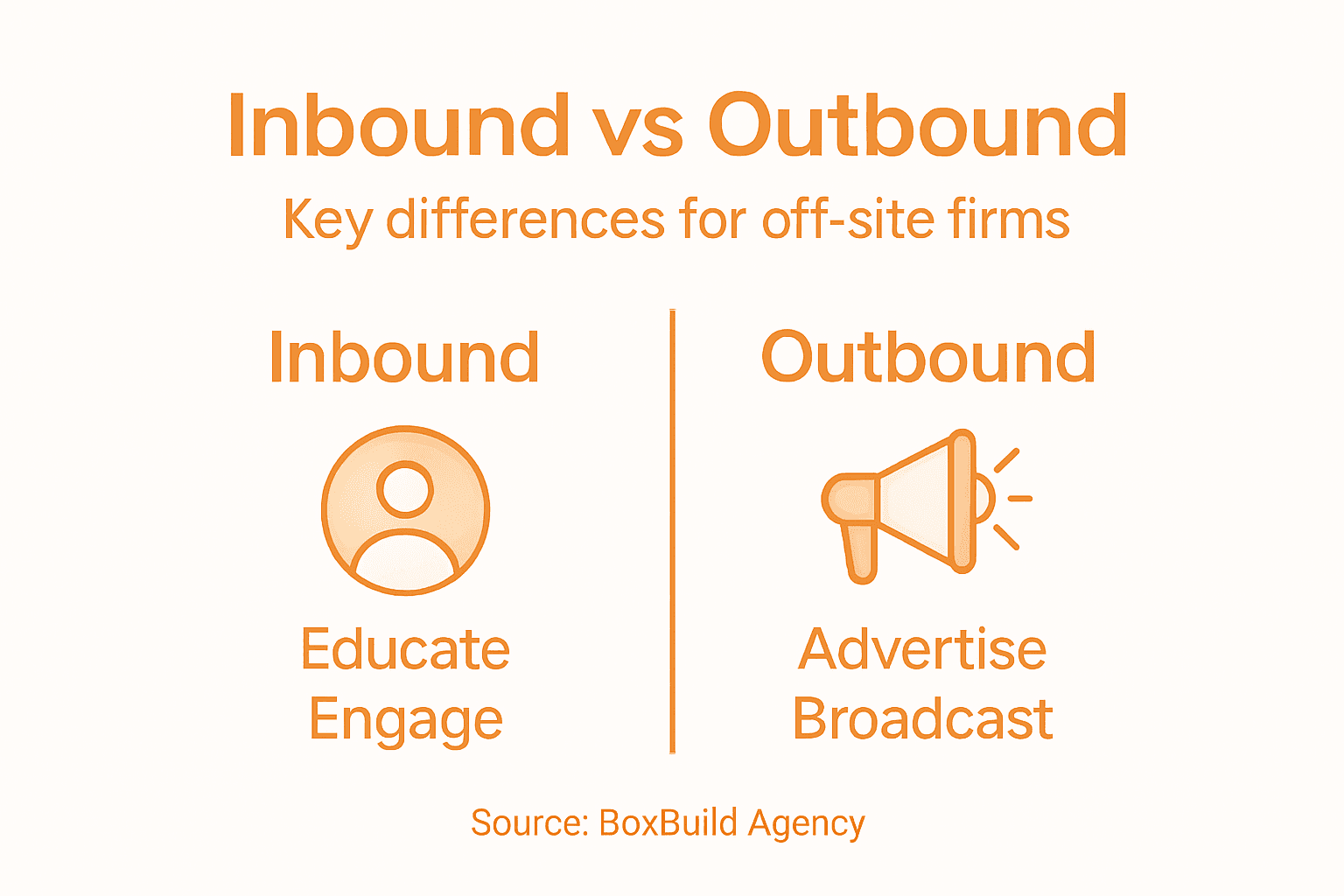
The distinction between inbound and outbound marketing fundamentally shapes how you allocate budget, structure your team, and measure success. Outbound marketing represents the traditional approach your sales team likely knows well: you identify a list of prospects and push your message toward them through cold calls, email blasts, trade show booths, and paid advertising. You are interrupting their day with a message they did not ask for, hoping enough of them respond to make the effort worthwhile. Inbound marketing flips this model entirely. Instead of pushing messages outward, you create valuable content and optimize your digital presence so prospects find you when they are actively searching for solutions. The customer pulls your content into their awareness because it answers a question they already have, not because you interrupted them with an unsolicited pitch.
This fundamental difference creates dramatically different results for off-site construction firms. Outbound tactics like cold calling and direct mail are perceived as intrusive, which means your message starts from a position of defensiveness. When a general contractor receives your cold email about modular construction capabilities, they are skeptical because they did not ask for it. Your team must overcome that initial resistance before any productive conversation can happen. With inbound marketing, the prospect arrives at your content already primed to listen. They typed “modular construction for commercial projects” into Google, found your detailed blog post, and read through your case studies because they wanted to learn. This reversal in mindset transforms your conversion rates dramatically. Prospects who find you organically convert at significantly higher rates because they are self-qualified; they demonstrated genuine interest by seeking out your content.
The cost structure tells another story that matters to your marketing budget. Outbound marketing requires continuous spending to maintain results. Stop running your paid ads, and your pipeline dries up almost immediately. Stop attending trade shows and making cold calls, and you lose the leads that approach generates. This creates an expensive treadmill where you must keep spending just to stay visible. Inbound marketing, by contrast, builds assets that work for you indefinitely. A blog post that ranks in search results continues attracting leads months or years after publication with zero additional spending. Your SEO-optimized website becomes a lead-generation machine that runs 24/7, pulling in prospects while your team sleeps. A whitepaper you created last year still converts new leads this quarter. Over time, inbound builds momentum; your library of content grows, your search rankings strengthen, and your lead costs decline as your library expands.
The relationship dynamic differs sharply as well. Outbound marketing creates a transactional interaction: you have something to sell, and you are trying to convince someone to buy it. The power dynamic feels adversarial because the prospect must decide whether to trust your claims. With inbound marketing, you establish yourself as an educator and trusted advisor before any sales conversation occurs. The permission-based, customer-centric approach of inbound marketing fosters genuine relationships and long-term loyalty rather than one-time transactions. A prospect who learned from your content, trusted your insights, and came to you with buying intent becomes a much more valuable customer. They tend to have higher lifetime value, refer others to your firm more readily, and switch to competitors less frequently because they already understand and respect your approach.
Qualified lead generation represents perhaps the most meaningful difference for your sales team. Outbound tactics generate volume; you contact hundreds of prospects hoping enough respond to create a pipeline. Many of those leads are cold, unaware of modular construction, and not ready to make a decision. Your sales team spends energy educating, explaining, and convincing people who may never become customers. Inbound marketing generates qualification; the leads that arrive through your content have already educated themselves about your services, understood the benefits of your approach, and demonstrated interest by seeking you out. Your sales conversations become consultative rather than exploratory. Instead of explaining what modular construction is, you are discussing project specifics, timelines, and how your firm executes better than competitors. This shift saves your sales team tremendous time and improves their close rates significantly.
To clarify how inbound and outbound marketing differ for off-site construction firms, consider the following comparison:
| Aspect | Inbound Marketing | Outbound Marketing |
|---|---|---|
| Audience Interaction | Prospects seek information online | Firm actively reaches out to prospects |
| Cost Structure | Content works long-term, declining cost per lead | Continuous budget needed for results |
| Lead Quality | Self-qualified, highly interested leads | Many cold, less-engaged prospects |
| Relationship Focus | Builds trust before sales conversation | Starts with skepticism, transactional |
| Measurement Approach | Prioritizes qualified lead conversion | Often tracks volume of contacts made |
Pro tip: Calculate the cost per lead for your current outbound efforts, then set that as your benchmark as you build inbound capabilities. You will likely find inbound costs decline over time as your content library grows, while outbound costs remain constant or increase.
Lead Nurturing and Automation Best Practices
Once your inbound marketing engine attracts prospects to your content, the real work begins. Lead nurturing separates modular construction firms that close deals from those that watch leads go cold. The gap between a prospect downloading your prefab building guide and actually requesting a proposal can span weeks or months. During that time, your prospects are likely evaluating multiple firms, gathering information, and building confidence in their decision. Without a systematic approach to staying in front of them with relevant information, you lose momentum. That is where automation becomes your competitive advantage. By setting up intelligent workflows that deliver the right message to the right prospect at the right time, you ensure no qualified lead falls through the cracks while your sales team focuses on high-priority opportunities.
Effective lead nurturing starts with segmentation based on how prospects behave and where they are in their buying journey. A general contractor who downloaded your modular construction cost analysis whitepaper has different needs than a facilities manager researching your factory quality controls. Rather than sending everyone the same generic email sequence, automated lead nurturing systems can deliver personalized content based on which content pieces they engaged with and how they progressed through your website. Create distinct email sequences for different prospect types. A commercial developer might receive emails highlighting project timeline acceleration and budget certainty. A healthcare organization might receive content emphasizing regulatory compliance and quality standardization. This targeted approach feels personal to the recipient and demonstrates you understand their specific challenges, dramatically improving engagement rates and moving them closer to a sales conversation.
Drip campaigns form the backbone of your automation strategy. These structured email sequences deliver educational content progressively, maintaining engagement without overwhelming prospects. Rather than bombarding someone with five emails in one week, a drip campaign might send one highly relevant message every three to five days, each building on the previous message and gradually advancing the conversation. Day one might introduce a case study matching their industry. Day four might share a whitepaper on modular construction ROI. Day seven might invite them to a webinar or consultation call. This measured pace keeps your firm visible while respecting their inbox and decision timeline. Automated workflows should adapt to lead engagement levels and progressively deliver educational content, ensuring someone actively clicking through and reading receives different messaging than someone ignoring emails. A prospect who opens every email and visits your pricing page obviously shows buying intent and should receive a sales conversation invitation immediately. Someone who has not opened anything in two weeks needs different nurturing content to reignite interest.
Lead scoring determines which prospects your sales team should prioritize. Not every lead deserves immediate attention. A prospect who visited your site once, looked at a single blog post, and disappeared is not yet ready for a sales conversation. A prospect who downloaded multiple resources, attended your webinar, visited your pricing page, and requested a demo should get immediate follow-up. By assigning point values to specific behaviors, you automatically identify which leads are hot and ready for sales engagement. Visiting your website counts for one point. Downloading a whitepaper counts for five points. Attending a webinar counts for ten points. Requesting a demo counts for twenty points. When a lead reaches fifty points, an alert triggers your sales team to reach out immediately. This prevents your sales team from wasting time on cold leads while ensuring genuinely interested prospects get contacted within hours, not weeks.
Integration between your customer relationship management system and your marketing automation platform ensures nothing falls through the cracks. When a prospect downloads your guide, that action automatically creates a new lead in your CRM and enrolls them in the appropriate nurturing sequence. When they reach a certain score, that notification appears in your sales team’s workflow. When they reply to an email or request information, that interaction logs automatically in their prospect record. Your entire team sees the complete history of every interaction, preventing your sales representative from asking questions the prospect already answered via email or website behavior. This integration also enables timely, personalized interactions based on lead activity and signals, allowing your team to strike while interest is hot.
Avoid the common trap of creating automation and then ignoring it. Your workflows should improve over time based on performance data. Track which email subject lines generate the highest open rates and use similar language in future campaigns. Monitor which content pieces attract the most downloads and create additional resources around those topics. Analyze which nurture sequences convert the highest percentage to sales conversations and replicate that structure with new sequences. Automation is not a set-and-forget system; it is a testing ground for discovering what actually resonates with your specific market.
Here is how automation and lead nurturing methods impact sales efficiency:
| Method | What It Does | Impact on Sales Team |
|---|---|---|
| Segmentation | Delivers relevant content by prospect type | Increases engagement and conversion rates |
| Drip Campaigns | Schedules targeted emails over time | Keeps prospects warm without manual effort |
| Lead Scoring | Ranks prospects by readiness | Prioritizes sales focus on hot leads |
| CRM Integration | Syncs marketing and sales data | Prevents missed follow-ups and lost leads |
Pro tip: Start with one focused nurture sequence for your most common prospect type, measure its performance, and refine based on data before expanding to additional sequences. A highly optimized sequence that converts 15 percent of subscribers beats a dozen mediocre sequences.
Measuring Success and Avoiding Common Pitfalls
Inbound marketing looks impressive in theory, but your marketing director needs to prove it works with real numbers. The challenge many modular construction firms face is distinguishing between metrics that feel good and metrics that actually matter. You could spend months celebrating that your blog post reached 50,000 views, only to realize those views generated zero qualified leads. That is the difference between vanity metrics and performance metrics. Your success measurement framework must focus on outcomes that directly impact revenue, not just activity. The key performance indicators you track should connect directly to business goals and demonstrate clear return on investment.
Start by defining what “qualified lead” actually means for your firm. Not every person who fills out a form is ready to become a customer. A qualified lead for a modular construction firm might be a general contractor with active commercial projects, a budget committed to modular solutions, and decision-making authority. That prospect differs dramatically from a student researching off-site construction for a school project. Setting clear KPIs such as lead quality, conversion rates, and customer acquisition cost ensures you are measuring what matters. Track how many visitors your website attracts, but more importantly, track how many of those visitors take meaningful actions like downloading resources, requesting proposals, or scheduling consultations. Measure conversion rates at each stage of your funnel: what percentage of website visitors become leads, what percentage of leads become sales opportunities, and what percentage of opportunities close into customers. These metrics tell the complete story of your inbound effectiveness.
Customer acquisition cost directly connects marketing spending to revenue generation. Calculate this by dividing your total marketing expenses by the number of new customers acquired during that period. If you spent $50,000 on inbound marketing and closed 10 new customers, your customer acquisition cost is $5,000 per customer. This number matters because you can compare it to your average project value and customer lifetime value. If your average modular construction project generates $200,000 in revenue with a 20 percent profit margin, a $5,000 acquisition cost represents exceptional return on investment. Track this metric monthly and watch for trends. If your customer acquisition cost climbs while your lead volume stays flat, something in your funnel is breaking down. If it drops while leads increase, your inbound strategy is improving.
Common pitfalls include neglecting ongoing content updates, failing to align marketing with sales, and over-relying on vanity metrics rather than meaningful engagement outcomes. Many firms create a content library then stop publishing, expecting old content to sustain lead generation indefinitely. Search engine algorithms reward fresh, updated content, and your prospects expect current information. A blog post written two years ago about modular construction timelines may contain outdated information that hurts credibility. Build a content refresh schedule where you update top-performing articles quarterly with new data, recent case studies, and current examples. Misalignment between marketing and sales represents another serious pitfall. Your marketing team might nurture leads and hand them to sales when they reach a certain score, but if your sales process takes six weeks to respond, those leads grow cold and convert at much lower rates. Marketing and sales must agree on lead qualification criteria and handoff timing. A lead marked ready for sales should receive contact from your sales team within 24 hours, not a week later.
Ignoring analytics data might be the most costly pitfall of all. You have access to detailed information about which content attracts prospects, which messages convert best, and which campaigns generate the highest-quality leads. Yet many firms make strategic decisions based on assumptions rather than data. Someone believes video content will work better than written guides, so the firm stops producing guides without testing. Someone assumes their ideal customer is a large general contractor, so they stop targeting mid-sized firms without measuring whether mid-sized firms actually convert better. Poor lead segmentation and inconsistent messaging undermine effectiveness, making it harder to connect with prospects authentically. The antidote is ruthless experimentation. Test different email subject lines and use the one that generates the highest open rate. Test different call-to-action button colors and track which converts more visitors into leads. Test targeting different audience segments and measure which generates the highest-quality leads. Make decisions based on what your data shows, not what you assume.
Establish a monthly reporting rhythm where you review key metrics with your team and adjust your strategy accordingly. Create a simple dashboard showing website traffic, leads generated, conversion rates, customer acquisition cost, and pipeline value. Celebrate wins, investigate declines, and always ask the fundamental question: are we generating more qualified leads at lower cost than our previous approach. This discipline separates firms that benefit from inbound marketing from those that implement it haphazardly and abandon it when results do not appear immediately. Inbound marketing compounds over time; your results improve as your content library grows, your SEO strengthens, and your nurturing processes optimize. Expect slow initial results, but track the trend line closely.
Pro tip: Create a simple spreadsheet tracking your top 10 metrics weekly, then share it with your sales team every Monday morning. When salespeople see the data and understand how their close rates connect to marketing quality, the entire organization becomes aligned on inbound success.
Take Your Off-Site Construction Inbound Marketing to the Next Level
Inbound marketing success relies on delivering valuable content that attracts and nurtures qualified leads who are already interested in modular, prefab, and container-based building solutions. The challenge your firm faces includes addressing prospect skepticism, building trust through education, and efficiently capturing leads with automation while reducing reliance on costly outbound tactics. You want to accelerate lead qualification, improve conversion rates, and ensure your marketing strategies align with real decision-maker questions just like the article describes.
At BoxBuild Agency, we specialize in helping off-site construction companies overcome these exact challenges. Our expertise includes developing strategic funnels that segment and nurture your leads with precision. We leverage cutting-edge Google Ads combined with SEO and content marketing to position your firm as the industry leader customers trust. This targeted, data-driven approach turns your educational content into a 24/7 sales asset that continuously draws in high-value leads and supports your sales team converting them faster.
Ready to stop wasting budget on cold outreach and start attracting qualified prospects actively searching for off-site construction solutions? Visit BoxBuild Agency now to discover how our tailored inbound strategies can transform your lead generation efforts and fuel sustained business growth today.
Frequently Asked Questions
What is inbound marketing for off-site construction firms?
Inbound marketing for off-site construction firms focuses on attracting qualified leads through valuable, educational content instead of traditional sales tactics. It positions the firm as a trusted authority on modular and prefab construction solutions.
How does inbound marketing differ from outbound marketing?
Inbound marketing pulls potential clients to your firm through informative content, whereas outbound marketing pushes messages outward through cold calls and ads. Inbound attracts self-qualified leads, while outbound often engages cold prospects.
What are some effective inbound marketing tactics for modular builders?
Effective tactics include creating strategic blog content targeting specific search queries, leveraging video walkthroughs and case studies, engaging on social media, optimizing content for SEO, and utilizing email nurturing campaigns.
Why is lead nurturing important in inbound marketing?
Lead nurturing is essential because it maintains engagement with prospects over time, helping to convert them from initial interest to actual sales. This process ensures no qualified lead falls through the cracks while providing valuable information tailored to their needs.
Recommended
- Content Strategy for Off-Site Builders to Boost Lead Generation – BoxBuild
- Why Marketing Matters for Builders: Complete Guide – BoxBuild
- Sales Funnel for Builders: Complete Expert Guide – BoxBuild
- Website Optimization Guide for Builders: Boost Leads Fast – BoxBuild
- What Is Lead Generation for Local Contractors
- Marketing Digital LinkedIn Guide: Strategies for 2026 Success – Aim Set Win