Most American construction firms lose up to 30 percent of potential leads due to poor customer experience. Decision-makers in modular and prefab sectors know that every client touchpoint can make or break a deal. Focusing on the full customer journey, from first inquiry to project completion, is now essential for building lasting relationships and driving growth. This article uncovers what truly defines memorable customer experience in construction and how your team can use it to increase conversion and retention.
Table of Contents
- Defining Customer Experience in Construction
- Key Elements Shaping The Customer Journey
- Digital Transformation And Automation Benefits
- Impact On Lead Generation And Client Retention
- Common Barriers And How To Overcome Them
Key Takeaways
| Point | Details |
|---|---|
| Holistic Customer Experience | In construction, customer experience is a multifaceted journey that involves every client interaction throughout the project lifecycle. |
| Strategic Engagement | Companies must actively engage clients during the project to co-create experiences and build trust. |
| Technological Integration | Leveraging advanced technologies enhances communication, transparency, and overall project efficiency. |
| Cultural Transformation | Firms need to foster a culture of client-centric thinking and collaboration to effectively overcome barriers to customer experience improvement. |
Defining Customer Experience in Construction
Customer experience in construction is far more complex than a simple transaction. It represents a holistic journey that encompasses every interaction a client has with a construction firm, from initial inquiry to project completion and beyond. Comprehensive understanding of customer interactions reveals this experience is multidimensional, involving cognitive, emotional, behavioral, sensory, and social responses.
At its core, customer experience in construction transcends traditional service delivery. It involves creating a systematic approach that integrates multiple organizational touchpoints to deliver consistent, memorable interactions. This means every department – from sales and design to project management and post-construction support – plays a critical role in shaping client perception. Customer Experience Management becomes a strategic imperative, not just a departmental function.
The construction industry demands a nuanced approach to customer experience. Unlike retail or service sectors, construction projects involve significant financial investments, complex technical requirements, and long-term relationships. Organizational engagement strategies must be adaptable, recognizing that each project represents a unique ecosystem of client expectations, technical challenges, and performance metrics.
Building an exceptional customer experience requires more than good intentions. It demands a deliberate, company-wide commitment to understanding and anticipating client needs. This means developing robust communication protocols, transparent project tracking, proactive problem-solving, and a culture of continuous improvement.
Pro Tip: Implement a standardized client feedback mechanism after each project phase to continuously refine your customer experience strategy and identify improvement opportunities.
Key Elements Shaping the Customer Journey
The construction customer journey is a complex, multifaceted process that extends far beyond traditional transactional interactions. Smart technologies and strategic touchpoints play a critical role in designing comprehensive customer experiences that meet evolving industry expectations. Modern construction firms must recognize that each interaction represents an opportunity to build trust, demonstrate value, and differentiate themselves in a competitive marketplace.
Key elements shaping this journey include strategic experience co-creation, which involves actively engaging customers throughout the project lifecycle. This approach transforms customers from passive recipients to collaborative partners, enabling more personalized and responsive service delivery. By implementing systematic customer journey mapping, construction companies can identify critical touchpoints and design targeted interventions that address specific client needs and expectations.
The customer journey typically encompasses several interconnected phases: initial consultation, design development, proposal generation, project execution, ongoing communication, and post-project support. Each phase requires tailored communication strategies, transparent processes, and proactive engagement. Successful navigation of these stages demands sophisticated technological integration, robust communication protocols, and a deep understanding of client motivations and potential pain points.
Technology plays a transformative role in enhancing customer journey experiences. Digital platforms, real-time project tracking tools, virtual collaboration spaces, and advanced communication channels enable more responsive, transparent, and engaging interactions. By leveraging these technologies, construction firms can create seamless, data-driven experiences that build long-term client relationships and competitive advantages.

Pro Tip: Develop a comprehensive customer journey map that visually tracks all potential touchpoints and interactions, allowing your team to proactively identify and address potential friction points.
Digital Transformation and Automation Benefits
Digital transformation represents a fundamental reimagining of construction business models and operational strategies. Technological integration drives organizational change, enabling construction firms to overcome traditional industry challenges through sophisticated digital solutions. This transformation goes beyond mere technological adoption, requiring a comprehensive approach that reimagines how construction teams collaborate, communicate, and deliver value.
Key technologies driving this transformation include Building Information Modeling (BIM), Internet of Things (IoT), artificial intelligence, and advanced automation systems. Automated systems optimize construction processes by enhancing productivity, improving safety standards, and enabling more precise decision-making. These technologies allow construction companies to move from reactive to predictive management, reducing errors, minimizing waste, and creating more efficient project workflows.
The benefits of digital transformation extend across multiple dimensions of construction operations. Productivity gains are substantial, with automated systems reducing manual labor, streamlining communication, and enabling real-time project monitoring. Data-driven insights allow for more accurate project planning, resource allocation, and risk management. Moreover, digital tools facilitate better collaboration between architects, engineers, contractors, and clients, creating more transparent and responsive project environments.
Here’s a summary of how digital tools transform construction firms:
| Technology | Core Function | Operational Impact | Client Benefit |
|---|---|---|---|
| BIM | 3D modeling and planning | Boosts accuracy and collaboration | Clear project visualization |
| IoT | Real-time monitoring | Improves safety and efficiency | Transparent site updates |
| AI | Data-driven automation | Enhances decision-making | Quicker issue resolution |
| Automation | Streamlines workflows | Reduces errors and delays | Faster project delivery |
However, successful digital transformation requires more than technological investment. It demands a cultural shift within organizations, emphasizing continuous learning, adaptability, and openness to innovation. Construction firms must develop comprehensive change management strategies, invest in workforce training, and create environments that encourage technological experimentation and skill development.
Pro Tip: Develop a phased digital transformation roadmap that aligns technological investments with specific organizational goals and gradually builds technological capabilities across your team.
Impact on Lead Generation and Client Retention
Customer experience has become a critical differentiator in the competitive construction marketplace, directly influencing lead generation and long-term client relationships. Customer success strategies transform business performance by converting initial interactions into sustainable, profitable partnerships. Construction firms that prioritize comprehensive customer experience management can dramatically improve their ability to attract and retain high-value clients.
Effective client retention begins with understanding and anticipating client needs throughout the project lifecycle. Strategic relationship management techniques enable construction companies to build trust, demonstrate value, and create memorable experiences that encourage repeat business. This approach goes beyond traditional transactional interactions, focusing on developing long-term connections that transform one-time projects into ongoing collaborative relationships.
Lead generation in construction is increasingly driven by reputation and client experience rather than traditional marketing approaches. Satisfied clients become powerful advocates, generating referrals and positive word-of-mouth recommendations that are far more compelling than conventional advertising. By consistently delivering exceptional experiences, construction firms can create a self-reinforcing cycle of attraction, conversion, and retention that naturally expands their client base and market influence.
Technology plays a crucial role in enhancing lead generation and client retention strategies. Advanced customer relationship management systems, personalized communication platforms, and data-driven insights enable construction firms to create more targeted, responsive, and engaging client interactions. These tools allow companies to track client preferences, anticipate needs, and provide proactive support that sets them apart in a competitive marketplace.
Pro Tip: Implement a systematic client feedback mechanism that captures insights at every project stage, using data to continuously refine and improve your customer experience approach.
Common Barriers and How to Overcome Them
Construction firms face significant challenges when attempting to transform customer experience, with organizational resistance emerging as a primary obstacle. Technological change resistance impacts innovation by creating systemic barriers that prevent meaningful progress. These challenges stem from deeply entrenched industry practices, risk-averse cultures, and a historical reluctance to adopt transformative approaches to client engagement.
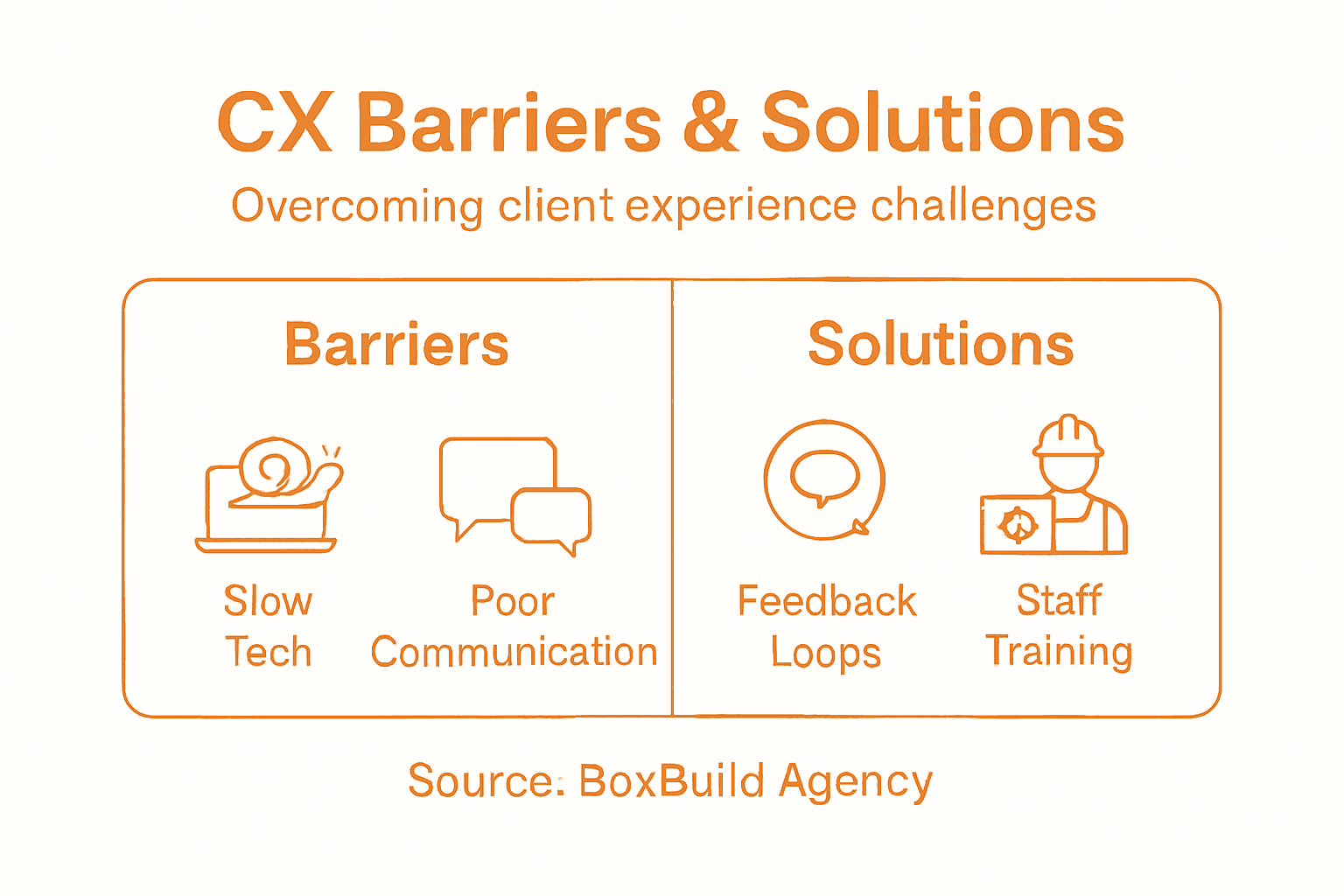
Communication breakdowns represent another critical barrier to exceptional customer experience. The construction industry’s fragmented nature often results in siloed departments, inconsistent messaging, and disconnected touchpoints that undermine client trust. Successful organizations must develop comprehensive communication strategies that create transparency, foster collaboration, and ensure consistent messaging across all project stages and organizational levels.
Implementing meaningful customer experience improvements requires more than technological solutions. Cultural transformation is essential, demanding leadership commitment to creating psychologically safe environments where innovation can flourish. This involves developing training programs, incentive structures, and organizational practices that reward client-centric thinking and encourage cross-functional collaboration. Firms must move beyond traditional hierarchical models to create more adaptive, responsive organizational structures.
Technology can be both a barrier and an enabler in customer experience transformation. While advanced tools offer tremendous potential, their implementation often fails due to inadequate change management, insufficient training, and misalignment with existing workflows. Successful adoption requires a holistic approach that considers human factors, provides comprehensive training, and demonstrates clear value to all stakeholders involved in the customer experience journey.
Compare common barriers and solutions for improving client experience in construction:
| Barrier | Challenge Description | Solution Approach | Impact on Client Experience |
|---|---|---|---|
| Organizational Resistance | Reluctance to change culture | Leadership buy-in and training | Drives innovation, increases trust |
| Communication Breakdowns | Inconsistent messaging | Integrated communication tools | Delivers clarity, improves relationships |
| Siloed Departments | Lack of cross-team engagement | Cross-functional collaboration | Enhances responsiveness, ensures consistency |
| Poor Tech Adoption | Ineffective integration | Robust change management | Smooth transitions, better support |
Pro Tip: Develop a cross-functional customer experience task force that includes representatives from different departments to identify and systematically address barriers to improved client engagement.
Elevate Your Construction Success Through Customer Experience and Digital Innovation
The article highlights the critical role of customer experience management in construction success. You face challenges like fragmented communication, organizational resistance to change, and the need for transparent client engagement throughout complex project lifecycles. BoxBuild Agency understands these pain points and uses a data-driven approach that integrates automation and advanced technology such as AI to help modular, prefab, and container-based builders generate more qualified leads and retain high-value clients. Our services are designed to create seamless, targeted funnels that convert prospects and nurture long-term trust.
Discover how embracing digital tools and strategic marketing can transform your customer journey into a powerful competitive advantage. Whether you need expert guidance on crafting effective Funnels – BoxBuild or leveraging artificial intelligence for smarter lead generation with AI – BoxBuild, our team delivers personalized solutions tailored to the off-site construction industry.
Don’t let communication breakdowns or outdated practices hold your projects back. Visit BoxBuild Agency today to partner with a digital growth expert who understands your industry and is ready to position your company as a trusted market leader. Take the next step toward amplified success and strategic growth now.
Frequently Asked Questions
What is customer experience in construction?
Customer experience in construction refers to the overall journey and interactions a client has with a construction firm, from initial inquiry through project completion and beyond. It encompasses various aspects including cognitive, emotional, and social responses during the entire process.
Why is customer experience management critical in construction?
Customer experience management is essential in construction because it directly influences client perception and satisfaction. A strong focus on integrating multiple touchpoints across departments fosters long-term relationships and can differentiate a company in a competitive marketplace.
How can technology improve customer experience in construction?
Technology enhances customer experience by enabling real-time project tracking, facilitating transparent communication, and providing interactive platforms for collaboration. Tools such as Building Information Modeling (BIM) and customer relationship management systems streamline processes, improving responsiveness and client engagement.
What are common barriers to improving customer experience in construction?
Common barriers include organizational resistance to change, communication breakdowns between departments, and poor technology adoption. Overcoming these challenges often requires leadership commitment, effective communication strategies, and robust change management practices.
Recommended
- Website UX in Construction – Impact on Lead Generation – BoxBuild
- Why Use Digital Marketing in Construction Today – BoxBuild
- Role of Data in Construction Marketing Success – BoxBuild
- Role of Branding for Builders: Complete Guide – BoxBuild
- Why Work with Experienced Builders in South Georgian Bay
- Role of Communication in Renovation Success – Astrotech Construction