Every experienced builder knows that marketing an ADU project takes more than a polished website or catchy slogan. Connecting with the right prospects is about understanding who is searching, what they truly need, and speaking to those demands with purpose. By developing research-based buyer personas and crafting content that addresses motivations unique to distinct groups, North American ADU builders can turn digital touchpoints into measurable lead generation.
Table of Contents
- Step 1: Identify Your Ideal ADU Buyer Personas
- Step 2: Audit and Optimize Your Current Content Assets
- Step 3: Craft Targeted Content for High-Intent Queries
- Step 4: Publish and Promote Content on Strategic Channels
- Step 5: Track Performance and Refine Conversion Tactics
Quick Summary
| Key Point | Explanation |
|---|---|
| 1. Identify Ideal ADU Buyer Personas | Create detailed profiles of your target buyers to understand their motivations and pain points. This leads to more effective marketing strategies. |
| 2. Audit Current Content Assets | Review existing content for performance and relevance. Optimize or remove low-performing pieces to improve your overall content strategy. |
| 3. Focus on High-Intent Queries | Craft content targeting specific, high-intent keywords that reflect potential customers’ needs, moving them closer to purchasing decisions. |
| 4. Publish and Promote Strategically | Use various channels to distribute your content where your target audience spends time. This enhances visibility and lead generation. |
| 5. Track Performance and Refine Tactics | Measure key metrics to identify successful content. Continuously optimize based on data to enhance conversion rates and lead generation efficiency. |
Step 1: Identify your ideal ADU buyer personas
You’re about to create detailed profiles of the people most likely to buy your ADU projects. This step focuses on moving beyond surface-level assumptions to understand the real motivations, pain points, and buying behaviors of your actual and potential customers. Think of this as building a mental model of who you’re actually selling to, not who you think you’re selling to.
Start by gathering data from your existing customers. Interview recent buyers about why they chose your ADUs, what problems they were trying to solve, and what their life looked like before making the purchase. Ask about their household composition, income level, timeline pressures, and concerns about traditional housing. A buyer persona is a research-based profile representing a segment of your target audience that goes far beyond basic demographics. You’ll want to capture behaviors, motivations, and goals that actually influence their purchasing decisions. Talk to your sales team too. They hear objections, reasons for hesitation, and what finally closes deals. They know which prospects turned into happy customers and which ones disappeared from your pipeline.
Once you’ve gathered interviews and feedback, identify patterns across your customer base. You might discover that 40 percent of your buyers are young families desperate for affordable housing in expensive markets, while another 30 percent are professionals seeking affordable investment properties. Another group might be retirees looking to downsize without losing quality. Notice the emotional drivers: fear of being priced out, desire for sustainability, need for quick solutions. Effective personas go beyond demographics to include emotional needs and behavioral patterns that reveal what actually matters to different customer segments. Document each persona with a name, photo (find stock images that match), age, family situation, income, what keeps them awake at night, and what success looks like for them. The more specific and grounded your personas feel, the better your marketing will resonate. Understanding these distinct segments helps you craft messaging that speaks directly to what matters most to each group, which is where your content strategy actually starts driving qualified leads.
Here is a summary of potential ADU buyer personas and their main motivations:
| Persona Type | Key Motivation | Typical Concern |
|---|---|---|
| Young Families | Affordable housing options | Rising home prices |
| Professionals | Investment property potential | Generating rental income |
| Retirees | Downsizing comfortably | Maintaining lifestyle quality |
| Eco-Conscious Buyers | Sustainability and efficiency | Environmental impact |
Pro tip Interview 8 to 12 of your best customers and 4 to 6 recent prospects who almost bought but didn’t. The stories of why they said “no” are just as valuable as understanding why others said “yes.”
Step 2: Audit and optimize your current content assets
Before you create new content, you need to understand what you already have and how it’s performing. This step involves reviewing every piece of content your company has produced, from blog posts to case studies to landing pages, then determining which pieces are pulling their weight and which ones need attention. A systematic review of all content will reveal gaps, redundancies, and opportunities you’ve been missing.
Start by creating a complete inventory of your existing content. This sounds tedious, but it’s absolutely necessary. Catalog everything: blog articles, whitepapers, videos, webinars, downloadable guides, landing pages, testimonials, and technical documentation. For each piece, record the title, URL, publication date, topic, target keyword, and format. Then pull the metrics that matter. How much organic traffic does each piece receive? What’s the engagement rate? How many leads did it generate? Which content pieces are actually being shared or linked to? Look for patterns. You might discover that your case studies about ADU projects in California consistently drive more inquiries than generic educational content. Or that a five year old blog post about modular construction costs still ranks well but contains outdated pricing information. Evaluating metrics like traffic and engagement helps you decide whether to keep, update, merge, or delete content, which directly impacts your overall marketing efficiency.
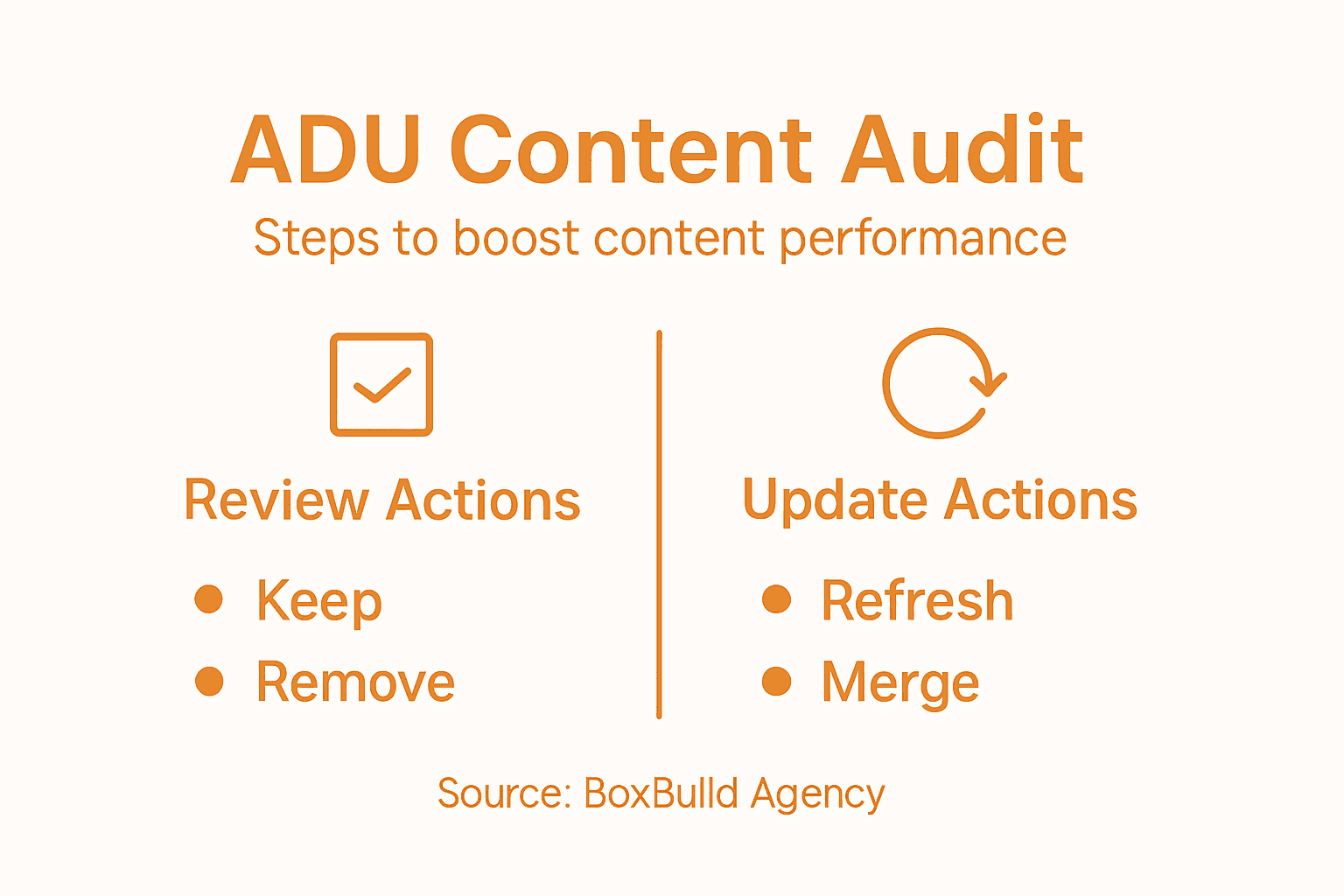
Once you’ve analyzed performance, take action. High-performing content that’s current stays as is. Outdated content with decent traffic gets refreshed with new data, statistics, and examples. Thin or redundant pieces can be merged together to create more comprehensive resources. Underperformers that don’t align with your buyer personas get deprioritized or removed. This process isn’t about vanity. It’s about ensuring every piece of content on your website serves a purpose in your lead generation funnel and reflects your current expertise. The time you invest here pays dividends because you’re now building your content strategy on a foundation of what actually works rather than assumptions.
This table compares content optimization actions and their business impacts:
| Content Action | When to Apply | Expected Effect |
|---|---|---|
| Refresh | Outdated, high-traffic | Restore accuracy, boost leads |
| Merge | Multiple thin pieces | Create comprehensive resource |
| Remove | Low-performing, misaligned | Clean up strategy and focus |
| Repurpose | High-value original | Reach more channels/audiences |
Pro tip Focus your optimization efforts on content that targets high-intent keywords like “ADU builder near me” or “affordable modular housing.” These pages have the most lead-generation potential, so improving them pays off faster than perfecting educational content.
Step 3: Craft targeted content for high-intent queries
Now you’re ready to create content that speaks directly to people actively searching for solutions. High-intent queries are searches performed by potential customers who are ready to take action, whether that means learning about specific modular building techniques, comparing ADU costs, or finding a builder in their area. This step focuses on creating content that matches exactly what these searchers need, moving them closer to a purchase decision.

Start by identifying the high-intent keywords your ADU buyer personas are actually typing into Google. These are searches that signal buying readiness. Instead of generic phrases like “what is an ADU,” you’re looking for specific queries like “affordable ADU builder in Colorado” or “modular home costs 2024” or “prefab ADU financing options.” Aligning content with search intent means understanding whether someone is in the awareness stage (just learning), consideration stage (comparing options), or decision stage (ready to buy). Once you’ve mapped your keywords to buyer journey stages, craft content that addresses the specific pain point or question at that moment. A decision-stage searcher looking for “ADU builders accepting projects now” needs fast facts, clear pricing, portfolio examples, and a straightforward way to request a quote. They don’t need a lengthy explanation of modular construction philosophy. That detailed content serves awareness-stage readers exploring the concept for the first time.
Content mapped to buyer journey stages and optimized for conversion performs dramatically better. When someone searching for “how much does a prefab ADU cost” finds your detailed pricing guide with real-world examples and financing options, they’re far more likely to contact you than if they landed on generic educational content. Targeting high-intent keywords attracts visitors ready to convert and increases measurable business growth. Write with specificity. Use actual price ranges, real project timelines, and concrete details. Avoid vague language. Instead of “we offer competitive pricing,” say “most ADU projects in your market range from $150,000 to $250,000 depending on specifications.” Include clear calls to action that match the searcher’s stage. Decision-stage content should offer immediate next steps like scheduling consultations or requesting quotes. This targeted approach ensures your content attracts the right people at the right time.
Pro tip Create separate content pieces for each high-intent keyword cluster rather than trying to cover everything in one article. A focused post on “ADU cost per square foot” will rank better and convert better than a generic piece attempting to cover ADU costs, financing, timelines, and builders all at once.
Step 4: Publish and promote content on strategic channels
Creating great content means nothing if it sits unpublished or gets lost in the noise. This step is about strategically distributing your content across the channels where your ADU buyer personas actually spend their time, then amplifying it to maximize visibility and lead generation. You’ll move beyond simply posting content and instead craft a promotion strategy that reaches the right people at the right time.
Start by identifying which channels your target audiences use most. For ADU builders, this typically includes your company blog and website as the foundation, but also Google Business Profile for local search visibility, LinkedIn for reaching architects and developers, YouTube for demonstrating prefab construction processes, and industry forums where people discuss modular building. Email remains one of your highest-converting channels for nurturing leads already interested in your work. Leveraging multiple platforms such as social media, email, blogs, and webinars increases visibility quickly and helps you reach audiences wherever they congregate. Don’t spread yourself thin trying to excel on every platform. Choose three to four channels where you can be genuinely active and provide real value. Publish your core content on your blog first, then adapt and repurpose it for other channels. A detailed case study about a successful ADU project becomes a LinkedIn article, a YouTube walkthrough video, several email newsletters, and social media posts highlighting different phases of construction.
Promotion requires intentional effort. When you publish a blog post, don’t just hope people find it. Engage stakeholders early and use storytelling to enhance impact, whether that means sharing with your email list, tagging relevant people on LinkedIn, asking satisfied customers to share, or partnering with complementary businesses to cross-promote. If you have team members or partners in the industry, activate your network. Ask your sales team to share content with prospects they’re currently speaking with. Provide them with the link and a simple message so they can position it naturally. Track what happens. Monitor which channels drive the most qualified traffic and which content formats generate the most leads. Some builders find YouTube demonstration videos crush it on their channel, while others see email remain their top performer. Double down on what works. Your content strategy only becomes truly effective when you’re distributing strategically and measuring results continuously.
Pro tip Schedule your content distribution across multiple channels on the same day it publishes. This concentrated effort creates momentum, improves search visibility faster, and increases the chances of social sharing and organic reach across your entire promotional ecosystem.
Step 5: Track performance and refine conversion tactics
You’ve created quality content and distributed it strategically. Now comes the critical part: measuring what actually works and using that data to continuously improve your results. This step focuses on setting up performance tracking, analyzing the metrics that matter most to lead generation, and making data-driven adjustments to increase conversions.
Start by establishing which metrics you’ll monitor. Not every number matters equally. Tracking content performance involves monitoring metrics such as views, engagement rates, conversions, and ROI. For ADU builders, the metrics that matter most are organic traffic to your site, click-through rates from search results, form submissions from specific landing pages, email list growth, and ultimately, qualified leads that convert to sales inquiries. Use Google Analytics to track which pages drive the most traffic, how long visitors stay on your content, and what actions they take before leaving. Set up conversion tracking for key actions: downloading a pricing guide, requesting a quote, scheduling a consultation, or signing up for your email list. Most builders focus too much on vanity metrics like total page views and not enough on which pages actually generate qualified leads. A blog post that gets 500 views but zero form submissions isn’t performing. A post that gets 50 views but generates 3 qualified leads is gold. Create a simple spreadsheet tracking your top performing content pieces and the leads they generated. This clarity helps you understand what your audience actually wants.
Once you have data, test and iterate. Conversion marketing tactics like clear calls-to-action and focused landing pages refine strategies through A/B testing. Test different calls-to-action on your pages. Does “Request a Free Quote” outperform “Schedule Your Consultation”? Try different landing page layouts. Does a longer page with detailed information convert better than a short, punchy version? Experiment with content formats. Maybe video case studies convert better than written ones in your market. Make one change at a time so you know what actually moved the needle. The builders who win aren’t necessarily the ones with the most content. They’re the ones who continuously measure, learn from their data, and double down on what works. Your first month of tracking reveals which content types resonate. Your second month shows how changes to calls-to-action or page layouts impact lead generation. By month three, you have a clear picture of your highest-converting content and tactics. That’s when your content strategy truly becomes a lead generation engine.
Pro tip Set up monthly reviews where you analyze your top five performing pages and your bottom five underperformers. For winners, ask what made them successful. For underperformers, decide if they need optimization, repositioning, or removal from your strategy.
Turn Your ADU Content Strategy Into Measurable Lead Growth
The challenge for ADU builders today is crafting content that not only educates but converts. This article highlights common pain points like identifying high-intent buyer personas, optimizing outdated content, and producing targeted messaging that resonates emotionally and triggers action. If you struggle with translating strategy into consistent, qualified leads your business deserves, you are not alone. Effective lead generation requires smart funnel design and ongoing campaign optimization tailored specifically for modular construction markets.
BoxBuild Agency is here to help you overcome these hurdles. Our expertise combines industry insight with advanced Funnels and Google Ads techniques to place your brand in front of serious buyers ready to engage. Imagine turning data-driven automation and search intent mastery into a steady flow of high-value project inquiries. Start maximizing your content strategy and watch your ADU business scale faster by partnering with a dedicated digital growth expert.
Ready to transform your content into a lead-generating machine Make your next move today by exploring how BoxBuild Agency delivers proven results for modular, prefab, and container-based builders. Visit us now at BoxBuild Agency and get the strategic support you need to close more deals and build your future confidently.
Frequently Asked Questions
How do I identify my ideal ADU buyer personas?
To identify ideal ADU buyer personas, gather data from existing customers through interviews, focusing on their motivations and pain points. Analyze the feedback to create detailed profiles that reflect the behaviors and needs of different customer segments.
What types of content should I prioritize for lead generation as an ADU builder?
Prioritize content that aligns with high-intent keywords related to ADUs, such as costs, financing options, and local builders. Create specific content pieces addressing these queries to attract visitors ready to convert into leads.
How can I optimize my existing content to improve lead generation for ADU projects?
Audit your current content to determine which pieces are high-performing or need updates. Refresh outdated but popular articles, merge similar low-performing content, and ensure all content aligns with your buyer personas to enhance lead generation effectiveness.
What metrics should I track to measure the performance of my ADU content strategy?
Track metrics such as organic traffic, engagement rates, form submissions, and conversions to understand content performance. Set up conversion tracking for key actions like quote requests or email list sign-ups to focus on lead generation success.
How often should I review the performance of my ADU content?
Conduct monthly reviews to analyze the performance of your top and bottom content pieces. This process helps you identify successful strategies and areas needing improvement, allowing you to refine your content approach continuously.