Most american modular projects lose weeks each year to poor coordination and unexpected bottlenecks. For project managers under pressure to deliver on time, every delay means higher costs and missed opportunities. The rise of Building Information Modeling in off-site construction is changing how global leaders tackle these problems by integrating real-time data and collaboration tools. This guide sheds light on the core principles behind BIM and reveals how firms using this proven approach reduce errors, cut waste, and stay ahead in a competitive market.
Table of Contents
- Defining BIM in Off-Site Construction
- Types of BIM Applications for Modular Projects
- How BIM Streamlines Off-Site Workflows
- Coordination, Visualization, and Collaboration Benefits
- Challenges, Costs, and Implementation Risks
- Avoiding Common BIM Adoption Mistakes
Key Takeaways
| Point | Details |
|---|---|
| Integration of BIM | Building Information Modeling is essential for optimizing off-site construction by fostering collaboration and enabling comprehensive data management. |
| Optimized Workflows | BIM allows for the detection of potential conflicts and improvement of manufacturing sequences before physical construction begins. |
| Importance of Training | Investing in standardized BIM training enhances data interpretation and maximizes the collaborative potential of project teams. |
| Strategic Planning | Successful adoption of BIM requires careful organizational planning, addressing financial, technical, and human resource challenges. |
Defining BIM in Off-Site Construction
Building Information Modeling (BIM) in off-site construction represents a transformative digital approach that integrates comprehensive data management across project lifecycles. By creating intelligent 3D models that contain rich parametric information, BIM enables project managers to visualize, simulate, and optimize modular construction processes with unprecedented precision. Advanced digital technologies in off-site construction now leverage BIM as a central platform for collaboration, design refinement, and performance prediction.
At its core, BIM transcends traditional 2D drafting by generating multidimensional digital representations that capture every aspect of a building component. These models include intricate details like material specifications, structural characteristics, thermal performance, and manufacturing requirements. Such comprehensive data allows off-site construction teams to detect potential conflicts, streamline fabrication workflows, and ensure higher quality control before physical production begins.
The integration of BIM in off-site construction fundamentally transforms how architectural, engineering, and manufacturing teams collaborate. By creating a shared digital environment, stakeholders can simultaneously access, modify, and validate design parameters, reducing communication errors and minimizing expensive rework. Bibliometric research confirms BIM’s critical role in accelerating industrialized construction processes, highlighting its capacity to enhance productivity, reduce waste, and improve overall project efficiency.
Pro tip: When implementing BIM in off-site construction, start by standardizing your digital model templates to ensure consistent data capture and interoperability across different project stages.
Types of BIM Applications for Modular Projects
BIM applications in modular construction encompass a sophisticated range of digital tools designed to optimize every stage of project development. Comprehensive scientific analysis reveals five critical application dimensions that transform how modular construction teams conceptualize, design, manufacture, and manage building components.
The first category focuses on generative design, where BIM tools enable advanced computational modeling to automatically generate and evaluate design alternatives. These applications leverage algorithmic processes to optimize spatial configurations, material selections, and structural performance. Advanced BIM technologies now integrate cloud-based platforms that support real-time collaboration, allowing designers to simulate complex prefabrication scenarios and predict potential manufacturing challenges before physical production begins.
Manufacturing and construction-oriented BIM applications represent another crucial dimension. These specialized tools facilitate automated manufacturability checks, precise dimensional verification, and detailed assembly sequencing. By embedding rich parametric data into digital models, project teams can simulate entire construction workflows, predict potential conflicts, and optimize production efficiency. Robotics integration and 3D printing technologies are increasingly being incorporated into these BIM platforms, enabling more sophisticated digital fabrication strategies for modular building components.

Pro tip: Invest in standardized BIM training for your entire project team to ensure consistent data interpretation and maximize the collaborative potential of your digital modeling workflows.
Here’s how major BIM applications benefit modular construction teams:
| Application Focus | Primary Benefit | Example Use Case |
|---|---|---|
| Generative Design | Optimized spatial layouts | Automatic floor plan generation |
| Manufacturing Workflows | Improved production control | Robotic assembly integration |
| Collaboration Platforms | Reduced coordination errors | Real-time model sharing |
| Visualization & Simulation | Enhanced design validation | Virtual walkthroughs of modules |
| Data Management | Streamlined information flow | Centralized material tracking |
How BIM Streamlines Off-Site Workflows
Workflow optimization represents the cornerstone of BIM’s transformative impact on off-site construction processes. Advanced implementation strategies demonstrate how BIM expedites project planning and coordination, enabling project teams to detect potential conflicts and streamline manufacturing sequences before physical production begins.
The digital ecosystem created by BIM fundamentally transforms communication and collaboration dynamics. By establishing a centralized, synchronized data environment, teams can simultaneously access and modify design parameters, reducing communication barriers and minimizing costly misunderstandings. Real-time digital design coordination supports enhanced scheduling and resource management, allowing project managers to track progress, allocate resources, and predict potential bottlenecks with unprecedented accuracy.
Off-site construction workflows benefit dramatically from BIM’s ability to integrate multiple project dimensions. Automated clash detection, precise dimensional verification, and comprehensive data tracking enable teams to simulate entire construction processes digitally. This approach dramatically reduces on-site errors, minimizes material waste, and compresses project timelines by identifying and resolving potential issues during the design and prefabrication stages, long before physical construction commences.
Pro tip: Implement a standardized BIM protocol that defines clear data exchange standards and assigns specific digital model responsibilities to each project stakeholder.
Coordination, Visualization, and Collaboration Benefits
Collaboration technologies in off-site construction have been revolutionized by BIM’s powerful visualization capabilities. Advanced digital platforms enable unprecedented levels of interdisciplinary communication, transforming how diverse teams interact, share complex design information, and make critical project decisions through immersive digital environments.
The integration of 3D and 4D modeling techniques provides project stakeholders with dynamic visualization tools that transcend traditional two-dimensional design representations. Real-time collaboration platforms support comprehensive data integration, allowing contractors, designers, and fabricators to simultaneously access, analyze, and modify project models. This synchronized approach dramatically reduces miscommunication, minimizes potential conflicts, and ensures that all team members maintain a consistent understanding of project requirements.
Visualization benefits extend beyond simple graphic representation, enabling sophisticated simulation and predictive analysis. By creating comprehensive digital twins of modular construction projects, teams can anticipate potential challenges, optimize design configurations, and validate complex assembly sequences before physical production begins. The ability to virtually walk through designs, detect potential clashes, and simulate construction processes provides an unprecedented level of insight and control that traditional design methodologies cannot match.
Pro tip: Invest in comprehensive BIM visualization training that helps team members develop advanced model interpretation skills and understanding of collaborative digital workflows.
Challenges, Costs, and Implementation Risks
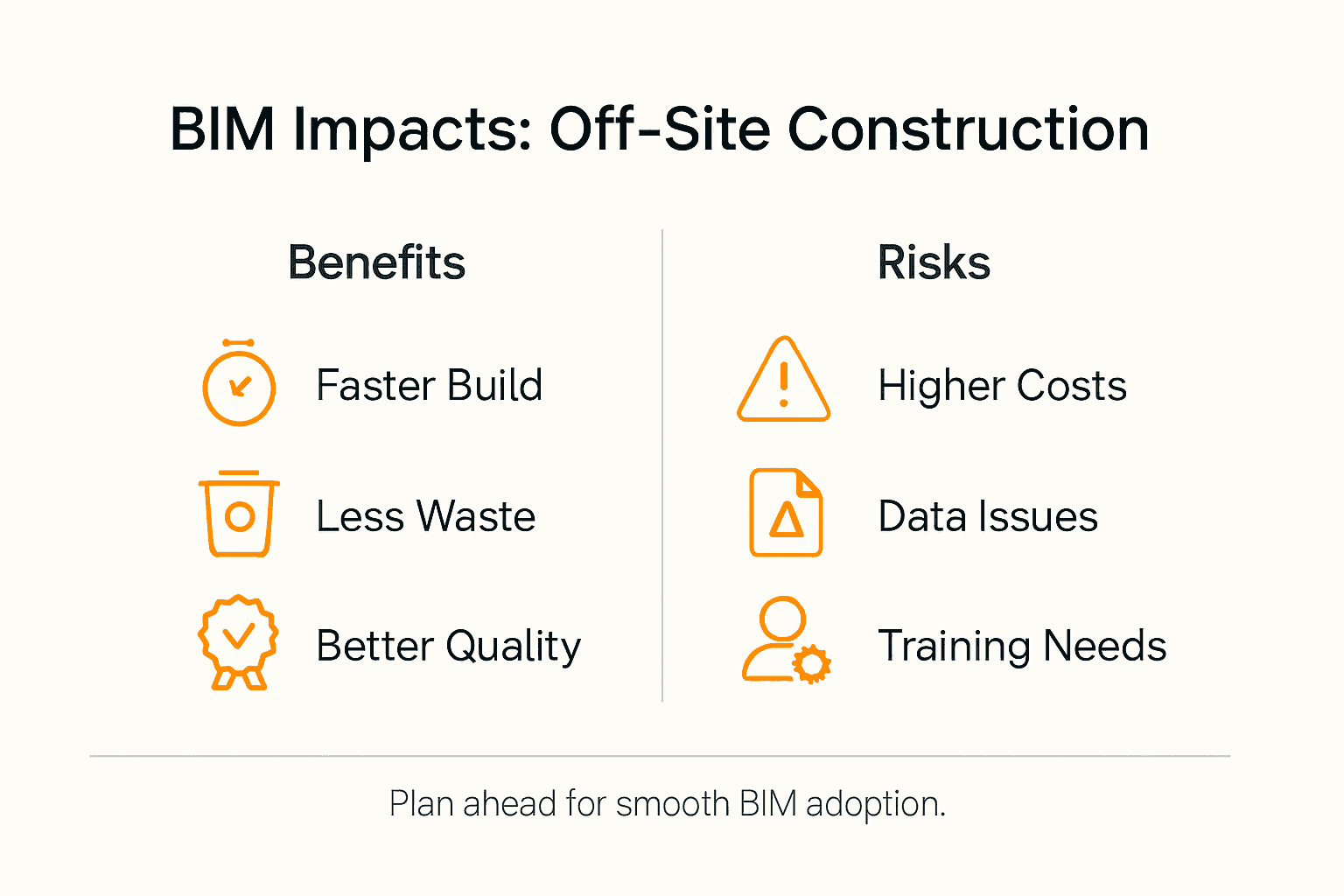
Implementing BIM in off-site construction presents complex financial and organizational challenges that require strategic planning and comprehensive risk management. Detailed evaluations reveal multiple critical factors influencing successful BIM integration, including substantial upfront technology investments, significant workforce training requirements, and potential resistance from traditional construction stakeholders.
The financial landscape of BIM implementation is characterized by substantial initial costs and potential short-term productivity disruptions. Technology integration complexity presents significant organizational risks, particularly in specialized construction sectors like healthcare and advanced manufacturing. These risks encompass workflow interruptions, extended learning curves for technical teams, and potential misalignment between digital expectations and practical implementation capabilities. Organizations must carefully balance the immediate financial investments against long-term efficiency gains and competitive advantages.
Technical challenges extend beyond monetary considerations, involving intricate data interoperability issues, standardization limitations, and skill gap uncertainties. Successful BIM adoption requires a holistic approach that addresses technological, human, and organizational dimensions simultaneously. This means developing comprehensive training programs, creating flexible implementation strategies, and fostering a culture of continuous learning and technological adaptation. Project teams must be prepared to invest not just financially, but also in cultural transformation and skill development.
Below is a summary of key organizational challenges when adopting BIM in off-site construction:
| Challenge Area | Common Risk | Strategic Mitigation |
|---|---|---|
| Financial | High upfront technology cost | Phased investment planning |
| Technical | Data interoperability issues | Adopt open data standards |
| Human Resources | Skill gaps in workforce | Comprehensive BIM training |
| Management | Resistance to workflow change | Stakeholder engagement early |
| Operations | Disrupted processes | Structured pilot projects |
Pro tip: Conduct a comprehensive organizational readiness assessment before full BIM implementation, identifying potential skill gaps and developing targeted training interventions to mitigate resistance and ensure smooth technological transition.
Avoiding Common BIM Adoption Mistakes
Successful BIM implementation in off-site construction demands strategic foresight and proactive planning. Comprehensive research identifies critical mistakes that can derail digital transformation efforts, highlighting the importance of understanding potential pitfalls before initiating BIM integration. Organizations frequently underestimate the complexity of transitioning from traditional design workflows to sophisticated digital modeling environments.
Stakeholder engagement represents a fundamental area where many off-site construction teams falter. Neglecting to involve key personnel from various disciplines during the early stages of BIM adoption can create significant resistance and implementation barriers. Successful BIM deployment requires carefully planned interoperability strategies, which means developing comprehensive training programs, establishing clear communication protocols, and creating a shared understanding of digital workflow expectations across different teams and organizational levels.
Technical challenges often emerge from insufficient pilot testing and premature full-scale implementation. Critical mistakes include rushing the digital transformation process, failing to customize BIM workflows to specific project requirements, and underestimating the necessary investment in personnel skill development. Successful organizations approach BIM adoption as a gradual, iterative process that requires continuous learning, adaptation, and a willingness to modify existing operational paradigms. This means developing robust change management strategies, creating phased implementation plans, and maintaining flexibility throughout the digital transformation journey.
Pro tip: Start with a small, well-defined pilot project to test BIM implementation, carefully documenting lessons learned and gradually expanding your digital capabilities across the organization.
Unlock the Full Potential of BIM for Off-Site Construction Projects
Navigating the complexities of BIM integration in off-site construction can seem overwhelming with challenges like workflow disruption, data management, and stakeholder coordination. You need marketing strategies that resonate with your technologically advanced workflow and highlight your expertise in generative design, manufacturing workflows, and real-time collaboration platforms. At BoxBuild Agency, we understand that capturing qualified leads for modular, prefab, and container-based building projects demands more than just generic marketing — it requires targeted digital growth solutions tailored to the off-site construction industry.
Leverage our expertise in AI and Funnels to streamline your client acquisition process while showcasing your mastery of BIM-enabled innovation. Whether you want to emphasize your capability in collision detection, visualization, or collaboration with advanced BIM models, we help position your brand as a trusted leader ready for the future of industrialized construction. Don’t let technical or organizational challenges slow your growth. Visit BoxBuild Agency today and start generating high-value project opportunities that reflect your cutting-edge BIM approach.
Frequently Asked Questions
What is Building Information Modeling (BIM) in off-site construction?
BIM in off-site construction is a digital approach that utilizes intelligent 3D models embedded with parametric information to improve project visualization, simulation, and optimization throughout the construction lifecycle.
How does BIM enhance collaboration among project teams in off-site construction?
BIM fosters collaboration by providing a shared digital environment where architectural, engineering, and manufacturing teams can access and modify design parameters simultaneously, reducing communication errors and minimizing costly rework.
What are the key benefits of using BIM applications for modular construction?
BIM applications offer benefits such as optimized spatial layouts via generative design, improved production control through automated workflows, enhanced visualization for design validation, and streamlined information management.
What common challenges do teams face when implementing BIM in off-site construction?
Common challenges include high upfront technology costs, data interoperability issues, skill gaps within the workforce, and potential resistance to changing existing workflows. It is crucial to address these challenges strategically to ensure successful implementation.
Recommended
- Off-Site Construction Terminology Explained: Key Insights – BoxBuild
- 7 Essential Off-Site Construction Best Practices – BoxBuild
- 7 Essentials for a Complete Off-Site Construction Checklist – BoxBuild
- Design-Build Method: Boosting Efficiency for Modern Builders – BoxBuild
- Construction Timeline Explained: Planning Success in Canada