
SYSTEM: REVENUE ENGINE — ONLINE
Construction growth, engineered
Your pipeline problem isn’t traffic. It’s trust.
BoxBuild is a construction-focused digital growth agency. We fix the trust, conversion, positioning, and follow-up problems that stop demand from becoming backlog.





The shortlist forms without you.
Owners, developers, and GCs vet you long before they call. They read your website the way they read a bid package: looking for reasons to disqualify. Thin proof, generic positioning, a site that looks like an afterthought — the shortlist forms without you, and you never hear about it.
The leads you do get die quietly. No response in the first hour. No structured follow-up across a sales cycle that runs months. Most construction firms don’t need more traffic; they need a system that converts the demand already reaching them. That’s what we build: trust, conversion, positioning, and follow-up, engineered as one machine.
From traffic to trust to signed contracts
01 / TRAFFIC
Traffic
Vertical SEO, AI-search visibility, and paid campaigns that reach owners and GCs while they’re still researching — before the RFP list is set.
02 / TRUST
Trust
Positioning and proof, built into a web presence that survives silent vetting. Your track record, delivery method, and safety story, presented the way buyers actually evaluate them.
03 / CONVERSION
Conversion & follow-up
Conversion paths that match how construction buys, backed by CRM automation that answers every inquiry fast and keeps the pipeline warm for months. No lead dies in an inbox.
One revenue system, five disciplines
Each service is a component of the same machine: put demand in front of the right buyers, prove you deserve the shortlist, and convert. Engage one lever or the whole system.
Website Design & Development
Construction website design and development engineered for trust and conversion, built for how owners, developers, and procurement teams actually vet builders.
Learn moreS.02Construction SEO
Construction SEO built around how owners research builders: vertical pages, technical SEO, and answer-engine optimization that reach buyers before the RFP.
Learn moreS.03Google Ads
Google Ads management for construction companies: vertical campaigns, landing pages built to convert, and reporting measured on qualified pipeline, not clicks.
Learn moreS.04CRM & Automation
CRM and automation for construction firms: instant lead response, staged nurture across long sales cycles, and pipeline visibility your leadership can trust.
Learn moreS.05AI Systems
AI systems for construction businesses: content engines, lead qualification, AI workflows, BI dashboards, and internal operating systems measured on results.
Learn moreSRC: VERIFIED
What one rebuilt system did
17×
quarterly lead-generating conversions on our flagship engagement
SRC — CUTTING EDGE HOMES — GA4, MAR–MAY 2025 VS FEB–APR 2026
3.5×
organic search users in the first quarter after the SEO programme launched
13 → 226
tracked conversions per quarter, same engagement, one year apart
IN THEIR WORDS
Clients on working with BoxBuild
“They bring structure, momentum, execution + strategic clarity.”
Working with BoxBuild Agency has been a valuable catalyst for our team. They helped bring structure and focus to our communication efforts by translating big-picture goals into clear, actionable steps. Their approach combines accountability and partnership. They keep us on track with timelines and commitments while also helping shape strategy, adapt when needed, and maintain forward momentum. What stood out most is their perspective. They bring clarity not only to execution, but also to how we think about both day-to-day operations and long-term strategy.
“They delivered exactly what they said, and then kept improving it.”
I’ve worked with a lot of vendors over the years, and BoxBuild stands out. They were highly responsive, quick to implement changes, and focused on the details that actually matter in practice, not just ticking boxes. What impressed me most is how invested they are in getting things right. They listen, adapt, and keep pushing until the outcome meets expectations. The work has already made a noticeable difference in how we present our offering and how clearly customers understand what we do.
CASE STUDY — FLAGSHIP
Cutting Edge Homes
Cutting Edge Homes — a California custom modular home builder with more than twenty years of delivery behind it — had demand reaching it, but nothing behind the website was built to capture it. In the quarter before the engagement, the site produced 13 tracked conversions. Paid traffic had no dedicated pages to land on, and inquiries lived in inboxes instead of a pipeline.
We rebuilt the machine end to end and sequenced it deliberately: Google Ads rebuilt and relaunched in June 2025, the new website live in August 2025, paid strategy recalibrated for lead quality in January 2026, and the SEO programme launched in April 2026 — with landing pages, email sequences, and CRM setup wired underneath from the start.
Read the full case study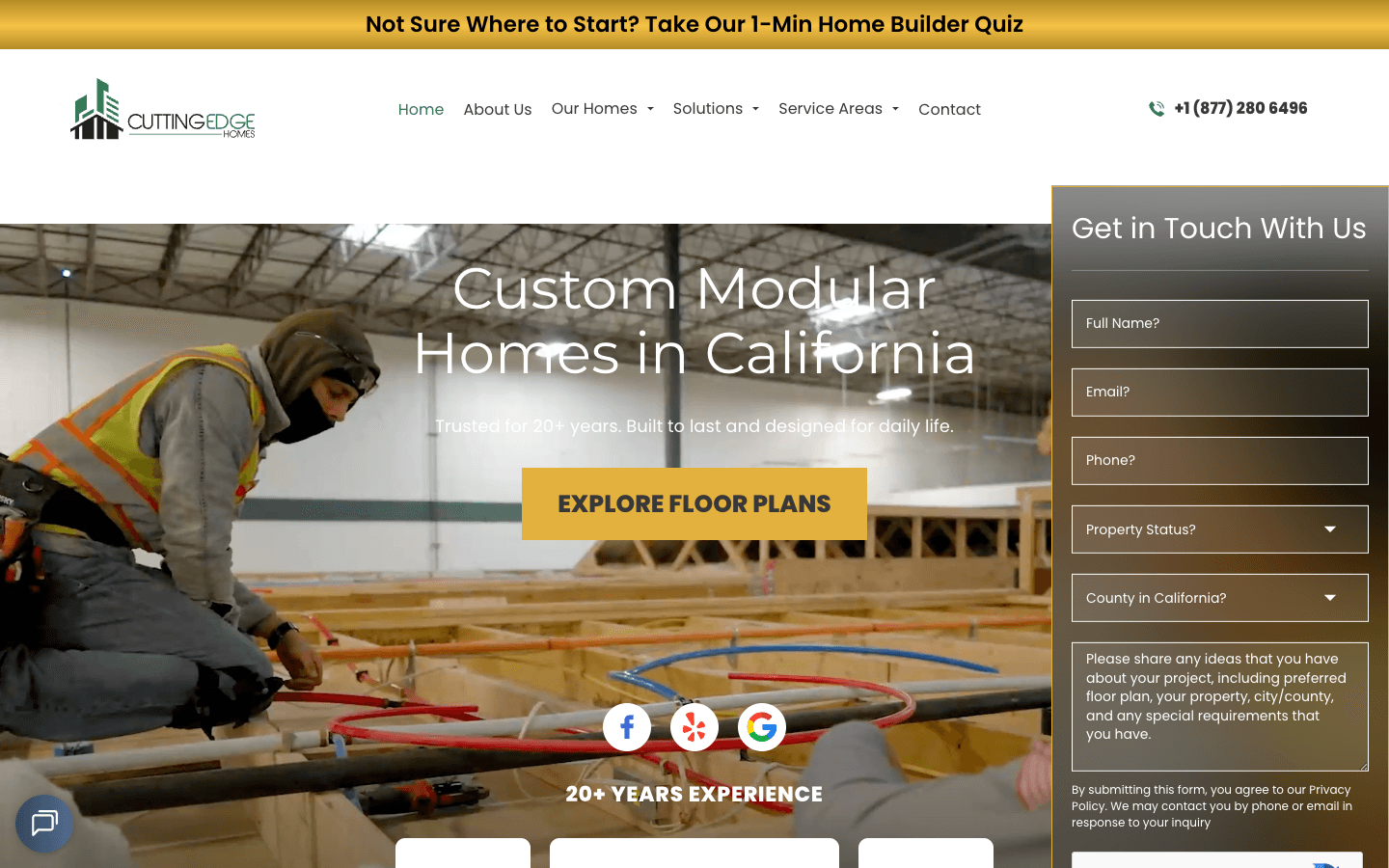
Built for the verticals driving this cycle
Data centers, power, industrial, healthcare, and the commercial GCs delivering it all. We build for more of the industry than this — but this is where capital is concentrating, so it’s where we concentrate proof.
Data Center Construction
BoxBuild positions data center contractors for hyperscale and colo procurement — trust, vertical content, and conversion built around how owners vet builders.
See how we helpIND.02Power & Energy Infrastructure
BoxBuild builds growth systems for power and energy contractors — positioning and conversion designed for utility, developer, and EPC procurement teams.
See how we helpIND.03Industrial & Manufacturing
BoxBuild positions industrial and manufacturing builders for reshoring-era capital projects — sector-fluent content, trust signals, and conversion systems.
See how we helpIND.04Healthcare Construction
BoxBuild builds growth systems for healthcare contractors — compliance-first positioning and conversion for hospital systems and medical facility owners.
See how we helpIND.05Commercial General Contractors
BoxBuild helps commercial GCs differentiate — positioning, proof, and follow-up systems that improve bid-hit ratios in the most crowded market in construction.
See how we helpIND.06Modular Construction
BoxBuild markets modular construction companies — education-first positioning, buyer-doubt content, and follow-up systems built for the volumetric sale.
See how we helpIND.07Prefab Construction
BoxBuild markets prefab construction companies — capturing method-stage research, answering buyer doubts, and converting curiosity into contracts.
See how we helpIND.08Panelized Construction
BoxBuild markets panelized construction firms — positioning speed, precision, and labor savings for the builders and owners who specify panels.
See how we helpIND.09Container Construction
BoxBuild markets container construction companies — legitimacy-first positioning that converts container curiosity into qualified, financeable projects.
See how we helpIND.10ADU Builders
BoxBuild markets ADU builders — local visibility, cost and permit education, and follow-up systems tuned to how homeowners buy backyard units.
See how we helpIND.11Custom Home Builders
BoxBuild markets custom home builders — portfolio-first trust, process transparency, and follow-up systems built for a seven-figure homeowner decision.
See how we helpIND.12Remodeling & Design-Build
BoxBuild markets remodeling and design-build firms — trust-first positioning and follow-up systems for a $518B market where homeowner anxiety decides.
See how we helpIND.13Specialty Trades
BoxBuild markets specialty trade contractors — roofing, concrete, electrical, plumbing, HVAC, excavation — for GC bid lists and direct work alike.
See how we helpIND.14Construction Suppliers
BoxBuild markets construction suppliers and building-product manufacturers — spec-ready content, specifier education, and lead systems that protect the spec.
See how we helpIND.15Architects & Designers
BoxBuild markets architecture and design firms — visible authority, niche positioning, and referral-ready presence for a market where billings are soft.
See how we helpFrequently asked questions
What does BoxBuild actually do?
BoxBuild builds revenue systems for construction companies. That means websites that survive buyer vetting, SEO and AI-search visibility, paid campaigns with proper landing pages, and CRM follow-up that works your pipeline while you run jobs. We work only in construction, with deep roots in off-site — volumetric modular, panelized, container-based building. The website is one component. The system is the product.
Why do you only work with construction companies?
Because construction buying works like no other market. Sales cycles run months to years, buyers vet you silently before they ever call, and credibility is judged in industry terms — backlog, bonding, delivery method, safety record. A generalist agency learns that on your budget. We already speak GC, design-build, and preconstruction, so we skip the education phase and go straight to what moves pipeline.
Do construction companies really have a traffic problem?
Usually not. Most construction firms we audit already have demand reaching them — the losses happen after the click. Visitors leave because the site fails their trust check, inquiries stall because follow-up is inconsistent, and positioning is too generic to earn a shortlist spot. We fix trust, conversion, positioning, and follow-up first. Only then does buying more traffic pay for itself.
How much does working with BoxBuild cost?
We don’t publish pricing — not as a sales tactic, but because a two-person ADU builder and a regional GC need very different systems, and pretending one price fits both would be dishonest. Every engagement is scoped to what your growth system actually needs: the levers involved, the verticals covered, the pace you want. You see exactly what a program costs, and what it’s accountable for, before you sign anything.
How is BoxBuild different from a generalist marketing agency?
Three ways. We work exclusively in construction, so nothing gets learned on your budget. We measure success in pipeline and backlog contribution, not traffic and impressions. And we build complete systems — positioning, website, search visibility, paid, and CRM follow-up — instead of selling one tactic and hoping the rest of your funnel holds. Generalists optimize for clicks. We optimize for awarded work.
Should we invest in SEO or Google Ads first?
Ads first if you need pipeline this quarter, SEO first if you can invest for compounding returns — but neither works until your site converts. Paid search buys immediate visibility and dies when you stop paying. SEO takes quarters to build and keeps producing after. Most clients run both: ads carry the near term while SEO and AI-search visibility take over the long term.
Insights
Thinking that wins work
Guides and playbooks on positioning, AI search, conversion, and follow-up — written for people who sell construction.
Trades & Suppliers Marketing: The 2026 Playbook for Subcontractors, Building-Product Manufacturers, and Design Firms
The supply side of construction — specialty trades, product suppliers, and the architects who specify them — wins work through verification, not advertising. GCs vet subs before bi…
Read the articleREF.02Residential Construction Marketing: The 2026 Playbook for Custom Builders and Remodelers
Residential construction marketing in 2026 is a trust game played during the homeowner’s silent research phase. Custom building holds about 20% of single-family starts (NAHB) and r…
Read the articleFind out where your pipeline leaks.
A 30-minute strategy call. We’ll walk your funnel end to end and show you where trust, conversion, or follow-up is costing you work — whether or not we ever work together.