Material prices remain stubbornly high, labor shortages slow deadlines, and digital tools promise new solutions. For Modular construction leaders, these obstacles aren’t just familiar headaches. They signal a turning point for how companies will compete and deliver value in 2025. This article explores how economic pressures, technology adoption, and sustainability expectations are redefining opportunities for those who want to thrive, not just survive, in the shifting global market.
Table of Contents
- Defining Construction Industry Trends For 2025
- Key Types: Modular, Prefab, Container
- Essential Technologies And Digital Advances
- Sustainability And Green Materials In Focus
- Legal, Safety, And Regulatory Changes Ahead
- Risks, Cost, And Competitive Considerations
Key Takeaways
| Point | Details |
|---|---|
| Core Trends | Construction in 2025 is driven by material costs, labor shortages, and sustainability demands, reshaping competitive dynamics in the industry. |
| Technology Adoption | Embracing digital tools like AI, BIM, and robotics is essential for improving efficiency and addressing labor shortages in modular construction. |
| Sustainability Focus | Clients now expect sustainability credentials, making it critical for builders to demonstrate environmental responsibility through measurable impacts. |
| Regulatory Compliance | Stricter regulations are emerging, requiring proactive management to ensure compliance and become a competitive advantage in project bidding. |
Defining Construction Industry Trends for 2025
Construction industry trends for 2025 represent much more than surface-level observations about what’s happening in the sector. They’re directional shifts that fundamentally reshape how modular builders operate, compete, and deliver value to clients. Understanding these trends means recognizing the intersection of three powerful forces: economic pressure, technological capability, and workforce reality. When you combine these forces, you get a clear picture of where the industry is actually heading, not where some analyst thinks it should go.
The core trends reshaping 2025 center on three areas. First, material costs and labor shortages continue to compress margins, particularly in emerging markets where modular solutions offer competitive advantages. Second, the industry is experiencing accelerated adoption of digital tools like scheduling software, drones, and robotics to compensate for workforce gaps. Third, sustainability requirements and government infrastructure investments are creating new opportunities for builders who can demonstrate environmental responsibility. These aren’t theoretical concerns for 2025—they’re already shaping which companies win projects and which ones struggle to stay profitable.
What makes 2025 distinct from previous years is the convergence of these trends with collaborative project delivery models. The construction industry is moving toward approaches where technology enables better coordination across teams, supply chains, and delivery phases. For modular leaders specifically, this means the competitive advantage no longer comes from simply having prefabrication capacity. Instead, it comes from demonstrating how your modular approach integrates with digital workflows, addresses labor constraints, delivers cost certainty amid price volatility, and meets sustainability benchmarks that clients now expect. The builders who treat these trends as operational challenges rather than business opportunities will find themselves increasingly sidelined by competitors who embrace them strategically.
Pro tip: Document how your current delivery process addresses at least three of these trends (cost control, labor efficiency, sustainability, or digital integration), then use this as your foundation for positioning your company in client conversations throughout 2025.
Key Types: Modular, Prefab, Container
Modular, prefab, and container-based construction aren’t interchangeable terms, though many people use them that way. Understanding the distinctions between these approaches matters because each type solves different problems and appeals to different project profiles. Modular construction involves building standardized units in a factory setting that arrive at the site substantially complete, then get assembled into the final structure. Prefabrication is broader and encompasses any building components or sections manufactured off-site before assembly on location. Container-based construction repurposes shipping containers as structural elements, offering a distinctive aesthetic and inherent structural framework. For your business strategy in 2025, recognizing these differences helps you position your capabilities accurately and target the right market segments.
The market opportunity across all three types is substantial. The modular and prefabricated construction sector is projected to reach $302 billion by 2035, growing at roughly 5.7% annually from a 2025 baseline of $173.5 billion. What drives this growth varies by type. Modular construction thrives because it delivers cost certainty, accelerates timelines, and scales across multiple project types. Prefabrication attracts builders seeking quality control and reduced on-site labor demands. Container-type buildings have carved out their niche by offering flexible, scalable solutions for temporary installations, permanent structures, and hybrid use cases. The growth engines fueling all three include cost savings compared to traditional construction, faster project delivery, sustainability credentials, and government infrastructure incentives that increasingly favor off-site methods.

Each type brings distinct competitive advantages worth emphasizing in your 2025 positioning. Steel remains the dominant material choice across modular and prefab projects, delivering durability and structural performance that clients understand and trust. Permanent modular construction appeals to healthcare, education, and hospitality sectors where quality, speed, and cost predictability matter most. Relocatable modular units capture demand from temporary housing, emergency response, and organizations needing scalable capacity without permanent commitments. Container-based approaches differentiate through visual distinctiveness and marketing appeal, particularly in retail, office, and creative workspace applications. Your competitive positioning should highlight which type aligns with your operational strengths and target market needs.
Here’s how modular, prefab, and container construction compare across critical dimensions:
| Construction Type | Typical Use Cases | Material Dominance | Key Client Benefits |
|---|---|---|---|
| Modular | Healthcare, education, hotels | Steel | Speed, cost certainty, quality |
| Prefab | Commercial, industrial, residential | Steel, concrete | Lower labor demands, quality control |
| Container | Retail, offices, creative spaces | Shipping containers | Flexibility, scalability, unique aesthetics |
Pro tip: Clearly articulate which construction type forms your core offering and which target sectors benefit most from that approach, then use specific project examples in your sales process to demonstrate how that type solved real problems for comparable clients.
Essential Technologies and Digital Advances
Technology adoption in modular construction separates market leaders from companies struggling with thin margins and delayed projects. The shift toward digital tools isn’t optional anymore. Emerging technologies like Building Information Modeling (BIM), Internet of Things (IoT), robotics, and artificial intelligence are fundamentally changing how construction gets planned, executed, and managed. What matters for your 2025 strategy is understanding which technologies deliver the highest return on investment for your specific business model. Some technologies solve immediate pain points like labor shortages. Others unlock future competitive advantages through data visibility and predictive capabilities. The construction industry historically moves slowly on digital adoption, but the companies recognizing that 2025 marks an inflection point will pull ahead significantly.
The practical technologies reshaping modular operations this year focus on three core areas. First, AI-driven project management streamlines scheduling and resource allocation with unprecedented accuracy, reducing costly delays and rework. Second, robotics and drones handle site surveying, inspections, and repetitive tasks that previously consumed skilled labor. Third, advanced BIM implementations create the digital backbone that connects design intent to manufacturing specifications to field execution. These three areas directly address the labor shortage crisis you’re facing, improve safety by removing workers from hazardous situations, and deliver cost predictability by catching errors before expensive corrections become necessary.
What separates successful adoption from failed technology investments is understanding that these tools work together as a system, not standalone applications. BIM, IoT, robotics, and AI working together enable what experts call Construction 5.0, creating a data-driven workflow where factory equipment communicates with site logistics, quality metrics feed back into design optimization, and predictive analytics surface problems before they impact schedules. The barrier to adoption isn’t technology capability anymore. It’s investment in implementation, training your teams to actually use these tools effectively, and building cross-functional collaboration so that manufacturing, procurement, and site teams work from shared intelligence. Your 2025 competitive position depends partly on which technologies you deploy, but more importantly on how thoroughly you embed them into your operational processes.
Below is a summary of how current technologies impact modular construction business outcomes:
| Technology | Core Application | Business Impact |
|---|---|---|
| AI Project Management | Scheduling, resource allocation | Cuts delays, increases accuracy |
| Robotics & Drones | Surveying, inspections | Boosts safety, reduces labor needs |
| Advanced BIM | Digital design coordination | Minimizes errors, enhances planning |
Pro tip: Start with one high-impact technology that directly addresses your biggest operational pain point (whether that’s labor efficiency, quality control, or schedule predictability), implement it thoroughly across a pilot project, measure the results precisely, then scale based on proven ROI rather than chasing every new tool.
Sustainability and Green Materials in Focus
Sustainability has shifted from a marketing advantage to a business necessity for modular builders in 2025. The buildings and construction sector accounts for 40% of global CO2 emissions and 32% of energy consumption, making it a primary target for decarbonization efforts globally. What this means for your business is straightforward: clients increasingly expect sustainability credentials, regulators are tightening building codes around energy efficiency, and governments are channeling infrastructure investments toward projects that meet net-zero commitments. The catch is that green materials and sustainable practices carry higher upfront costs, creating tension between client budgets and environmental performance. Modular construction actually positions you well to navigate this challenge because factory-based production generates less waste, consumes less energy per unit produced, and enables precision material use that traditional construction struggles to match.
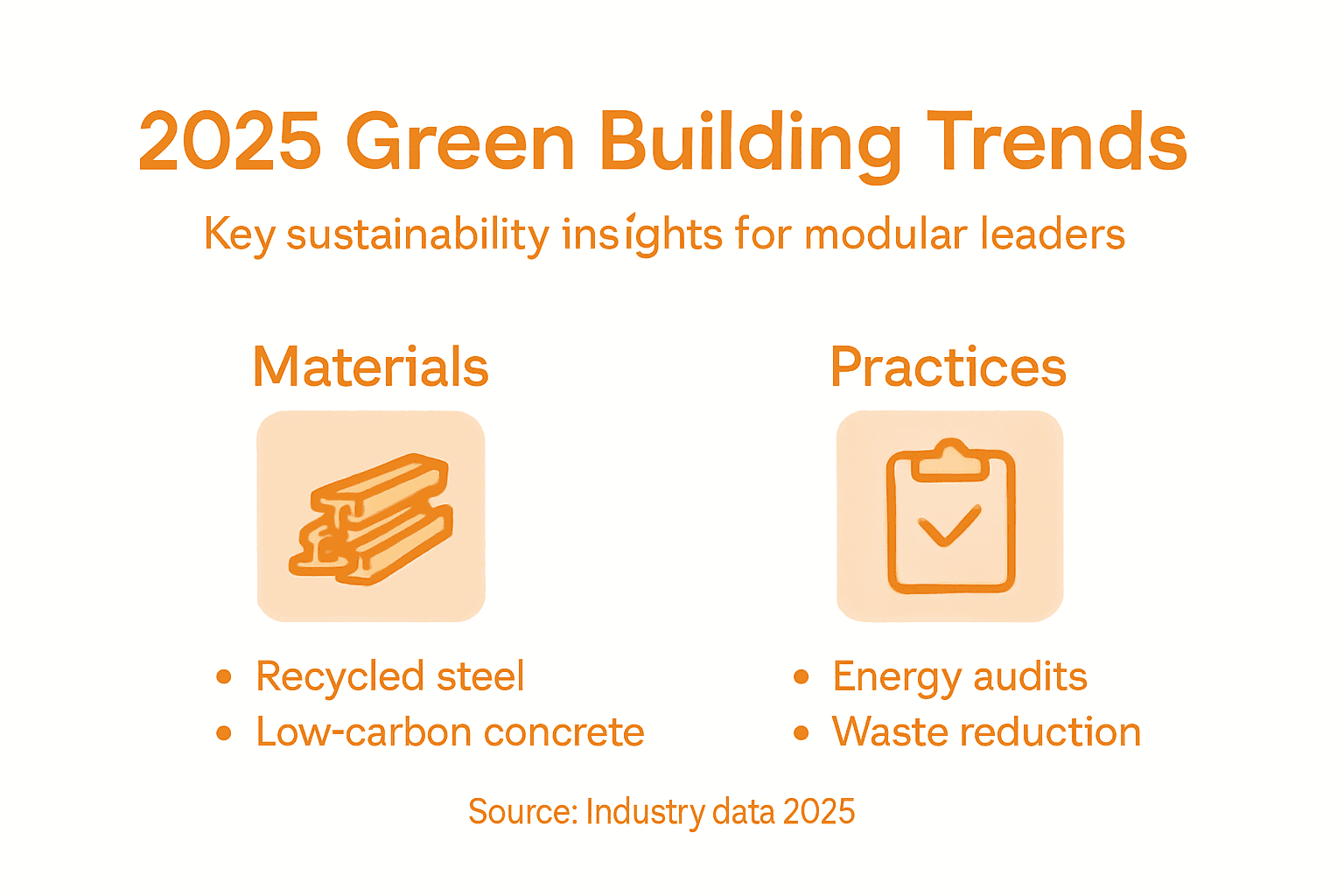
The real sustainability opportunity for modular leaders involves understanding what your clients actually prioritize. Initial costs and lack of ROI evidence remain the biggest barriers to green building adoption, even as demand growth continues in certain regions. This tells you something important: clients want sustainability, but they need proof that it delivers financial benefit or at minimum doesn’t penalize their project economics. Your competitive positioning should emphasize how modular approaches reduce material waste by 50% or more compared to traditional construction, lower embodied carbon through optimized material use, and often deliver faster occupancy timelines that reduce financing costs. Where possible, quantify these benefits in terms clients understand: dollars saved, timeline compression, and long-term operating cost reduction through energy efficiency.
Implementing sustainability in your 2025 operations requires specific, measurable actions beyond general green claims. Start by mapping your material supply chain to understand which inputs carry the highest carbon footprint, then identify lower-impact alternatives that perform equally. Steel and concrete remain dominant materials, but recycled steel content, supplementary cementitious materials, and cross-laminated timber offer viable alternatives depending on project type. Establish waste reduction targets for your manufacturing facilities, capture and report accurate carbon metrics for each project type, and invest in supplier partnerships with companies committed to decarbonization. The companies winning sustainability-focused projects aren’t those making vague environmental promises. They’re those providing transparent carbon accounting, demonstrating measurable impact reduction, and helping clients understand total cost of ownership including energy performance over the building lifecycle.
Pro tip: Develop a simple carbon calculator or specification sheet for your core project types showing embodied carbon, operational energy efficiency, and lifecycle cost comparisons against traditional construction methods, then use this as a differentiator in every proposal to demonstrate genuine sustainability commitment backed by data.
Legal, Safety, and Regulatory Changes Ahead
Regulatory frameworks governing construction are tightening across all major markets, and modular builders operating internationally or planning expansion need to understand what’s coming. The UK government has announced plans for a Single Construction Regulator designed to unify oversight of buildings, products, and professionals in response to the Grenfell Tower Inquiry. This represents a fundamental shift from fragmented regulatory systems toward centralized accountability and enforcement. The new framework prioritizes safety, quality, and industry competence with phased implementation planned through 2026. Similar regulatory consolidation pressures are emerging across Europe, North America, and Asia-Pacific regions, all pushing toward stricter standards and more rigorous enforcement. For your business, this means that regulatory compliance is no longer a box-checking exercise. It’s a core competitive differentiator that influences which projects you can bid on and which clients will trust you with high-value work.
The specific legal and safety changes reshaping 2025 operations focus on several interconnected areas. Building safety reforms include stricter fire safety standards and sustainability compliance alongside evolving planning reforms designed to accelerate development. These requirements interact in complex ways. A project might need to meet tighter fire safety codes while simultaneously demonstrating carbon performance and energy efficiency improvements. Workforce development is also becoming a legal liability issue as regulators shift responsibility for construction defects and insurance coverage toward builders rather than distributing risk across multiple parties. This means your quality assurance processes, training documentation, and safety protocols become legally consequential in ways they weren’t before. Companies with transparent documentation of how they manage quality, train workers, and verify compliance will defend themselves far better in disputes than those relying on informal processes.
The operational reality of navigating these changes requires proactive rather than reactive strategies. Start by mapping which regulatory jurisdictions your current and planned projects occupy, then identify the specific requirements for each. Document your current processes against these standards and identify gaps honestly. Invest in staff training around new requirements before they become mandatory, establishing internal expertise that competitors may lack. For modular builders specifically, leverage the factory-based environment to implement stricter quality controls and safety protocols more systematically than site-based construction allows. Your factory becomes a regulatory asset demonstrating consistent compliance. Build relationships with regulatory bodies and industry associations in your key markets. Companies that engage constructively with regulators during implementation phases often gain competitive advantage by understanding requirements earlier than competitors and positioning themselves as compliant leaders rather than reluctant followers.
Pro tip: Assign one person or team to monitor regulatory changes in each jurisdiction where you operate, establish a quarterly review process to assess impact on your operations, and update your compliance documentation before new rules take effect rather than scrambling during enforcement transition periods.
Risks, Cost, and Competitive Considerations
The 2025 construction environment presents a paradox for modular leaders. Growth opportunities exist, but the path to capturing them is lined with financial and operational hazards. The primary risk factors you face center on three interconnected pressures: cost volatility, labor availability, and competitive intensity. Material prices remain elevated despite easing inflation, creating margin compression especially in fixed-price contracts signed months earlier. Labor shortages persist in most advanced markets, driving wage inflation that directly impacts profitability. Supply chain fragility adds unpredictability to project timelines and costs. What separates thriving modular builders from struggling ones isn’t immunity to these risks. It’s having systems and strategies to absorb them without passing excessive costs to clients or sacrificing profitability.
Inflationary pressures, labor shortages, and supply chain disruptions create compounding financial risks that demand proactive management. When material costs spike unexpectedly, your fixed-price contract suddenly becomes unprofitable. When skilled labor gets harder to find, wage pressure accelerates. When suppliers face geopolitical disruptions, your project timeline extends. The firms managing these challenges most effectively use several concrete strategies: financial vetting of suppliers and subcontractors to identify stability early, fixed-price contracts with appropriate escalation clauses that protect margins without pricing yourself out of competitiveness, workforce development programs that reduce reliance on external labor markets, and enhanced safety training that reduces costly incidents and rework. For modular builders specifically, your factory environment offers an advantage here. You can standardize processes, train workers thoroughly, and implement quality controls that minimize rework more effectively than site-based construction allows.
Your competitive position depends increasingly on risk management capabilities that clients recognize and value. Top construction risks including labor shortages, material cost volatility, and regulatory challenges affect project timelines, budgets, and profitability directly. Mitigation strategies that work include supplier diversification so you’re not dependent on single sources, contract structures that align risk appropriately between parties, and adoption of cost-efficient designs that deliver value without bloated specifications. The companies winning premium contracts and repeat business are those demonstrating they’ve thought through these risks and built resilience into their operations. This translates into client conversations where you articulate clearly how your modular approach reduces schedule risk through factory control, manages cost risk through precision manufacturing, and addresses labor risk through standardized training. Clients increasingly want partners who can absorb shocks and still deliver on commitments.
Pro tip: Build a quarterly risk register documenting your top five financial and operational risks, assign ownership for each, establish monitoring metrics, and review it with your leadership team to surface emerging threats before they cascade into project crises.
Master 2025 Construction Trends with Strategic Digital Growth
Facing rising material costs, labor shortages, and the urgent need for sustainability means modular leaders must sharpen their competitive edge. The article outlines how digital integration and risk management are no longer optional but essential to thrive. If you want to convert these industry challenges into growth opportunities you need a partner who understands the modular construction market inside out.
At BoxBuild Agency we specialize in accelerating modular, prefab, and container construction businesses through targeted, data-driven marketing strategies. From optimizing your Funnels – BoxBuild to harnessing cutting-edge AI – BoxBuild tools and precision Google Ads – BoxBuild campaigns we position you as a trusted market leader ready for 2025 and beyond.
Don’t let cost volatility or labor constraints define your growth. Partner with BoxBuild Agency today to build a digital presence that reflects your operational excellence and sustainability commitments. Visit BoxBuild Agency to learn how we can help you win high-value construction projects with confidence.
Frequently Asked Questions
What are the key trends shaping the construction industry in 2025?
The primary trends include rising material costs, labor shortages, accelerated adoption of digital tools, and increasing sustainability requirements. These trends are reshaping how modular builders operate and compete in the market.
How does technology impact modular construction in 2025?
Technology adoption, including AI, robotics, and advanced Building Information Modeling (BIM), enhances project management, improves safety, and streamlines operations. It allows modular builders to address labor shortages, reduce errors, and enhance cost predictability.
What distinguishes modular construction from prefab and container construction?
Modular construction involves creating complete units off-site which are then assembled on location. Prefabrication encompasses constructing any building components off-site, and container construction utilizes shipping containers as structural elements. Each approach serves different project needs and offers unique benefits.
Why is sustainability important for modular builders in 2025?
Sustainability is not just a competitive advantage; it is essential for meeting client expectations and regulatory requirements. Modular construction can reduce waste, lower energy consumption, and help meet net-zero commitments, making it a desirable option for environmentally-conscious projects.
Recommended
- 7 Key Modular Home Design Best Practices for Builders – BoxBuild
- Design-Build Method: Boosting Efficiency for Modern Builders – BoxBuild
- Apply 2025 Website Trends for Builders: A Step-by-Step Guide – BoxBuild
- Automation in Construction: Boosting Modular Efficiency – BoxBuild
- Protective Coating Trends 2025: Innovations for Infrastructure