Nearly half of American off-site construction marketers admit their websites lose potential leads due to poor technical setup and confusing navigation. For mid-level managers juggling tight deadlines and client expectations, every missed opportunity can impact business growth. This guide offers a step-by-step approach to auditing performance, refining specialized content, and elevating user experience—all proven strategies for maximizing lead capture and online visibility in a competitive global market.
Table of Contents
- Step 1: Audit Site Performance And Technical Setup
- Step 2: Refine Content For Industry Relevance
- Step 3: Enhance User Experience And Navigation
- Step 4: Implement SEO Strategies For Higher Rankings
- Step 5: Verify Lead Capture And Conversion Processes
- Step 6: Monitor Results And Adjust For Growth
Quick Summary
| Key Insight | Explanation |
|---|---|
| 1. Conduct a Performance Audit | Utilize tools like Google PageSpeed Insights to identify website performance issues that hinder lead conversion. |
| 2. Create Relevant Content | Develop tailored resources that address specific challenges in off-site construction to resonate with your target audience. |
| 3. Enhance User Experience | Design intuitive navigation paths that make it easy for construction professionals to find important information quickly. |
| 4. Optimize for SEO | Implement targeted SEO strategies focusing on industry-specific keywords to improve your search rankings and attract leads. |
| 5. Monitor and Adjust | Regularly track performance metrics and optimize strategies based on data insights for continual improvement. |
Step 1: Audit site performance and technical setup
A thorough website performance audit helps you diagnose hidden issues preventing potential leads from converting. By systematically evaluating your site’s technical infrastructure, you can identify bottlenecks that might be silently driving away valuable construction project prospects.
Begin your audit by leveraging specialized tools that comprehensively analyze your website’s performance. A complete website audit helps uncover optimization challenges including page load speed, mobile responsiveness, and technical SEO factors. Start with free tools like Google PageSpeed Insights and Google Search Console to get an initial technical assessment. These platforms will generate detailed reports showing exactly where your website might be underperforming.
Focus on key technical metrics that impact user experience and search rankings. Check your site’s loading times across desktop and mobile devices, verify that all links are functional, and ensure your website’s architecture supports smooth navigation. Pay special attention to mobile optimization since many off-site construction professionals research solutions on smartphones and tablets.
Pro Tip: Run your performance audit during low-traffic periods to minimize potential disruption to your website’s daily operations and capture the most accurate technical snapshot.
Here’s a quick reference on website audit tools and their core benefits for construction industry websites:
| Tool Name | Main Function | Unique Benefit |
|---|---|---|
| Google PageSpeed Insights | Analyzes load speed and issues | Improves mobile performance |
| Google Search Console | Monitors search presence | Helps fix SEO errors |
| GTmetrix | Advanced speed diagnostics | Identifies resource bottlenecks |
| Screaming Frog | Crawls site for technical SEO | Discovers broken links |
Step 2: Refine content for industry relevance
Creating content that resonates with off-site construction professionals requires a strategic approach that goes beyond generic marketing materials. Your goal is to develop resources that speak directly to the unique challenges and opportunities within the modular and prefab building sectors.
Industry specific content is crucial for professional skill growth, especially in technical fields like construction. Focus on developing resources that showcase real-world applications, technical insights, and practical solutions specific to off-site construction. This means crafting articles, case studies, and guides that demonstrate deep understanding of modular building techniques, innovative design approaches, and project management strategies unique to your target audience.
Target your content by interviewing industry experts, analyzing current project trends, and incorporating technical details that prove your understanding of off-site construction challenges. Include specific examples like cost comparisons between traditional and modular building methods, sustainability advantages of prefab construction, or technical breakdowns of advanced manufacturing processes. By providing nuanced, technically precise content, you position your brand as a knowledgeable partner rather than a generic service provider.
Pro Tip: Create a content library that includes technical white papers, project case studies, and industry trend reports to establish your credibility and attract high-value leads.
Step 3: Enhance user experience and navigation
Improving website usability for off-site construction professionals requires a strategic approach that transforms your digital platform into an intuitive resource for potential clients. Your goal is to create a seamless navigation experience that guides visitors effortlessly through your service offerings and technical capabilities.

User experience strategies are critical for reducing digital interaction friction and keeping potential leads engaged. Focus on designing clear, logical navigation paths that help construction industry professionals quickly find the information they need. This means developing a website structure that reflects how off-site construction decision makers actually search for solutions such as creating distinct sections for project types, technical specifications, case studies, and service breakdowns.
Implement navigation best practices specifically tailored to technical professionals. Use clear, descriptive menu labels that speak directly to modular and prefab construction challenges. Ensure that critical information like project timelines, cost estimates, and technical capabilities are no more than two clicks away from your homepage. Organize content hierarchically with primary navigation categories that address specific construction segments such as residential modular, commercial prefab, and specialized container solutions. By creating an intuitive user journey, you demonstrate professional understanding and make it easier for potential clients to evaluate your expertise.
Pro Tip: Conduct periodic user testing with actual construction industry professionals to continuously refine your website navigation and identify potential usability barriers.
Step 4: Implement SEO strategies for higher rankings
Successfully positioning your off-site construction website in search results requires a strategic and comprehensive approach to search engine optimization. Your mission is to develop an SEO strategy that elevates your online visibility and attracts high-value construction leads.
An effective SEO strategy begins with setting clear business-aligned goals that directly connect your digital marketing efforts to actual project acquisitions. For off-site construction professionals, this means targeting keywords specific to modular building, prefab construction, and specialized architectural solutions. Focus on developing content that addresses technical search queries potential clients might use such as “modular home design costs” or “prefab commercial building solutions.”
Create a targeted SEO approach that combines technical optimization with industry relevant content. Optimize your website architecture to ensure search engines can easily crawl and understand your specialized construction services. This includes implementing structured data markup for construction projects, developing location-specific pages for different regional markets, and creating comprehensive project case studies that demonstrate technical expertise. Build high quality backlinks by contributing guest articles to construction industry publications, participating in technical forums, and showcasing your unique modular building innovations.
Pro Tip: Develop a quarterly content and keyword review process to continuously refine your SEO strategy and stay ahead of emerging construction industry search trends.
Step 5: Verify lead capture and conversion processes
Effective lead management demands a systematic approach that transforms website visitors into qualified construction project opportunities. Your goal is to create a robust lead capture system that seamlessly tracks potential clients through every stage of their decision making process.
Lead management involves systematically capturing, tracking, nurturing, and converting leads with precision and strategic intent. For off-site construction businesses, this means implementing multiple touchpoints that capture detailed information about potential project requirements. Design contact forms that request specific details like project type, estimated budget, timeline, and technical specifications. Integrate intelligent form validation that ensures you collect comprehensive information while maintaining a smooth user experience.
Implement advanced tracking and qualification mechanisms to prioritize and nurture leads effectively. Develop a lead scoring model that evaluates potential clients based on their project complexity, budget range, and alignment with your specialized construction services. Use marketing automation tools to segment leads, trigger personalized follow up communications, and route high potential prospects directly to your sales team. Create automated email sequences that provide targeted content demonstrating your technical expertise in modular and prefab construction solutions.
Pro Tip: Configure your lead management system to automatically flag and escalate leads matching your ideal customer profile within 24 hours of initial contact.
Compare traditional construction lead qualification vs. automated digital lead processes:
| Qualification Type | Data Accuracy | Speed to Sales Team | Scalability |
|---|---|---|---|
| Manual (Traditional) | Often incomplete | Several days | Limited by staff |
| Automated Digital Processes | Highly detailed | Immediate notification | Handles large volumes |
Step 6: Monitor results and adjust for growth
Successfully optimizing your website for lead generation requires consistent performance tracking and strategic refinement. Your ultimate goal is to transform data insights into actionable improvements that continuously enhance your digital marketing effectiveness.
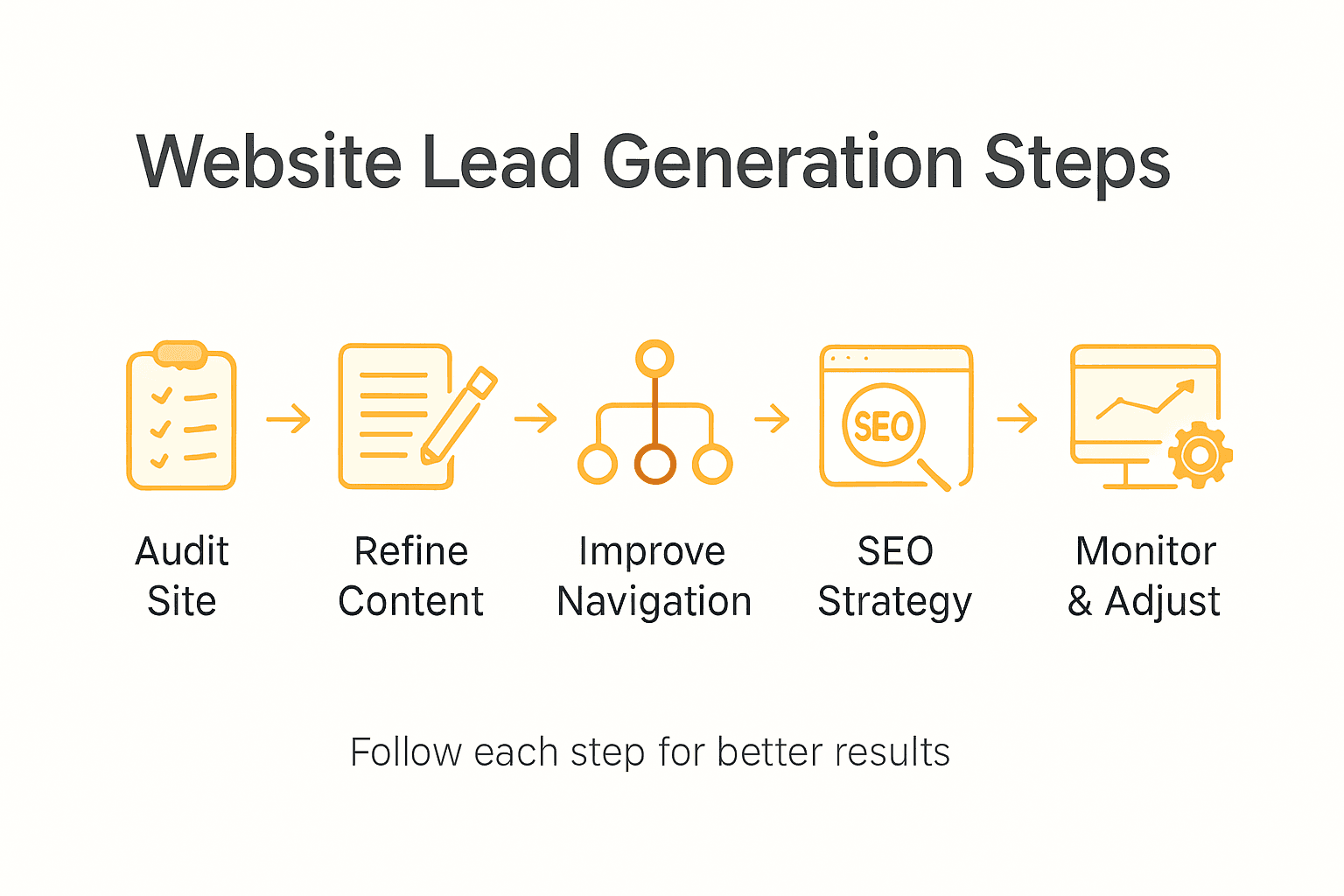
Progress monitoring is about setting clear goals, efficiently tracking meaningful data, and using insights to adjust strategies that drive tangible business results. For off-site construction professionals, this means developing a comprehensive analytics framework that goes beyond surface-level metrics. Implement robust tracking tools that measure key performance indicators specific to your industry such as project inquiry rates, consultation request conversions, and geographic lead distribution.
Establish a systematic review process that allows you to diagnose website performance with surgical precision. Create monthly performance dashboards that highlight conversion rates, user engagement metrics, and lead quality indicators. Compare your results against predefined benchmarks for off-site construction marketing, identifying both strengths to amplify and potential optimization opportunities. Use advanced analytics segmentation to understand how different audience groups interact with your website, allowing you to develop increasingly targeted content and conversion strategies.
Pro Tip: Schedule quarterly comprehensive performance reviews that include cross-functional insights from sales, marketing, and technical teams to ensure a holistic approach to continuous improvement.
Unlock Maximum Lead Generation With Expert Website Optimization
Struggling to convert off-site construction visitors into qualified leads is a common challenge. This article highlights how auditing site performance, refining industry-specific content, enhancing navigation, and implementing targeted SEO are critical steps to overcome these hurdles. Pain points like slow load times, unclear user journeys, and weak lead capture systems can silently sabotage your growth. With the right strategy, you can position your modular, prefab, and container-based building business to close more high-value projects.
At BoxBuild Agency, we specialize in turning these complex optimization steps into actionable results. Our expertise in creating strategic Funnels tailored for the off-site construction industry ensures your website not only attracts but also converts the right leads. Combine that with data-driven marketing powered by Google Ads and innovative AI solutions to take your lead generation to the next level.
Ready to transform your website into a powerful lead generation tool that delivers qualified construction project opportunities? Visit BoxBuild Agency today to see how our specialized approach can help you optimize every step from audit to conversion. Act now to secure your position as a trusted market leader and watch your high-value projects multiply.
Frequently Asked Questions
How can I audit my website’s performance for lead generation?
A thorough website performance audit identifies issues that prevent potential leads from converting. Begin by using specialized tools to analyze load speeds and functionality, and make necessary adjustments to enhance user experience.
What content should I create to attract off-site construction professionals?
Focus on developing content that addresses the unique challenges in off-site construction. Create articles, case studies, and guides with real-world applications and technical insights to engage your target audience effectively.
How can I improve the user experience on my website?
Enhance website usability by designing clear navigation paths that make it easy for users to find information. Organize content logically, ensuring critical details are accessible within two clicks from the homepage.
What SEO strategies should I implement to increase my website’s visibility?
Develop a targeted SEO strategy by optimizing your website architecture and content for specific construction-related keywords. Continually review and refine your approach to stay ahead of emerging industry search trends.
How can I verify that my lead capture process is effective?
Implement a robust lead management system that tracks potential clients effectively. Use advanced tracking mechanisms and ensure your contact forms gather detailed project information to qualify leads accurately.
How do I monitor the results of my website optimization efforts?
Set up a comprehensive analytics framework to measure key performance indicators related to lead generation. Schedule regular reviews to assess performance metrics and adjust strategies for continuous improvement.