Most American modular builders spend nearly a third of their time wrangling leads and tracking project details across scattered tools. When workflows become fragmented, costs rise and client satisfaction drops. Efficient construction CRM systems are changing the way professionals manage projects, bringing order to complex prefabricated processes for modular builders everywhere. Discover how the right CRM solution delivers smoother lead management and sharper client relationships in modular construction.
Table of Contents
- Defining Construction CRM for Modular Builders
- Types of Construction CRM Systems and Their Distinctions
- Key Features Supporting Modular and Prefab Workflows
- Integration, Automation, and Real-World Use Cases
- Costs, Common Pitfalls, and Choosing the Right CRM
Key Takeaways
| Point | Details |
|---|---|
| Understand CRM Specialization | Construction CRMs for modular builders are tailored to manage complex project workflows and client relationships, surpassing generic contact management tools. |
| Focus on Integration | Choose CRM solutions that integrate seamlessly with existing design, engineering, and project management tools to enhance operational efficiency. |
| Conduct Workflow Audits | Before selecting a CRM, perform a comprehensive audit of current processes to ensure the chosen platform addresses specific needs and avoids unnecessary complexities. |
| Be Aware of Costs | Different CRM tiers offer varied features, so evaluate each option based on scalability and alignment with business objectives to avoid pitfalls in implementation. |
Defining Construction CRM for Modular Builders
A Construction CRM represents a specialized digital platform designed specifically for construction professionals to manage complex client relationships, project workflows, and sales pipelines. For modular builders, these systems go far beyond traditional contact management – they serve as mission-critical infrastructure for tracking leads, coordinating stakeholders, and maintaining precise project visibility.
Modern construction CRM platforms are engineered to address the unique challenges of prefabricated building projects. Unlike generic customer management tools, these solutions centralize sales and client communications across intricate project lifecycles. They enable modular builders to track potential clients from initial inquiry through design, fabrication, transportation, and final installation – creating a seamless digital environment that supports rapid decision making and transparent collaboration.
The core capabilities of construction CRM systems for modular builders typically include:
- Comprehensive lead tracking and qualification processes
- Detailed project management dashboards
- Real-time communication logs with clients and subcontractors
- Automated proposal and contract management
- Financial tracking and budget monitoring
- Integration with design and engineering software platforms
Pro Tip for Modular Builders: Invest time in thoroughly mapping your current sales and project management workflows before selecting a construction CRM. Understanding your specific operational requirements will help you choose a solution that truly transforms your business efficiency, rather than adding unnecessary complexity.
Types of Construction CRM Systems and Their Distinctions
Construction CRM systems are not one-size-fits-all solutions, and understanding their diverse typologies is crucial for modular builders seeking optimal workflow management. Different CRM platforms offer varying approaches to project tracking and client relationship management, ranging from generic contact management tools to highly specialized construction-specific systems designed for complex building workflows.
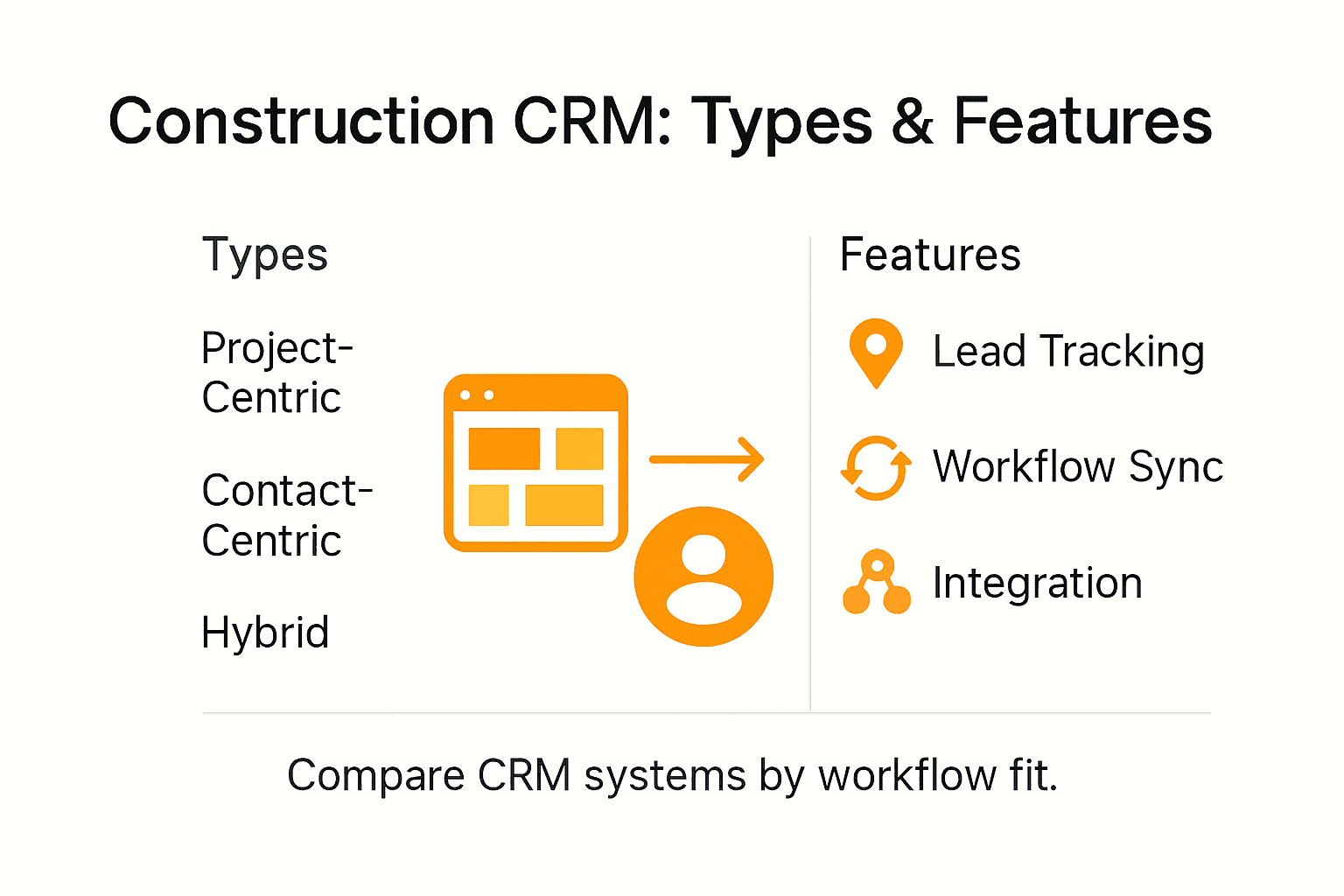
Two primary categories emerge in the construction CRM landscape: project-centric systems and contact-centric platforms. Project-centric CRMs are specifically engineered for modular builders, focusing on tracking entire project lifecycles rather than simply managing individual client interactions. These specialized systems integrate critical functionalities like:
- Detailed project timeline tracking
- Stakeholder communication management
- Budget and resource allocation monitoring
- Design and engineering workflow integration
- Automated reporting and documentation
In contrast, contact-centric CRMs represent more generic customer relationship management tools that may require significant customization to meet modular construction requirements. These systems prioritize client interaction tracking over comprehensive project management, potentially creating operational gaps for complex prefabrication projects that demand intricate coordination between design, manufacturing, transportation, and installation stages.
Here’s a comparison of project-centric and contact-centric construction CRM systems for modular builders:
| Criteria | Project-Centric CRM | Contact-Centric CRM |
|---|---|---|
| Project Lifecycle View | Full workflow visibility | Limited, focused on client info |
| Customization Level | Highly tailored for modular | Requires extensive modification |
| Collaboration Support | Advanced stakeholder tools | Basic client communication |
| Integration Ability | Integrates with design tools | Minimal platform integrations |
Pro Tip for Modular Builders: Always conduct a comprehensive workflow audit before selecting a CRM system. Map out your specific operational requirements, communication channels, and project tracking needs to ensure the chosen platform can genuinely streamline your unique business processes.
Key Features Supporting Modular and Prefab Workflows
Construction CRM systems for modular builders require specialized features that transcend traditional customer management platforms. Digital technologies are transforming how modular construction workflows integrate technology and project management, creating more streamlined and intelligent project tracking mechanisms.
The most advanced CRM solutions for modular builders incorporate sophisticated technological integrations designed to support complex off-site construction processes. Key features that distinguish these specialized platforms include:
- Building Information Modeling (BIM) Integration
- Real-time project tracking and documentation
- Mobile field access and remote collaboration tools
- Automated stakeholder communication workflows
- Digital document management and version control
- Comprehensive project pipeline visualization
Modular construction CRM systems now support intricate coordination across design, manufacturing, transportation, and installation stages, enabling builders to manage complex project ecosystems with unprecedented precision. These platforms leverage advanced technologies to create transparent, efficient communication channels that reduce errors, minimize delays, and optimize resource allocation across multifaceted construction projects.

Pro Tip for Modular Builders: Prioritize CRM solutions with robust integration capabilities that can seamlessly connect with your existing design, engineering, and project management tools to create a unified technological ecosystem.
Integration, Automation, and Real-World Use Cases
Modular builders increasingly recognize that CRM integration and automation represent more than technological upgrades—they are fundamental transformations of business operations. The strategic implementation of CRM technologies can revolutionize how construction companies manage complex project workflows, creating unprecedented efficiency and communication precision.
Real-world automation in construction CRM systems typically manifests through several critical processes:
- Automated bid management and proposal generation
- Real-time project progress tracking
- Intelligent resource allocation algorithms
- Dynamic client communication scheduling
- Seamless data synchronization across platforms
- Predictive analytics for project forecasting
These technological integrations enable modular builders to transcend traditional operational limitations. By connecting disparate systems—from design software and manufacturing platforms to financial tracking and client management tools—construction CRMs create a unified technological ecosystem that dramatically reduces administrative overhead, minimizes human error, and accelerates project timelines. Automated workflows allow teams to focus on strategic decision making rather than getting lost in manual data entry and communication management.
Pro Tip for Modular Builders: Conduct a comprehensive workflow audit before implementing CRM automation, identifying specific repetitive tasks that consume significant time and could benefit from intelligent technological solutions.
Costs, Common Pitfalls, and Choosing the Right CRM
Construction CRM investments represent strategic decisions that extend far beyond simple software purchases. CRM pricing structures for modular builders typically range across three critical tiers: entry-level, mid-range, and enterprise solutions, each presenting unique capabilities and cost considerations that directly impact operational effectiveness.
Modular builders must navigate several potential implementation challenges when selecting a CRM platform:
Below is a summary of CRM cost tiers and what modular builders should consider at each level:
| CRM Tier | Typical Features | Best For | Key Consideration |
|---|---|---|---|
| Entry Level | Basic contact tracking | Small teams and startups | Limited scalability |
| Mid-Range | Project dashboards | Growing businesses | Balance cost and feature |
| Enterprise Level | Advanced automation | Large-scale modular firms | Custom integration needs |
- Inadequate executive leadership buy-in
- Poor strategic workflow alignment
- Insufficient data migration planning
- Lack of scalability for future growth
- Complex integration requirements
- Limited construction-specific customization options
Successful CRM implementation demands careful evaluation of workflow compatibility, strategic planning, and long-term business objectives. The most effective solutions provide flexible architectures that can adapt to evolving project management needs, integrate seamlessly with existing technological ecosystems, and offer robust support for the unique complexities of modular construction processes.
Pro Tip for Modular Builders: Conduct a comprehensive internal workflow audit before CRM selection, identifying specific operational pain points and required integrations to ensure the chosen platform genuinely addresses your unique business requirements.
Elevate Your Modular Building Business with Smart CRM Integration and Targeted Digital Growth
Managing complex modular construction projects demands precision in client communication, lead tracking, and seamless workflow management. This article highlights the challenges modular builders face with traditional CRMs and the need for automation, integration, and tailored solutions that support every stage from design through installation. If you recognize the pain points of inefficient process tracking or are striving to become a trusted market leader, strategic digital marketing combined with the right technology can unlock your growth potential.
At BoxBuild Agency, we partner with modular and prefab builders to generate more qualified leads and close high-value projects through smart, data-driven strategies. Our expertise extends beyond basic marketing to include advanced Funnels – BoxBuild that precisely target your audience alongside innovative AI – BoxBuild tools to automate and optimize your outreach. This synergy perfectly complements your investment in a construction CRM, creating a unified ecosystem that accelerates decision making and project progression.
Ready to transform your modular construction business by combining cutting-edge CRM insights with powerful digital growth tactics Visit BoxBuild Agency now to schedule a consultation and start building your path to sustainable success.
Frequently Asked Questions
What is a Construction CRM for modular builders?
A Construction CRM is a specialized digital platform designed to help modular builders manage client relationships, project workflows, and sales pipelines throughout complex building projects.
What are the key features of Construction CRM systems for modular builders?
Key features include comprehensive lead tracking, detailed project management dashboards, real-time communication logs, automated proposal management, financial tracking, and integration with design software.
How do project-centric CRM systems differ from contact-centric CRM systems?
Project-centric CRM systems focus on tracking entire project lifecycles and are highly tailored for modular construction, whereas contact-centric systems prioritize client interactions and may require more customization for construction projects.
What are some common pitfalls when implementing a Construction CRM?
Common pitfalls include inadequate leadership buy-in, poor alignment with strategic workflows, insufficient planning for data migration, and a lack of scalability for future growth.